On eBird ↗
Anchieta's Sunbird
Live sightings near you, the range map, bar charts of when it is seen, and Macaulay Library photos and recordings.
Anchieta's Sunbird
Anthreptes anchietae
The Anchieta's sunbird (Anthreptes anchietae) is a species of bird in the Nectariniidae family. It is found in Angola, the DRC, Malawi, Mozambique, Tanzania, and Zambia, and is named after José Alberto de Oliveira Anchieta.
From the article Anchieta's sunbird on Wikipedia (CC BY-SA), quoted section by section
Description
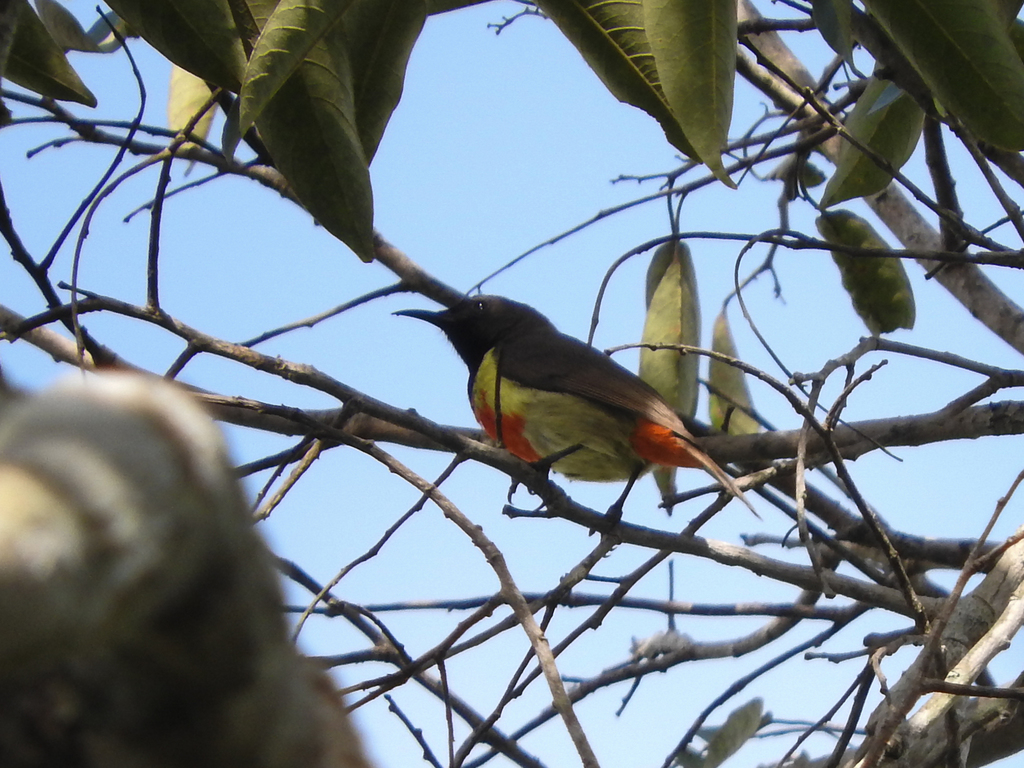
Anchieta's sunbird is a small bird, about 10–12 cm (3.9–4.7 in) long and weighing around 8 grams (0.28 oz). The male has dark iridescent blue on the forehead, crown, chin, and upper breast. Its wings and tail are brown. The side of the breast is bright yellow, and the central breast to the upper belly is bright orangey-red. The rest of the underparts are greyish-brown, while the bill and legs are black. The female is similar but has only blue on the forehead. Her chin and throat are brown with blue tips, and her breast is a dull yellow.
Range & habitat
Anchieta's sunbird lives in Brachystegia and areas of degraded woodland, where they favor rocky zones Anchieta's sunbird is found across several countries in sub-Saharan Africa, including Angola, the Democratic Republic of the Congo, Malawi, Mozambique, Tanzania, and Zambia. The bird's adaptability to various altitudes and ecosystems allows it to thrive in both dry and wetter regions. The Anchieta Sunbird is usually not found in Zambia during the rainy season from November to April. This is because heavy rainfall affects the availability of flowering plants that are crucial for the bird's nectar-based diet. As a result, the sunbird may move to drier areas with more food to survive during these tough conditions.
Wikipedia: “Distribution and habitat”
What it does
Anchieta's sunbirds have a specialized diet. They eat nectar from different flowering plants. They also eat small insects and fruits, which give them the protein and nutrients they need. In Africa, sunbirds are the dominant pollinator. This dual diet of nectar and insects means they play a significant role in pollination and controlling insect populations.
Wikipedia: “Diet”
Listen
Looking for field recordings…
Where it lives
Recorded sightings
—
geo-referenced records in GBIF, from museums, herbaria and field observers.
Drag the globe to turn it. Dots are where records exist, not a range map; darker means more records.
In the stacks
Searching the stacks…
Every page naming Anthreptes anchietae in the Biodiversity Heritage Library →
This page is assembled live from iNaturalist, GBIF, Wikipedia, the Source Library and the Internet Archive. It is not yet part of the hand-edited codex. iNaturalist taxon 13363.