- Animals
- ›Arthropods
- ›Hexapods
- ›Insects
- ›Winged and Once-winged Insects
- ›Ants, Bees, Wasps, and Sawflies
- ›Narrow-waisted Wasps, Ants, and Bees
- ›Ants, Bees, and Stinging Wasps
- ›Bees and Apoid Wasps
- ›Square-headed Wasps, Sand Wasps, and Allies
- ›Philanthinae
- ›Philanthini
- ›Philanthina
- ›Philanthus
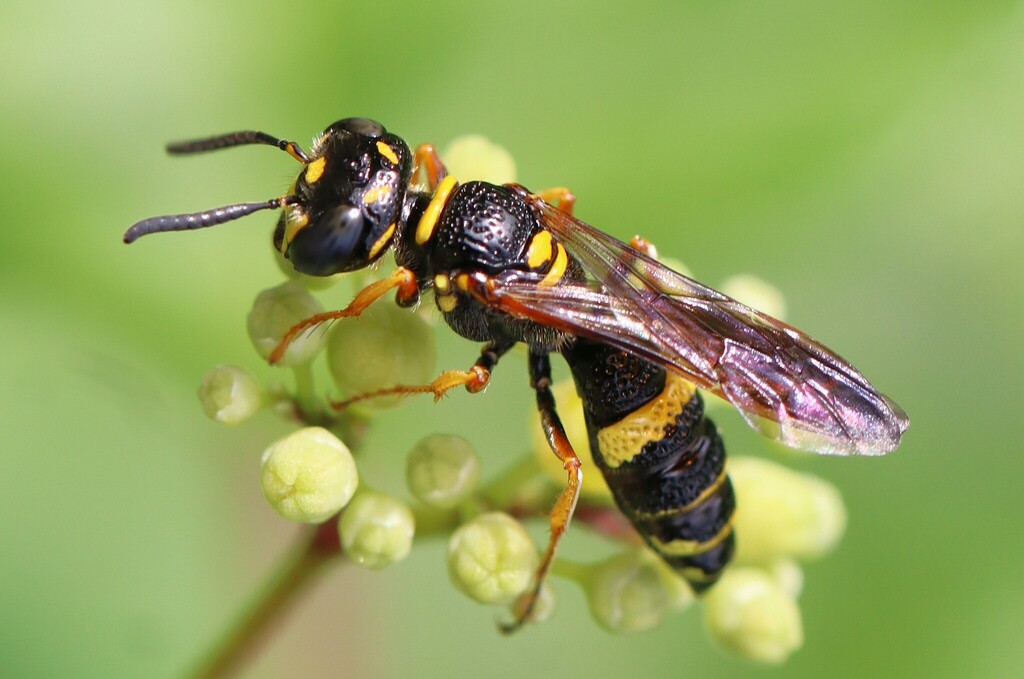
Hump-backed Beewolf
Philanthus gibbosus
Philanthus gibbosus, the hump-backed beewolf, is a species of bee-hunting wasp and is the most common and widespread beewolf in North America. P. gibbosus is of the order Hymenoptera and the genus Philanthus. It is native to the Midwestern United States and the western Appalachians. P. gibbosus are often observed to visit flowers and other plants in search of insect prey to feed their young. The prey that P. gibbosus catches is then coated in a layer of pollen and fed to the young wasps.
From the article Philanthus gibbosus on Wikipedia (CC BY-SA), quoted section by section
Description
Philanthus gibbosus is a small and robust wasp that is about 10–12 mm in length. P. gibbosus has an especially broad head and a coat of chitin that is shiny black with yellow spots on the head and yellow stripes on the abdomen and thorax. There are very large, deep punctures on the abdomen of P. gibbosus, making the species easy and distinct to identify in comparison to other members of the genus Philanthus.
Females. While the general range of P. gibbosus size is 10–12 mm in length, females are usually closer to the smaller end of the scale. Female P. gibbosus have more yellow coloration on the head than do the males of the species.
Males. The males of P. gibbosus resemble the females very closely, but the most notable difference is the significantly reduced presence of yellow spots on the head. This is opposite of the usual pattern observed within the order Hymenoptera. Most commonly, the males in hymenopteran species have an excess of yellow spots on the head while females lack spots.
Wikipedia: “Description and identification”
Range & habitat
Philanthus gibbosus is a common and widely distributed species in North America. It has been primarily observed to inhabit the central Midwestern United States; it has been observed as far west as Kansas and as far south as Georgia, but tends to be concentrated around Missouri and Tennessee. P. gibbosus also tends to inhabit coastal areas where the soil has a sandy composition. P. gibbosus is known to prefer the climate and habitat of deciduous forests. P. gibbosus prefers the soil composition of deciduous and coastal regions because it builds its nests in burrows. Thus, the soil must be of an ideal composition for burrowing.
Wikipedia: “Distribution and habitat”
What it does
Adult P. gibbosus females are responsible for digging tunnels into the ground for nesting. Meanwhile, territorial males mark objects and supporting structures surrounding the nest with pheromones to demarcate the nesting territory from competing males. The larvae generated by the females are carnivorous, which forces the inseminated females to hunt for other invertebrates, in this case bees (hence the common name "beewolf"), on which she lays her eggs. By laying her eggs on pollen-coated bee species, the larvae are supplied with prey for nutrients instantly when they emerge. The adults, on the other hand, feed on nectar that is foraged from flowers.
Burrow occupation. Philanthus gibbosus is a solitary wasp that nests in the ground. Several individuals have been observed to cohabit a single burrow at a time. However, there is evidence that suggests that while females tend to occupy the parental nest for a mere several days of their lives, the males will sometimes inhabit the nest for their entire life. After the few days in their original nest, the females will disperse to new nests. However, one single female may continue to inhabit and expand the original nest. On very rare occasions, two females may provision the original nest at the same time for a very brief period. Evidence suggests that P. …
Wikipedia: “Behavior”
How it is grown
Philanthus gibbosus is a pollinator of some plants. It has been observed pollinating carrot plants.
Wikipedia: “Agriculture”
Listen
Looking for field recordings…
Where it lives
Recorded sightings
—
geo-referenced records in GBIF, from museums, herbaria and field observers.
Drag the globe to turn it. Dots are where records exist, not a range map; darker means more records.
In the stacks
Searching the stacks…
Every page naming Philanthus gibbosus in the Biodiversity Heritage Library →
This page is assembled live from iNaturalist, GBIF, Wikipedia, the Source Library and the Internet Archive. It is not yet part of the hand-edited codex. iNaturalist taxon 133268.