- Animals
- ›Chordates
- ›Vertebrates
- ›Ray-finned Fishes
- ›Spiny-rayed fishes
- ›Butterflyfishes, Angelfishes, and Allies
- ›Emperor Breams
- ›Lethrininae
- ›Lethrinus
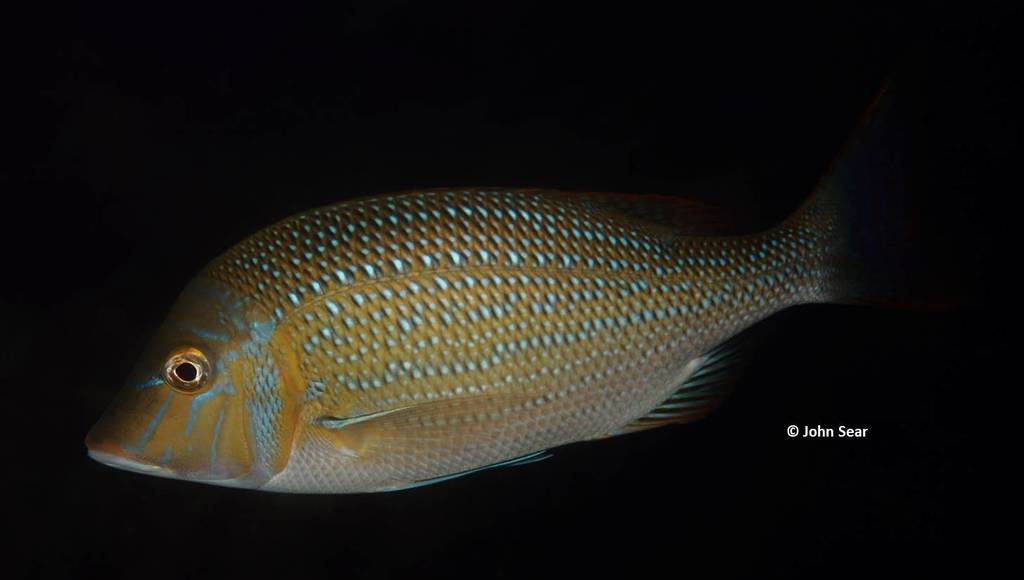
Spangled Emperor
Lethrinus nebulosus
Lethrinus nebulosus, the spangled emperor, green snapper, morwong, north-west snapper, sand bream, sand snapper, sixteen-pounder, sharie, sheri and yellow sweetlip, is a species of marine ray-finned fish belonging to the family Lethrinidae, the emperors and emperor breams. This species is found the Indo-West Pacific region.
From the article Lethrinus nebulosus on Wikipedia (CC BY-SA), quoted section by section
Description
This species commonly grows to approximately 70 cm in length, however the largest individuals have been found to be 87 cm.[clarification needed] It is yellow to yellowish-brown or bronze in colour, the belly being lighter. It has scattered blue markings over the body. The cheeks have no scales and may have a vertical blue markings. It has whitish or yellowish fins with a yellowish-edged dorsal fin.
Range & habitat
This fish occurs in the waters of East Africa to the southern parts of Japan. It also lives in Australian coastal waters, and has been recorded in the Red Sea, Persian Gulf and New Caledonia, where it is one of the major commercial fish.
Wikipedia: “Distribution”
What it does
This species feeds mainly on mollusks, echinoderms, and crustaceans. It also eats polychaetes and other fish, but less commonly.
Wikipedia: “Diet”
At the table
Lethrinus nebulosus is sought after by recreational fishers and is considered to be delicious.
Wikipedia: “As food”
In human culture
Lethrinus nebulosus has the specific name nebulosus which means "cloudy", Forsskål described it as having "longitudinal clouds of blue and yellow-brown" which is thought to be an allusion to the irregular dark bars that sometimes appear on its flanks.
Wikipedia: “Etymology”
Where it lives
Recorded sightings
—
geo-referenced records in GBIF, from museums, herbaria and field observers.
Drag the globe to turn it. Dots are where records exist, not a range map; darker means more records.
In the stacks
Searching the stacks…
Every page naming Lethrinus nebulosus in the Biodiversity Heritage Library →
This page is assembled live from iNaturalist, GBIF, Wikipedia, the Source Library and the Internet Archive. It is not yet part of the hand-edited codex. iNaturalist taxon 132389.