- Plants
- ›Vascular Plants
- ›flowering plants
- ›Dicots
- ›Sunflowers, Bellflowers, Fanflowers, and Allies
- ›Sunflowers, Daisies, Asters, and Allies
- ›Asteroideae
- ›stinkworts and allies
- ›Inulinae
- ›Pentanema
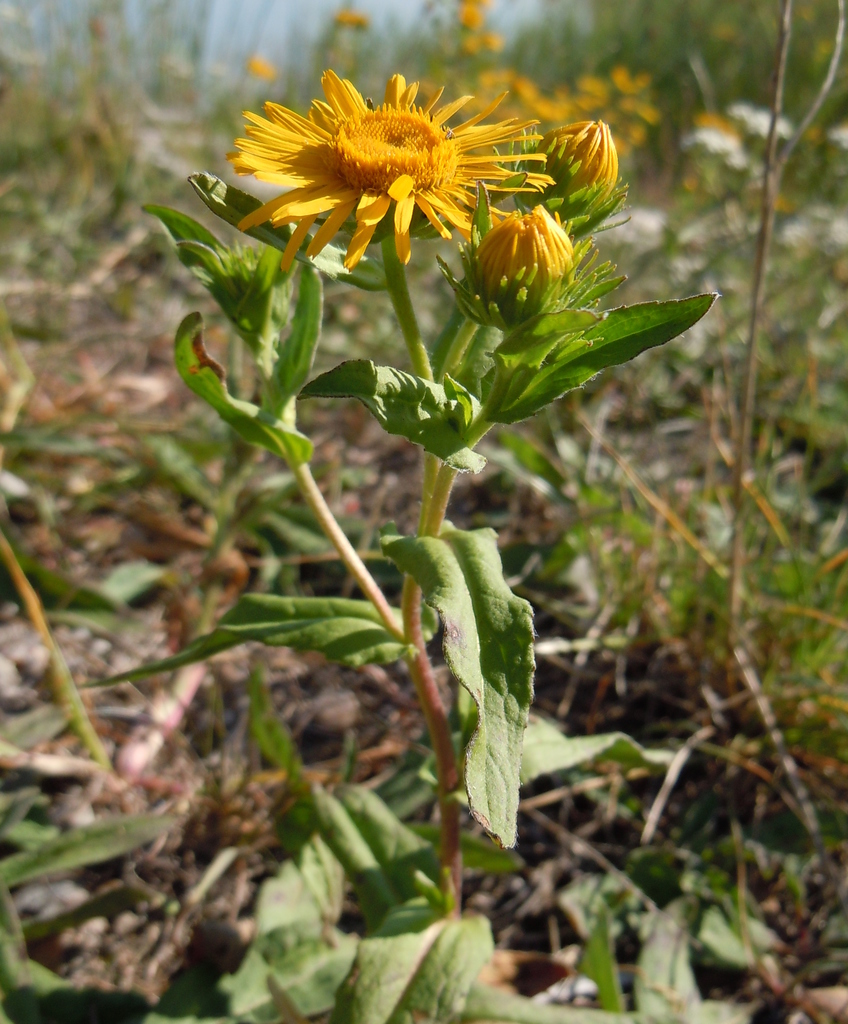
Meadow Fleabane
Pentanema britannica
Pentanema britannica, the British yellowhead or meadow fleabane, is a Eurasian species of plant in the daisy family. It is widespread across much of Europe and Asia, and sparingly naturalized in scattered locations in North America.
Pentanema britannica is an erect herb up to 75 cm (30 inches) tall, with fine hairs but not the thick woolly coat characterizing some related species. Leaves are lance-shaped, up to 5 cm (2 inches) long. One plant produces a few heads, each on a long flower stalk. Each had contains 50-150 yellow ray flowers and 100-250 yellow disc flowers.
From the article Pentanema britannica on Wikipedia (CC BY-SA), quoted section by section
Description
Observations of Pentanema britannica in various new habitats have led to conclusions that it is capable of thriving in a wide range of temperatures as well as climates, indicated by its presence in Sweden and eastern North America, respectively. A limiting (and, thus influential) factor of the successful establishment of P. britannica in new habitats is moisture, with higher moisture levels corresponding to a higher level of invasibility. Furthermore, this species was suspected to have been introduced without any natural enemies, which also has been speculated to contribute to its success as an invasive species Within its original habitat as well as new ones, P. britannica is known to infest nursery crops, specifically hostas (also known as plantain lilies) in the Netherlands where their roots and rhizomes become intertwined with the hosta root systems. Specifically, root fragments of P. britannica are known to enter under bulb scales. Once intertwined, this plant is aggressive and hard to remove, and can remain even after the infested hosta roots are washed. The overall impact of this species is that it is harmful, as upon infestation, P. britannica impedes hostas from retrieving valuable nutrients from the soil. …
Wikipedia: “Characteristics as an invasive species”
Range & habitat
Pentanema britannica is native to regions of Europe and Asia and was first observed in North America after introduction to Ontario, Canada in 1928 and observation in Long Island, New York before 1915. Following the introduction of Pentanema britannica in New York, it was then introduced to Michigan in 1990, Minnesota in 2004, and Oregon in 2002. The current distribution of this species is extensive and includes a multitude of countries spanning several continents. In Europe, this includes Albania, Austria, Belgium, Bulgaria, Czech Republic, Slovakia, Denmark, Finland, France, Germany, Greece, Hungary, Italy, Luxembourg, Netherlands, Norway, Poland, Romania, Russia/USSR (Northern Region, Baltic Region, Central Region, Southwestern Region, Crimea, Southeastern Region), Spain, Sweden, Switzerland, Turkey (European part), and Yugoslavia. In Asia, this includes China (North and Northeastern), Korea, Iran, Armenia, Kurdistan, Dzhyuungaria-Kashgaria, Mongolia, USSR (Eastern Siberia, Far East, Soviet Central Asia), and several of the Japanese islands (Hokkaido, Honshu, Shikoku, and Kyushu). In North America, this includes Canada (Ontario and Quebec) and the United States (New York, Michigan, Minnesota, and Oregon).
Wikipedia: “Origin and current distribution”
At the table
Pentanema britannica is used in Chinese Herbalism by harvesting and drying the flower. It has been used to treat sputum, as the Chinese found it to be beneficial when phlegm has accumulated in the bronchi. Other symptoms in which it has been found to be a clinical remedy for are nausea, vomiting, hiccups, and flatulence. The severity of the condition determines what part of the plant is used; if the symptoms are mild, the leaves are used, whereas more severe cases require use of the flowers. A multitude of different chemical constituents have been isolated from Pentanema britannica. Some of the chemical constituents include steroids, terpenoids, phenolics and flavonoids. The majority of these compounds are found in the flowers and have been found to have anticancer, antioxidant, anti-inflammatory, neuroprotective and hepatoprotective properties. Pentanema britannica has pharmacological potential.
Wikipedia: “Medicinal uses”
Where it lives
Recorded sightings
—
geo-referenced records in GBIF, from museums, herbaria and field observers.
Drag the globe to turn it. Dots are where records exist, not a range map; darker means more records.
In the stacks
Searching the stacks…
Every page naming Pentanema britannica in the Biodiversity Heritage Library →
This page is assembled live from iNaturalist, GBIF, Wikipedia, the Source Library and the Internet Archive. It is not yet part of the hand-edited codex. iNaturalist taxon 1320685.