- Animals
- ›Arthropods
- ›Hexapods
- ›Insects
- ›Winged and Once-winged Insects
- ›Beetles
- ›Water, Rove, Scarab, Long-horned, Leaf, and Snout Beetles
- ›Cucujiform Beetles
- ›Darkling Beetles and Allies
- ›Darkling Beetles
- ›Tenebrioninae
- ›Tenebrionini
- ›Tenebrio
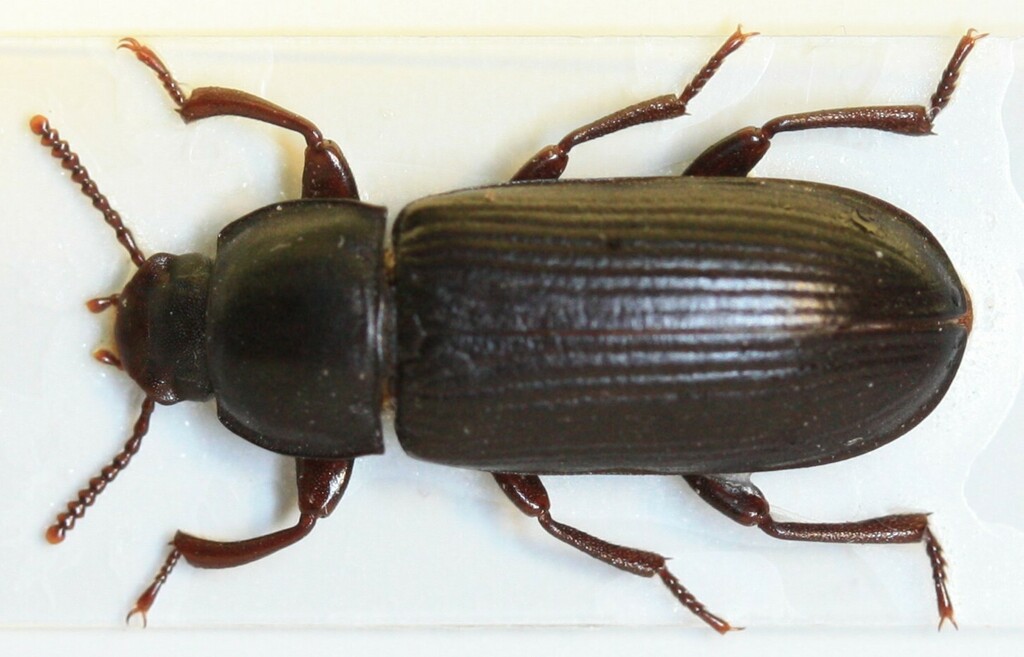
Yellow Mealworm Beetle
Tenebrio molitor
Mealworms are the larval form of the mealworm beetle, Tenebrio molitor, a species of darkling beetle. Like all holometabolic insects, they go through four life stages: egg, larva, pupa, and adult. Larvae typically measure about 2.5 cm or more, whereas adults are generally between 1.25 and 1.8 cm in length.
From the article Mealworm on Wikipedia (CC BY-SA), quoted section by section
Description
Like all holometabolic insects, T. molitor goes through four life stages: egg, larva, pupa, and adult. Larvae typically measure about 2.5 centimetres (0.98 in) or more. Adults are generally 1.25 to 1.8 centimetres (0.49 to 0.71 in) in length. T. molitor is dark brown or black as an adult, with larvae up to 1.25 inches (3.2 cm) long and adults up to 0.75 inches (1.9 cm) long. The yellow mealworm beetle can be differentiated from other beetles, due to the linear grooves that are evenly divided and run along the abdomen. The beetle has only four tarsal segments on its hind legs. Most ground beetles, which are similar in size to Tenebrio molitor, have five tarsal segments. Commonly mistaken with the black mealworm beetle (T. obscurus), key variations in regard to size and shape distinguish these two. The abdomen of the adult black mealworm beetle is more rounded and ends in a pointed tip, as opposed to the more rectangular and blunt-ended abdomen of the yellow mealworm beetle. The larvae of T. molitor are lighter colored than those of T. obscurus.
Range & habitat
Mealworms most-likely originated in the Mediterranean region, but are now present in many areas of the world as a result of human trade and colonization. The oldest archaeological records of mealworms can be traced to Bronze Age Turkey. Records from the British Isles and northern Europe are from a later date, and mealworms are conspicuously absent from archaeological finds from ancient Egypt.
Wikipedia: “Distribution”
What it does
The eggs hatch 4 to 19 days after the female oviposits. During the larval stage, the mealworms feed on vegetation and dead insects, and molt between each larval stage, or instar (9 to 20 instars). After the final molt, they pupate. The new pupa is whitish and turns brown over time. After 3 to 30 days, depending on environmental conditions such as temperature, it emerges as an adult beetle.
As larvae. In studies, T. molitor larvae show an incubation period of seven to eight days and a period of three to four days for the first instar. After the first instar, there is significant variation for the number of days in each instar period, though variation may be due to malnutrition or pathogens. Before emergence, most larvae typically go through 15 to 17 instars, with very few larvae going through the 19 to 20 instars. The body length of the larvae gradually increases with each successive instar, reaching maximum length at the 17th instar. The body length decreases beyond the 17th instar. Pupation occurs after the 14th instar, with most larvae showing total pupation between the 15th and 17th instars. Larvae are white in the first instar and gradually turn brown after the second instar.
Effect of parental age and temperature. Offspring produced by older beetles have shorter larval stages than those produced by younger beetles. …
Wikipedia: “Life cycle”
At the table
Pheromones are chemical signals that function as mate attractors and relay important information to prospective mates. For a reliable signal, it must be costly to produce, which means it is likely to have condition dependent expression. A study found that female preference of the pheromones was dependent on the nutritional condition of the males. They spent significantly more time with males who received constant food, than males who received no food. Phenoloxidase activity was dependent on the nutritional condition of the males, with phenoloxidase activity being two to six times higher in males with constant food, than in males who received no food. However, nutritional conditions had no effect on the encapsulation rate of the males. When receiving constant food, male initial body mass had no correlations with phenoloxidase activity or encapsulation rate. This shows that pheromone mediated attractiveness and the immunocompetence in terms of phenoloxidase activity of males were condition-dependent, as both decreased with nutritional stress. This suggests that there is a trade-off between allocation of resources and energy into the production of pheromones and immunocompetence, and that the production of pheromones are condition dependent sexual traits.
Wikipedia: “Nutritional condition”
Listen
Looking for field recordings…
Where it lives
Recorded sightings
—
geo-referenced records in GBIF, from museums, herbaria and field observers.
Drag the globe to turn it. Dots are where records exist, not a range map; darker means more records.
In the stacks
Searching the stacks…
Every page naming Tenebrio molitor in the Biodiversity Heritage Library →
This page is assembled live from iNaturalist, GBIF, Wikipedia, the Source Library and the Internet Archive. It is not yet part of the hand-edited codex. iNaturalist taxon 131970.