On eBird ↗
White-throated Robin
Live sightings near you, the range map, bar charts of when it is seen, and Macaulay Library photos and recordings.
White-throated Robin
Irania gutturalis
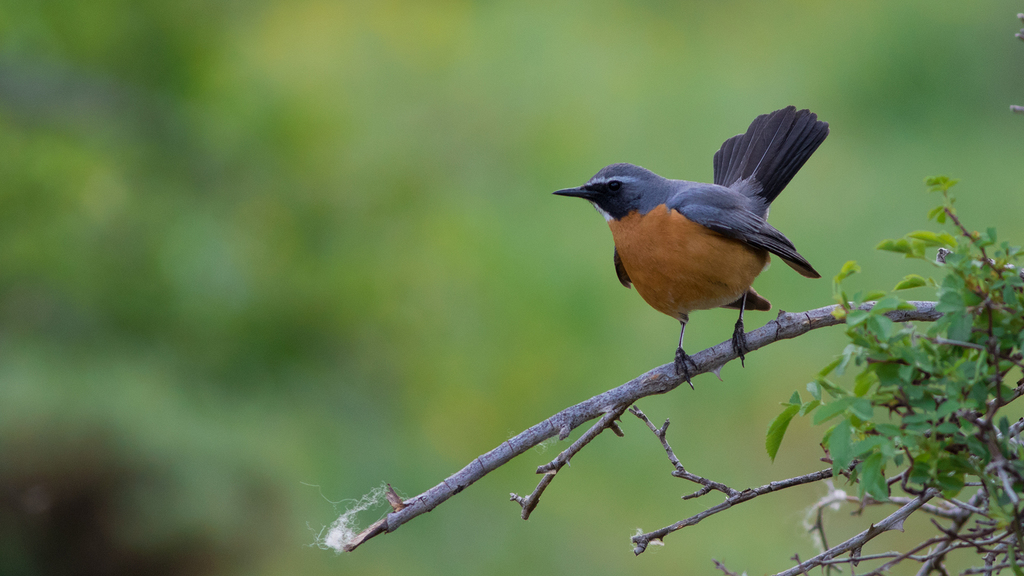
The white-throated robin or irania (Irania gutturalis) is a small, migratory passerine bird in the Old World flycatcher family Muscicapidae, and the only member of the genus Irania. It breeds on high-altitude mountain slopes with dense scrub in western Asia and winters in East Africa. Males have lead-grey upperparts and bright orange underparts with a namesake white throat patch. Females are duller, with greyer underparts, orange sides, and a fainter white throat compared to the males.
From the article White-throated robin on Wikipedia (CC BY-SA), quoted section by section
Description
This species is larger than the European robin, having a length of 16 centimetres (6.3 in) and a wingspan of 28 centimetres (11 in). The breeding male has lead-grey upperparts, a black face with a white throat and supercilium, and orange underparts. The tail is black, as is the strong bill. Females are plainer, mainly grey apart from a black tail, hints of orange on the flanks, and some white throat streaks. The male's song is a fast twittering, given from a bush or in flight. The call of this species is a chis-it double note, like that of the white wagtail.
Range & habitat
The white-throated robin is a migratory species, breeding from Turkey to Afghanistan in western Asia, and wintering in East Africa. In East Africa they are found in closed thickets in dry country, typically Acacia-Commiphora woodland on the dry central plateau. Small numbers reach the Usangu Plains of Ruaha National Park in Tanzania, which is normally their southern limit. In dry years however, some may move still further south, and reach moister uplands at 1,600 metres (5,250 ft). The species is also a very rare vagrant to Europe, with observations as far northwest as Norway, the United Kingdom, and Sweden. The white-throated robin's main breeding habitat is dry rocky slopes dominated by scrub, often at high altitudes, usually 1,000 to 2,200 metres (3,300 to 7,200 ft) above sea level. Other breeding habitats include semi-desert and mountain steppes, but also less arid habitats such as ravines with mountain streams.
Wikipedia: “Distribution and habitat”
What it does
The white-throated robin is mostly insectivorous. It has been observed foraging for small invertebrates on the ground or in low vegetation, particularly during the breeding season when protein is important for the chicks' development. During autumn, fruits are also taken. It is a seasonal breeder, breeding from May to June. It nests low to the ground in a bush or tree cavity or on a stump or log, laying a clutch of 4–6 eggs. Nests are flat and cup-shaped and made out of cereal stalks, twigs, hair, and feathers.
Wikipedia: “Behavior”
Listen
Looking for field recordings…
Where it lives
Recorded sightings
—
geo-referenced records in GBIF, from museums, herbaria and field observers.
Drag the globe to turn it. Dots are where records exist, not a range map; darker means more records.
In the stacks
Searching the stacks…
Every page naming Irania gutturalis in the Biodiversity Heritage Library →
This page is assembled live from iNaturalist, GBIF, Wikipedia, the Source Library and the Internet Archive. It is not yet part of the hand-edited codex. iNaturalist taxon 13196.