- Animals
- ›Chordates
- ›Vertebrates
- ›Ray-finned Fishes
- ›Spiny-rayed fishes
- ›Anglerfishes
- ›Frogfishes
- ›Fibonacci frogfishes
- ›Abantennarius
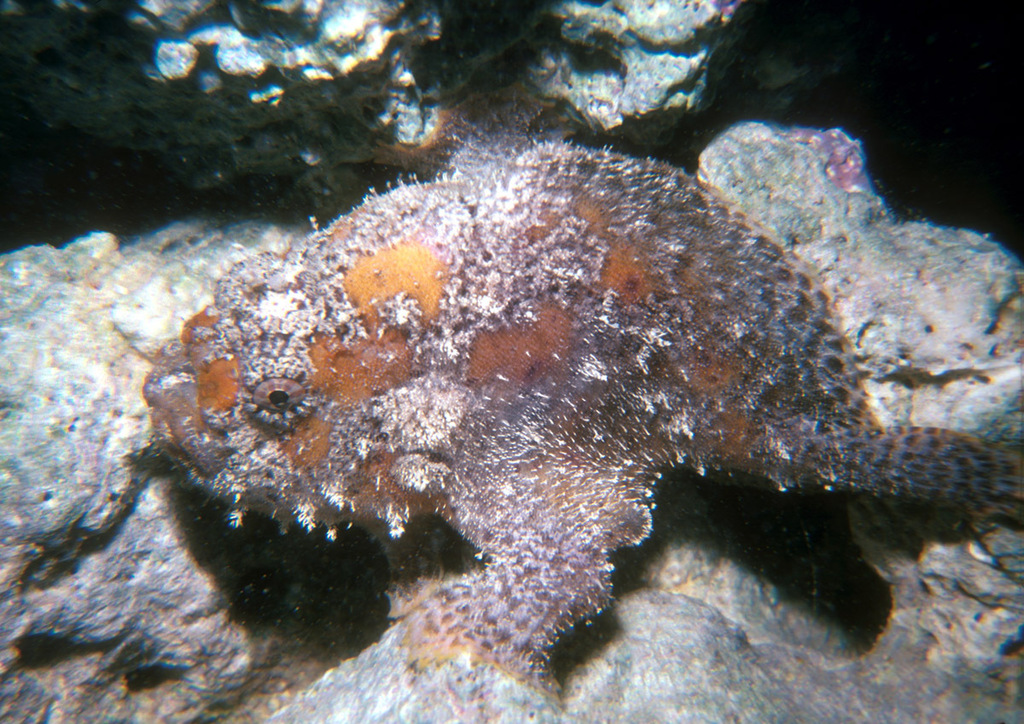
Hawaiian Freckled Frogfish
Abantennarius drombus
Abantennarius drombus, freckled frogfish or Hawaiian freckled frogfish, is a species of marine ray-finned fish belonging to the family Antennariidae, the frogfishes. The freckled frogfish is endemic to the Hawaiian Islands. Because of the fish's expertise in camouflage and small range, there have been few instances of observation and study. Therefore, the description of this fish is heavily inferred from order, family, and genus information.
From the article Abantennarius drombus on Wikipedia (CC BY-SA), quoted section by section
Description
Frogfish are easily identified by their globose body structure and color patterns that match the background of their environment, which is observed in freckled frogfish variations ranging from brown to reddish brown or gray with small dark blotches to match its marine reef habitat. Typically, this fish is marked with small dark blotches, the "freckles" that give it its common name, which are especially obvious on the fins. There also tends to be sexual dimorphism between males and females for fish within this family; however, there is no literature describing this specific difference in A. drombus. It is likely that these individuals do exhibit sexual dimorphism as it plays a role in the mating rituals observed within Antennariidae. Generally, fish within the Antennariidae family have a modified first dorsal spine, which is called the illicium. The second dorsal fin is not connected to the head with a membrane and acts as a lure to attract prey, with the shape typically differing between species. The illicium is a key characteristic for fish within this family, working in tandem with their large, cave-like mouth for feeding. Distinguishing fin characteristics of the freckled frogfish include Abantennarius drombus has 3 dorsal spines, 12 soft rays in the second dorsal fin, and 7 soft rays in the anal fin. A distinguishing feature separating it from A. …
Range & habitat
Frogfish are typically found in a variety of different locations, but often observed at the floor of shallow-water habitats. This distribution is a high contributor to the morphological diversity of fish in this family, as they tend to have coloration patterns allowing them to camouflage with their environment. Abantennarius drombus has been found in the western central Pacific Ocean, where it's been seen off Johnston Atoll, Midway Atoll, and the Hawaiian Islands in the North Pacific Ocean. This fish is endemic to the area and restricted to this range. A study surveying reef fish found A. drombus dwelling at the bottom of shallow spur and groove habitats, explaining the coral-like coloration. It is found in shallow waters at depths between 0 and 104 m (0 and 341 ft), typically shallower than 10 m (33 ft) on coral and rocky reefs.
Wikipedia: “Distribution and habitat”
What it does
In addition to assumptions made from morphological features, the mating behavior of A. drombus can be predicted using mating observations from other frogfish species. The study of reference for this prediction describes mating behavior observed in Antennarius stratus or, or the hairy frogfish. Although closely related, it's important to note that differences in size and habitat likely contribute to differences in the mating ritual and behavior. To attract a female, the sexually dimorphic smaller male will swim around the female, changing color and deploying its dorsal and anal fins in a vibrating dance. This ritual took place over 4 days, with the male changing color every day and remaining the same color on the third day. It was also noted that the male is aggressive towards the female during courtship. After successful courting, the female will undergo an increase in size, followed by the excretion of a mucus band. Within this mucus band are eggs arranged in two groups of 3. Succeeding this excretion, the female returns to her original size and goes into a state of torpor. In response, the male will swim around this band, rubbing it with his snout and fins. Finally the male will swim over the mucus band and fertilize the eggs. As mentioned previously, since A. drombus and A. …
Wikipedia: “Mating behavior”
In human culture
Abantennarius drombus has the genus name Abantennarius, which prefixes ab-, meaning "away from", onto antennarius, a fish of the family Antennaridae. This is an allusion to the gill opening being positioned away from the base of the pectoral fin, which is typically where it is located in frogfishes. The specific name drombus was not explained, and it is not known what David Starr Jordan meant by it in this fish or in the genus of Filipino gobies he used this name for.
Wikipedia: “Etymology”
Where it lives
Recorded sightings
—
geo-referenced records in GBIF, from museums, herbaria and field observers.
Drag the globe to turn it. Dots are where records exist, not a range map; darker means more records.
In the stacks
Searching the stacks…
Every page naming Abantennarius drombus in the Biodiversity Heritage Library →
This page is assembled live from iNaturalist, GBIF, Wikipedia, the Source Library and the Internet Archive. It is not yet part of the hand-edited codex. iNaturalist taxon 1316899.