- Animals
- ›Chordates
- ›Vertebrates
- ›Ray-finned Fishes
- ›Spiny-rayed fishes
- ›Butterflyfishes, Angelfishes, and Allies
- ›Snappers
- ›Fusiliers
- ›Lutjanus
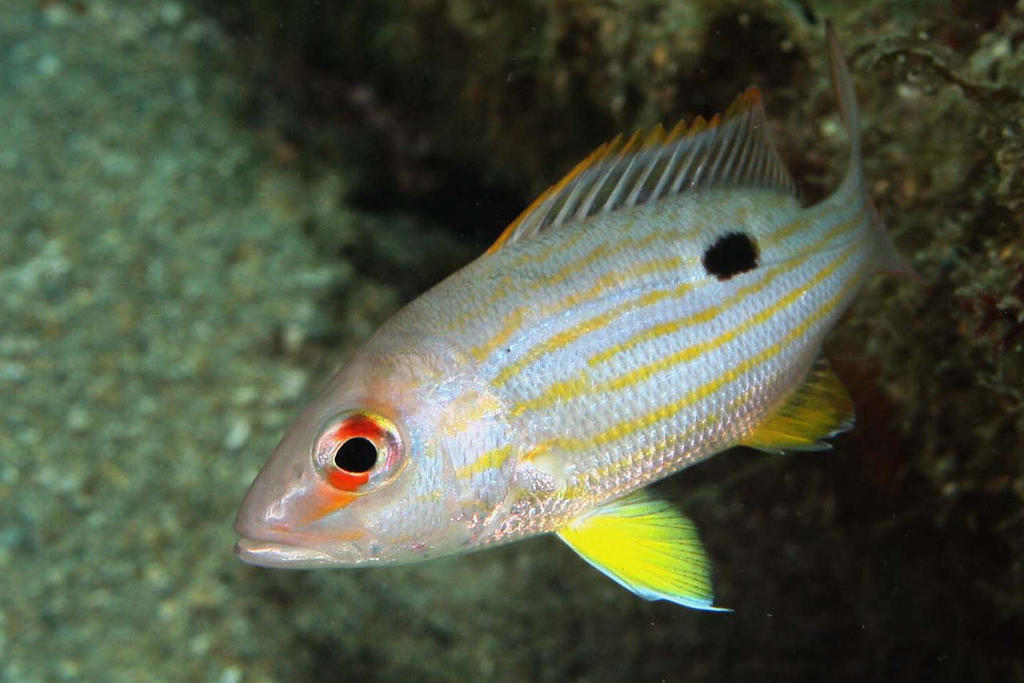
Lane Snapper
Lutjanus synagris
The lane snapper (Lutjanus synagris) is a species of snapper native to the western Atlantic Ocean from North Carolina to southern Brazil, including the Gulf of Mexico and the Caribbean Sea. It can be found in a wide range of habitats, though it prefers coral reefs and sandy areas with plentiful vegetation. It occurs at depths from 10 to 400 m (33 to 1,312 ft), most frequently between 21 and 70 m (69 and 230 ft).
From the article Lane snapper on Wikipedia (CC BY-SA), quoted section by section
Description
The lane snapper has an oblong, compressed body. It has a sharply pointed snout, With a pair of front and a pair of rear nostrils which are simple holes, it has a relatively large mouth with a moderately protrusible upper jaw which has most of its length below the cheek bone when the mouth is shut., Each jaw has one or more rows of sharp, conical teeth with a few of these being enlarged to form canines. The vomerine teeth are arranged in an anchor shaped patch of teeth with a short rearwards extension along the middle of the palate and there is a pair of tooth patches ar either side of the palate. The preopercle is serrated, and has a weakly developed incision and knob. It has a continuous dorsal fin which has 10 spines and 12-13 soft rays, with a slight incision sometimes visible between the spines and soft rays, the anal fin has 3 spines and 8-9 soft rays. It has relatively short pectoral fins which do not extend as far as the anus and contain 15-16 fin rays. The caudal fin is emarginate. This fish attains a maximum total length of 60 cm (24 in), although 25 cm (9.8 in) is more typical, and the maximum published weight is 3.5 kg (7.7 lb). This species has two colour phases, a deep-water phase which is darker and more distinctive than the colour of the shallow-water resting phase. In both phases the upper flanks and the back are pink to red with a green tint on the back. …
Range & habitat
The lane snapper is found in the Western Atlantic Ocean where it occurs as far north as North Carolina and Bermuda south through the Gulf of Mexico and the Caribbean Sea, along the coast of South America as far south as Santa Catarina, Brazil. It occurs over reefs and sandy bottoms with algae or sea grass at depths between 30 and 122 m (98 and 400 ft). The juveniles live in sheltered inshore waters.
Wikipedia: “Distribution and habitat”
What it does
Lane snappers are opportunistic, nocturnal predators feeding on a diverse range of animals. Known prey includes smaller fishes, cephalopods, gastropods, and crustaceans such as shrimps and crabs.
Wikipedia: “Feeding”
Where it lives
Recorded sightings
—
geo-referenced records in GBIF, from museums, herbaria and field observers.
Drag the globe to turn it. Dots are where records exist, not a range map; darker means more records.
In the stacks
Searching the stacks…
Every page naming Lutjanus synagris in the Biodiversity Heritage Library →
This page is assembled live from iNaturalist, GBIF, Wikipedia, the Source Library and the Internet Archive. It is not yet part of the hand-edited codex. iNaturalist taxon 131530.