- Animals
- ›Chordates
- ›Vertebrates
- ›Birds
- ›Perching Birds
- ›Old World Flycatchers, Robins, and Chats
- ›Enicurus
On eBird ↗
Little Forktail
Live sightings near you, the range map, bar charts of when it is seen, and Macaulay Library photos and recordings.
Little Forktail
Enicurus scouleri
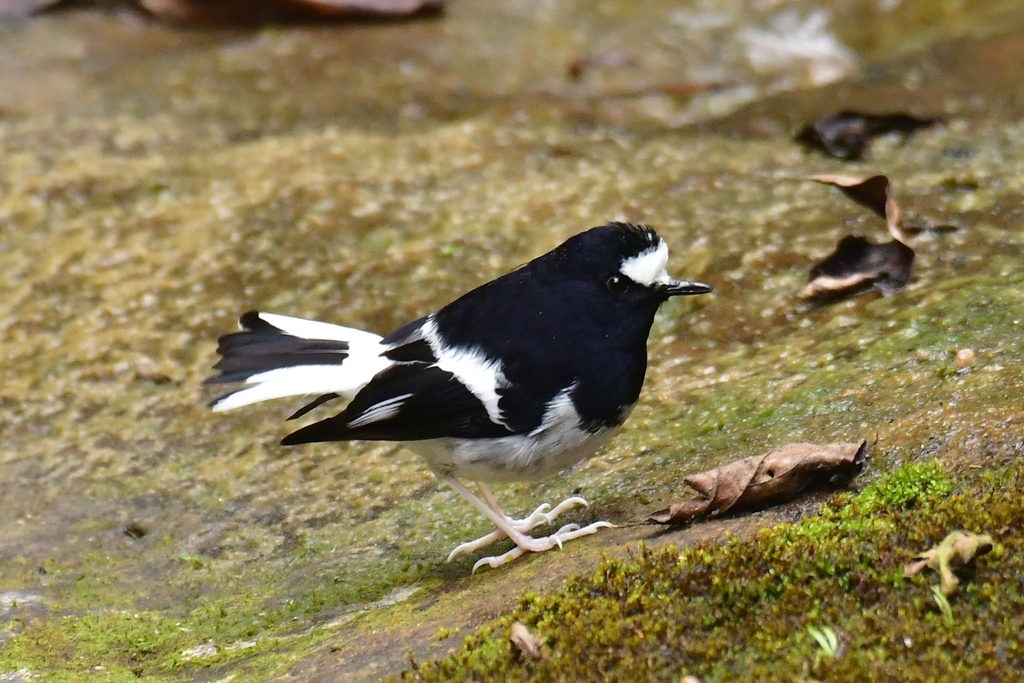
The little forktail (Enicurus scouleri) is a species of bird in the family Muscicapidae. The specific name commemorates Dr. John Scouler of Glasgow.
From the article Little forktail on Wikipedia (CC BY-SA), quoted section by section
Description
The sexes are alike, with black and white plumage. Black above, with white forehead; white band in wings extends across lower back, small, black rump patch; slightly forked, short tail with white in outer feathers; black throat, white below.
Range & habitat
The little forktail is a bird of mountain streams, waterfalls and small shaded forest puddles; breeding between 1200-3700m. It is found in the Tian Shan and Himalayan mountain ranges, southern China and Taiwan. Its natural habitats are subtropical or tropical moist lowland forest and subtropical or tropical moist montane forest.
Wikipedia: “Distribution and habitat”
What it does
They are either solitary or found in pairs. They forage energetically on moss-covered and wet slippery rocks. Their diet consists primarily of aquatic insects, and they plunge underwater to pursue prey. It constantly wags and flicks its tail, occasionally launching short sallies. They are generally silent, save for a rarely uttered sharp 'TZitTzit' call.
== References ==
Wikipedia: “Behaviour”
Listen
Looking for field recordings…
Where it lives
Recorded sightings
—
geo-referenced records in GBIF, from museums, herbaria and field observers.
Drag the globe to turn it. Dots are where records exist, not a range map; darker means more records.
In the stacks
Searching the stacks…
Every page naming Enicurus scouleri in the Biodiversity Heritage Library →
This page is assembled live from iNaturalist, GBIF, Wikipedia, the Source Library and the Internet Archive. It is not yet part of the hand-edited codex. iNaturalist taxon 13091.