- Animals
- ›Chordates
- ›Vertebrates
- ›Birds
- ›Perching Birds
- ›Old World Flycatchers, Robins, and Chats
- ›Enicurus
On eBird ↗
Black-backed Forktail
Live sightings near you, the range map, bar charts of when it is seen, and Macaulay Library photos and recordings.
Black-backed Forktail
Enicurus immaculatus
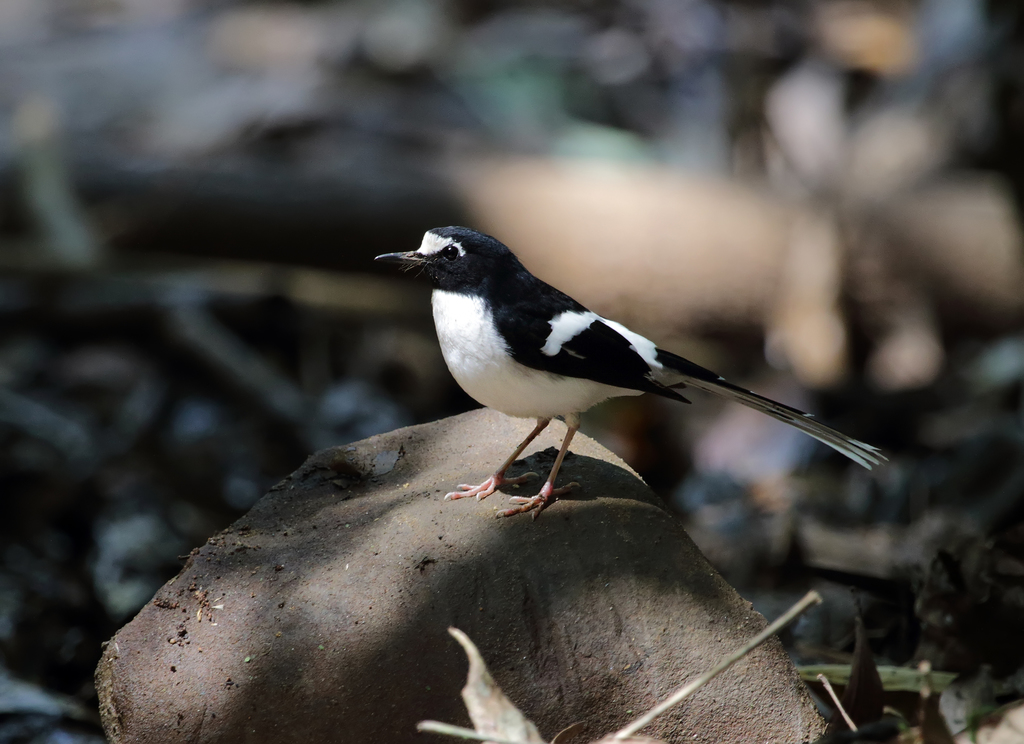
The black-backed forktail (Enicurus immaculatus), occasionally referred to as the black-throated forktail, is a forktail species in the family Muscicapidae. The species was described in 1836, from a specimen collected in Nepal. It is a medium-sized forktail, weighing between 25 and 29 grams, with a length of 20.5 to 23 centimetres (8+1⁄8 to 9 in). The species has a broad white stripe across its forehead. The crown, face, and mantle are black, while the bird's underparts are white, sharply divided from the black above. The wings are largely black with a broad white stripe across the greater coverts. The tail of the species, similar to that of other forktails, is long, graduated, and deeply forked. The tail is black with a white tip and three white bands created by shorter tail feathers. The beak of the bird is black, while the feet and legs are light pink, and the iris is brown. The species is monomorphic.
The black backed forktail is solitary, but is occasionally found in pairs or in family groups. It is described as a shy species. The bird breeds between March and June, building a nest of plant matter in holes or crevices in rocks and dead trees. Three eggs are generally laid, which are pink and spotted with red-brown. Both sexes build the nest and incubate the eggs. The species frequents fast-flowing rivers and streams in temperate forests and subtropical or tropical moist lowland forests. It is found in the Indian subcontinent and in some adjoining regions of Southeast Asia. It ranges across Bangladesh, Bhutan, India, Myanmar, Nepal and Thailand.
From the article Black-backed forktail on Wikipedia (CC BY-SA), quoted section by section
Description
A medium-sized forktail, the black-backed forktail is between 20.5 and 23 centimetres (8+1⁄8 and 9 in). It weighs between 25 and 29 grams. The length of the wing has been recorded as between 8.6 and 9.8 centimetres (3+3⁄8 and 3+7⁄8 in) in the male and 8.6 to 9.0 centimetres (3+3⁄8 to 3+1⁄2 in) in the female. The bill extends 2 centimetres (3⁄4 in) from the skull, while the tail is between 12.4 and 12.7 centimetres (4+7⁄8 and 5 in) long. The species has a broad white stripe beginning just behind the eyes and running across its forehead. The crown and mantle are completely covered in black feathering, which extends down to the upper forehead, face, scapulars, throat, and sides of the neck. The underparts of the bird are white, sharply delineated from the black of the throat. The lesser coverts and median coverts are completely black, as are the bases of the greater coverts. A broad white band runs across the wing, running across the greater coverts as well as the bases of the inner secondary and tertiary feathers. The highest tertial feather is white, and the inner primaries have white tips and the base of the secondaries are covered in a small white patch. The flight feathers are otherwise black. As with most other forktails, the tail of the species is long, graduated, and deeply forked. The feathers are black, with white tips, except for the outermost feathers, which are white. …
Range & habitat
The black-backed forktail's habitat of choice is near fast-flowing rivers and streams in moist tropical broadleaf forest and subtropical lowland forest. It frequents rocks and boulders within or bordering streams, as well as mud or sand banks bordering rapidly moving stretches of water. The western end of the species's range is in Garhwal, in the northwest portion of the Indian state of Uttarakhand. The range extends from there through western and central Nepal to Bhutan and the northeastern Indian states, including Sikkim, Assam, Meghalaya, Arunachal Pradesh, Nagaland, and Manipur. It is known as a winter visitor to Nameri National Park in Assam. West of Sikkim the species is uncommon, but it is common in Bhutan. It is also found in the Sylhet and Chittagong regions of Bangladesh, where it is uncommon. The range extends to Myanmar, except for the region of Tenasserim, and to northwestern Thailand. It has also been reported from southwestern Yunnan in China, and from southeastern Tibet. Birdlife International maps its range as being contiguous over these regions, except for an area in south Myanmar separated from the rest of the range. Field guides for birds in south Asia describe its distribution as discontinuous. In the western part of its range the species is found up to 1,450 metres (4,760 ft) above sea level; in the eastern part, up to 900 metres (2,950 ft) above sea level. …
Wikipedia: “Range and distribution”
What it does
The species is solitary, or occasionally found in pairs, but may be seen in family groups during the breeding season. Described as a shy bird, it often bobs its tail when feeding, and when at rest opens and closes it with a scissor-like motion. It habitually flies along the course of a river or stream, and its flight is described as quick and straight, occasionally undulating slightly. It has been observed near waterfalls. The precise diet of the black-backed forktail is unknown, but it has been observed to consume aquatic insects, the larvae of these insects, and crustaceans. It typically forages along fast-moving streams and rivers, including on rocks in midstream, and may occasionally enter the water. It may also forage along slower-moving rivers, ponds, or forest pools, and has been recorded as foraging in damp areas of the forest. When inactive, it has been observed to remain in bushes or low shrubbery. The breeding season of the black-backed forktail is between March and June. The nest consists of a cup constructed of plant matter, including dried leaves, moss, and fibres, sometimes lined with leaf skeletons. It may be located in the hole of a dead tree, under a bank, on a ledge, or in a hole or cleft among rocks. Usually, three eggs are laid, which are pinkish and sparsely specked with fine red-brown. The speckles occasionally form blotches or caps at the end of the eggs. …
Wikipedia: “Behavior and ecology”
Listen
Looking for field recordings…
Where it lives
Recorded sightings
—
geo-referenced records in GBIF, from museums, herbaria and field observers.
Drag the globe to turn it. Dots are where records exist, not a range map; darker means more records.
In the stacks
Searching the stacks…
Every page naming Enicurus immaculatus in the Biodiversity Heritage Library →
This page is assembled live from iNaturalist, GBIF, Wikipedia, the Source Library and the Internet Archive. It is not yet part of the hand-edited codex. iNaturalist taxon 13086.