On eBird ↗
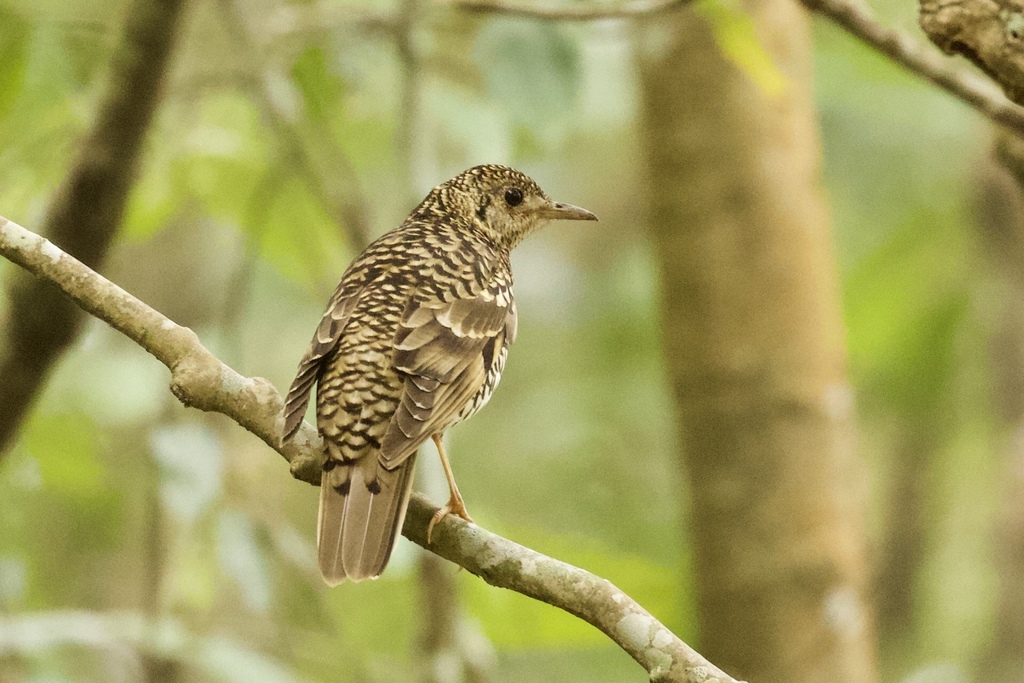
Scaly Thrush
Live sightings near you, the range map, bar charts of when it is seen, and Macaulay Library photos and recordings.
Scaly Thrush
Zoothera dauma
The scaly thrush (Zoothera dauma) is a member of the thrush family Turdidae.
From the article Scaly thrush on Wikipedia (CC BY-SA), quoted section by section
Description
The sexes are similar, 27–31 cm long, with black scaling on a paler white or yellowish background. The most striking identification feature in flight is the black band on the white underwings, a feature shared with most other species in the genus Zoothera, and also Siberian thrush in the genus Geokichla. The male has a song which is a loud, far-carrying mechanical whistle, with 5-10 second pauses between each one second long phrase twee...tuuu....tuuu....tuuu.
Range & habitat
It breeds in dense wet forests in the Himalayas east through southwestern China to northern Indochina, and with disjunct populations (but possibly separate species) on Iriomote Island off southern Japan, and on Sumatra and Java in Indonesia.
Wikipedia: “Distribution and habitat”
What it does
The scaly thrush is very secretive, preferring dense cover. It nests in trees, laying three or four dull green eggs in a neat cup nest. It is omnivorous, eating a wide range of insects, earthworms and berries.
Wikipedia: “Behaviour”
Listen
Looking for field recordings…
Where it lives
Recorded sightings
—
geo-referenced records in GBIF, from museums, herbaria and field observers.
Drag the globe to turn it. Dots are where records exist, not a range map; darker means more records.
In the stacks
Searching the stacks…
Every page naming Zoothera dauma in the Biodiversity Heritage Library →
This page is assembled live from iNaturalist, GBIF, Wikipedia, the Source Library and the Internet Archive. It is not yet part of the hand-edited codex. iNaturalist taxon 13018.