- Animals
- ›Chordates
- ›Vertebrates
- ›Birds
- ›Perching Birds
- ›Old World Flycatchers, Robins, and Chats
- ›Phoenicurus
On eBird ↗
Common Redstart
Live sightings near you, the range map, bar charts of when it is seen, and Macaulay Library photos and recordings.
Common Redstart
Phoenicurus phoenicurus
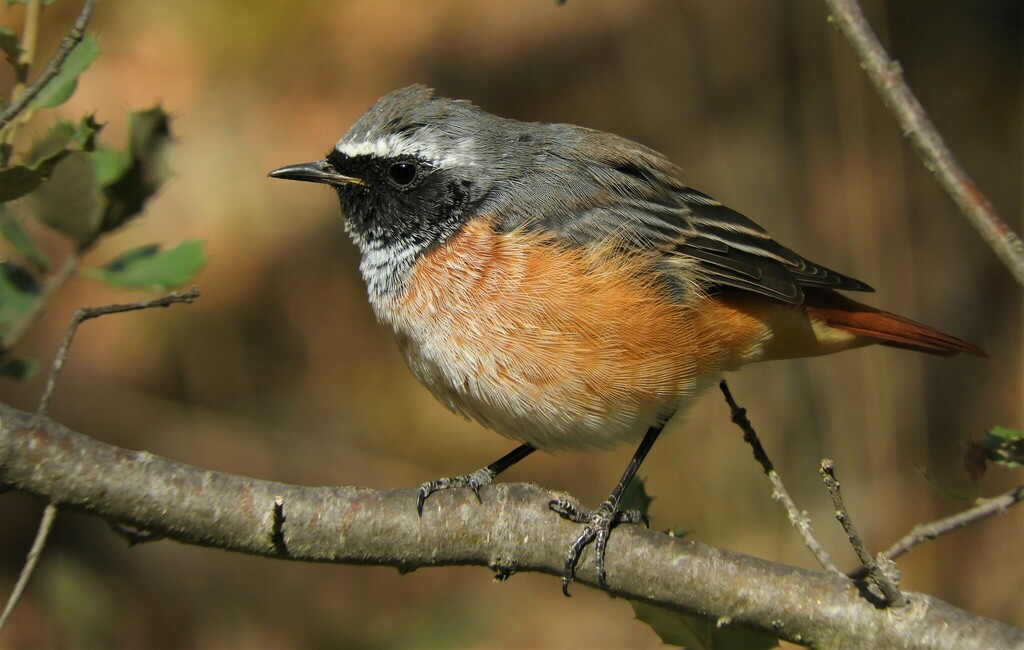
The common redstart (Phoenicurus phoenicurus), or often simply redstart, is a small passerine bird in the redstart genus Phoenicurus. Like its relatives, it was formerly classed as a member of the thrush family, (Turdidae), but is now known to be an Old World flycatcher (family Muscicapidae).
From the article Common redstart on Wikipedia (CC BY-SA), quoted section by section
Description
The Common Redstart shows some affinity to the European Robin in many of its habits and actions. It has the same general carriage, and chat-like behaviour, and is the same length at 13–14.5 cm (5.1–5.7 in) long but slightly slimmer and not quite as heavy, weighing 11–23 g (0.39–0.81 oz). The orange-red tail, from which it and other redstarts get their names ("start" is an old word for "tail"), is frequently quivered. Among common European birds, only the black redstart (Phoenicurus ochruros) has a similarly coloured tail.
The male in summer has a slate-grey head and upperparts, except the rump and tail, which, like the flanks, underwing coverts and axillaries are orange-chestnut. The forehead is white; the sides of the face and throat are black. The two central tail feathers are dark brown, the other tail feathers bright orange-red. The wings are grey-brown in male P. p. phoenicurus but the remiges have white outer webs forming a pale to whitish wing-patch in adult male P. p. samamisicus (see Taxonomy and systematics). The orange on the flanks shades to almost white on the belly. The bill and legs are black. In autumn, pale feather fringes on the body feathering obscure the colours of the male, giving it a washed-out appearance. The female is grey-brown above and buff-white or light orange below. …
Range & habitat
Common Redstarts prefer open mature birch, oak or, particularly in the north of the breeding range, conifer woodland with a high horizontal visibility and low amounts of shrub and understorey especially where the trees are old enough to have holes suitable for its nest. Other habitats of the species are orchards as well as villages, parks and old gardens in urban areas. In Britain the Common Redstart occurs primarily in upland areas less affected by agricultural intensification. Nests are built in cavities, e.g. natural tree holes, so dead trees or those with dead limbs are beneficial to the species; nestboxes are commonly used. A high cover of moss and lichen is also preferred. In England, where it has declined by 55% in the past 25 years , the Forestry Commission offers grants under a scheme called England's Woodland Improvement Grant (EWIG); as does Natural Englands Environmental Stewardship Scheme. It is a very rare breeding bird in Ireland, with between one and five pairs breeding in most years, nearly all of them in County Wicklow.
Wikipedia: “Distribution and habitat”
What it does
It is a summer visitor throughout most of Europe and western Asia (east to Lake Baikal), and also in northwest Africa in Morocco. It winters in central Africa and Arabia, south of the Sahara Desert but north of the Equator, from Senegal east to Yemen. It is widespread as a breeding bird in Great Britain, particularly in upland broadleaf woodlands and hedgerow trees, but in Ireland it is very local, and may not breed every year. The first males arrive in early to mid April, often a few days in advance of the females. Five or six light blue eggs are laid during May, with a second brood in midsummer in the south of the breeding range. It departs for Africa between mid-August and early October. It often feeds like a flycatcher, making aerial sallies after passing insects, and most of its food consists of winged insects. The main contact call in Central Europe is a rising, slightly dissylabilic huid. In southern Italy and as well as within the range of the subspecies P. p. samamisicus this call is replaced by a monosyllabic heed. This call can be rising or constant in Italy but is always constant and reminiscent of the slightly higher pitched contact calls of Collared Flycatcher Ficedula albicollis in P. p. samamisicus. A third call variant exists on the Iberian peninsula, whereas in Siberia huid and heed calls can be combined. …
Wikipedia: “Behaviour and ecology”
Listen
Looking for field recordings…
Where it lives
Recorded sightings
—
geo-referenced records in GBIF, from museums, herbaria and field observers.
Drag the globe to turn it. Dots are where records exist, not a range map; darker means more records.
In the stacks
Searching the stacks…
Every page naming Phoenicurus phoenicurus in the Biodiversity Heritage Library →
This page is assembled live from iNaturalist, GBIF, Wikipedia, the Source Library and the Internet Archive. It is not yet part of the hand-edited codex. iNaturalist taxon 12992.