On eBird ↗
Kamao
Live sightings near you, the range map, bar charts of when it is seen, and Macaulay Library photos and recordings.
Kama'o
Myadestes myadestinus
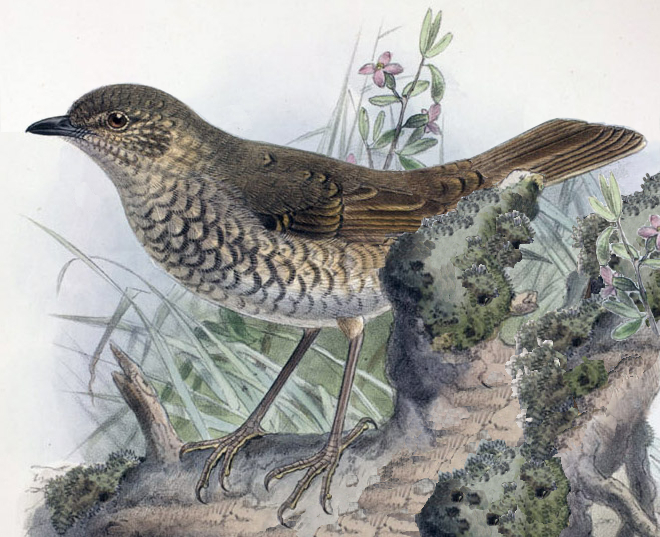
The kāmaʻo or large Kauaʻi thrush (Myadestes myadestinus) is an extinct species of small, dark solitaire that was endemic to Kauaʻi in the Hawaiian Islands.
From the article Kāmaʻo on Wikipedia (CC BY-SA), quoted section by section
Description
The adult bird grew up to 8 inches (20 cm) in length. The male and female of the species looked similar. It was dark brown above and gray below, with black legs. It was closely related to the other species of Hawaiian thrushes, the Puaiohi (M. palmeri), the ʻŌmaʻo (M. obscurus) and the likely-extinct olomaʻo (M. lanaiensis). Its song was a complex melody composed of flute-like notes, liquid warbles, buzzy trills, and gurgling whistles. The call was a raspy "braak," with an alternate high pitched note similar to a police whistle. The bird occurred in the understory of densely vegetated gulches, where it often perched motionlessly in a hunched posture. Like other native Hawaiian thrushes, it often quivered its wings and fed primarily on fruit and insects. There was no segregation on the thrushes that existed either on Molokai or Lanai, which were given the name Olomao. In addition, there was no confirmation of any thrush sighting on Maui. On Kauai, there were more than one thrush species that were documented and accounted for. With a fighter-jet-like flying maneuver, the thrush used to fly vertically while singing melodies and then flying down into the lower lush canopy. While not confirmed, but it was never seen flying below 3,500 feet in Kauai. …
Wikipedia: “Characteristics”
Listen
Looking for field recordings…
Where it lives
Recorded sightings
—
geo-referenced records in GBIF, from museums, herbaria and field observers.
Drag the globe to turn it. Dots are where records exist, not a range map; darker means more records.
In the stacks
Searching the stacks…
Every page naming Myadestes myadestinus in the Biodiversity Heritage Library →
This page is assembled live from iNaturalist, GBIF, Wikipedia, the Source Library and the Internet Archive. It is not yet part of the hand-edited codex. iNaturalist taxon 12963.