- Animals
- ›Chordates
- ›Vertebrates
- ›Ray-finned Fishes
- ›Spiny-rayed fishes
- ›Puffers and Filefishes
- ›Pufferfishes, Porcupinefishes, and Molas
- ›Pufferfishes
- ›Canthigaster
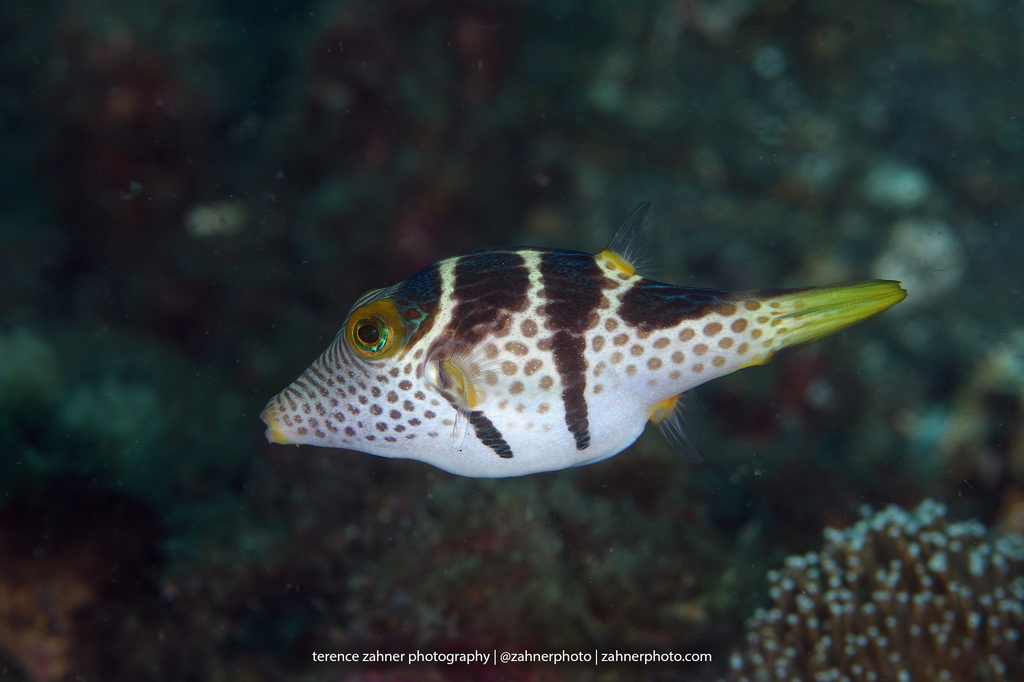
Blacksaddle Toby
Canthigaster valentini
Valentin's sharpnose puffer (Canthigaster valentini), also known as the saddled puffer or black saddled toby, is a demersal marine fish belonging to the family Tetraodontidae. The saddled puffer is a small sized fish which grows up to 11 cm. It is widely distributed throughout the tropical and subtropical waters of the Indian Ocean, Red Sea included, and until the oceanic islands of the Pacific Ocean. It inhabits rocky and coral reefs, lagoons and external reef until 55 m. Canthigaster valentini has a diurnal activity.
Canthigaster valentini has four distinct black stripes (saddles) on its back. The head is blue-grey and the main body is white speckled with blue-grey spots. The tail and fins show hints of yellow and there is a rainbow streak of color behind the eyes. It is omnivorous, it feeds on filamentous green and red algae, tunicates, and on smaller amounts of corals, bryozoans, polychaetes, echinoderms, mollusks, and brown and coralline red algae.
From the article Valentin's sharpnose puffer on Wikipedia (CC BY-SA), quoted section by section
What it does
Canthigaster valentini are gonochoric, approximately half of the population being male and the other half being female, distinguishable by external characteristics. Dominant males breed exclusively with the females in their territory and maintain territorial boundaries. C. valentini's eggs are demersal, attached to algae on coral rubble. Females can lay anywhere between fifteen and over 800 eggs at a time every four to ten days depending on the season. Spawning generally occurs between 8:00AM and 3:30PM year-round. After eggs are laid, no parental care is required because eggs are unpalatable and, thus, reasonably safe from predation. It was found that predatory fish would rarely attempt to eat the eggs of C. valentini and when eggs were ingested they would be quickly egested. This allows females and males to maintain their territory without the necessity of protecting their eggs as well.
Wikipedia: “Reproductive behavior”
Toxicity
The toxin found in C. valentini as well as in other pufferfish species is one of the most potent naturally occurring toxins. It is a neurotoxin called tetrodotoxin present in the skin and other tissues of C. valentini. It is lethal to many species of fish, thus making C. valentini unpalatable to predators. Threat of predation for adults as well as larvae and eggs is low due to unpalatability, causing reproductive behaviors to differ from other species according to the reduced predation risk.
Mimicry model. Their toxic skin makes C. valentini a model for Batesian mimicry, specifically by the filefish species Paraluteres prionurus which is similarly colored, allowing it to benefit from C. valentini's low risk of predation. It is also mimicked by juveniles of the grouper Plectropomus laevis.
In human culture
The puffer was named in honor of Dutch naturalist François Valentijn (1666–1727).
Wikipedia: “Etymology”
Where it lives
Recorded sightings
—
geo-referenced records in GBIF, from museums, herbaria and field observers.
Drag the globe to turn it. Dots are where records exist, not a range map; darker means more records.
In the stacks
Searching the stacks…
Every page naming Canthigaster valentini in the Biodiversity Heritage Library →
This page is assembled live from iNaturalist, GBIF, Wikipedia, the Source Library and the Internet Archive. It is not yet part of the hand-edited codex. iNaturalist taxon 129549.