- Animals
- ›Arthropods
- ›Hexapods
- ›Insects
- ›Winged and Once-winged Insects
- ›Butterflies and Moths
- ›Owlet Moths and Allies
- ›Underwing, Tiger, Tussock, and Allied Moths
- ›Tiger Moths and Allies
- ›Tiger Moths
- ›Callimorphina
- ›Haploa
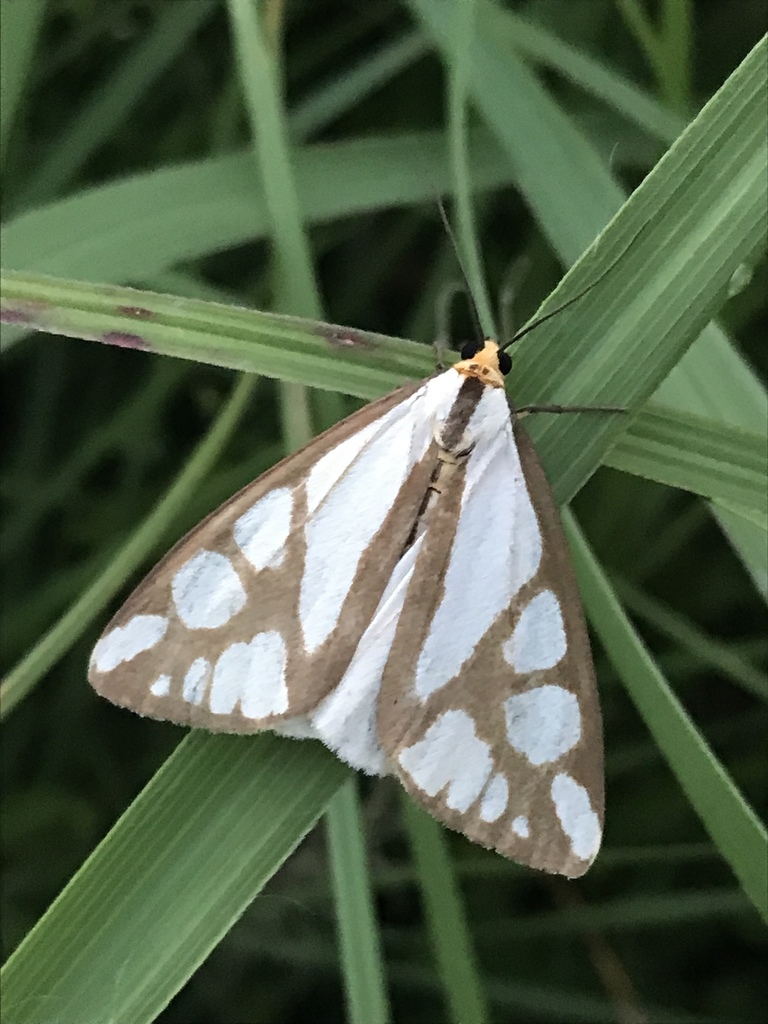
Reversed Haploa Moth
Haploa reversa
Haploa reversa, the reversed haploa, is a moth of the family Erebidae. The species was first described by Stretch in 1885. It is found in North America, from south-eastern Illinois, Iowa, Kansas, New York, Oklahoma and Wisconsin and north into Southern Canada.
From the article Haploa reversa on Wikipedia (CC BY-SA), quoted section by section
Description
The wingspan of this species ranges between 33 mm and 48mm. The upper side of the front wings has brown bands and white patches, including a distinctive white triangular patch that extends from the thorax to more than half the length of the wing and three similar white patches along the front edges. The larvae are black with yellow to orange stripes, a reddish orange stripe along their back, and bristly spines.
What it does
Adults are on wing in June in one generation per year. The larvae feed on a wide range of plants, including Malus species (apple trees).
Wikipedia: “Life Cycle”
Listen
Looking for field recordings…
Where it lives
Recorded sightings
—
geo-referenced records in GBIF, from museums, herbaria and field observers.
Drag the globe to turn it. Dots are where records exist, not a range map; darker means more records.
In the stacks
Searching the stacks…
Every page naming Haploa reversa in the Biodiversity Heritage Library →
This page is assembled live from iNaturalist, GBIF, Wikipedia, the Source Library and the Internet Archive. It is not yet part of the hand-edited codex. iNaturalist taxon 129151.