- Animals
- ›Arthropods
- ›Hexapods
- ›Insects
- ›Winged and Once-winged Insects
- ›Grasshoppers, Crickets, and Katydids
- ›Katydids, Crickets, and Allies
- ›Crickets
- ›True Crickets and Allies
- ›True Crickets
- ›Field Crickets
- ›Gryllini
- ›Gryllina
- ›Gryllus
- ›Gryllus
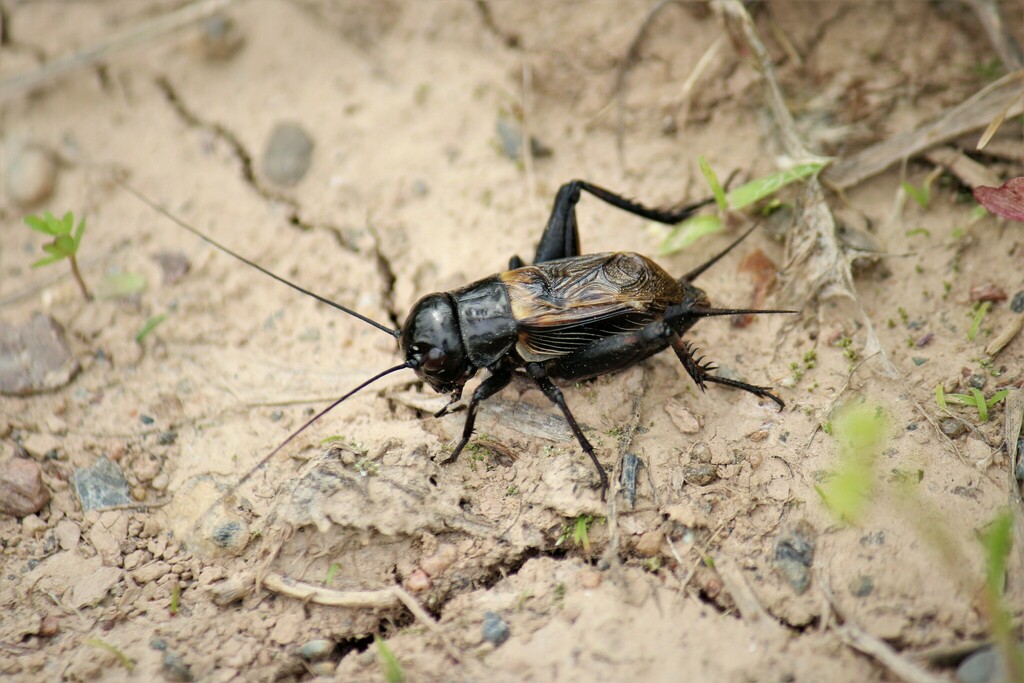
Spring Field Cricket
Gryllus veletis
Gryllus veletis, commonly known as the spring field cricket, is abundant throughout eastern North America. G. veletis is a solitary, aggressive, omnivorous, burrow-inhabiting species of field cricket. This species is commonly confused with Gryllus pennsylvanicus (fall field cricket), as they inhabit the same geographical area. However, the two species are easily distinguished through examination of life history, ovipositor and behavioural differences. Predators of G. veletis, and most field crickets, include American toads, wild turkeys, red-tailed hawks,...
From the article Gryllus veletis on Wikipedia (CC BY-SA), quoted section by section
Range & habitat
Gryllus veletis is abundant in much of North America, and was found in a recent study to be the most geographically widespread of its genus on the continent. Within the United States, Weissman and Gray found it absent only from the southeastern states. West of the Cascade Range and the Sierra Nevada, it is replaced by G. veletisoides, which is however not a sister species. Alexander and Bigelow report it from southern Canada to northern Georgia, but Walker does not have records from the southeast United States. G. veletis occurs in the same areas as G. pennsylvanicus, but the spring field cricket does not reach as far north as Nova Scotia, Canada. G. veletis can be found in disturbed habitats such as old fields and weedy roadsides.
Wikipedia: “Distribution”
What it does
Spring field crickets are sexually mature from late May to early August. Males of the species attract sexually receptive females by acoustic signals, known as stridulation. This process occurs by rubbing two rigid veins on the wings against one another. One vein is a scraper (smooth surface), the other a file (rough surface). The wings are held at a 45 degree angle above the thorax to amplify the sound. Calling tends to peak at sunrise and lasts between 1.3 and 1.8 hours per night. However, if nighttime temperatures drop below 10 °C (50 °F), calling will switch to the daytime. At 29 °C (85 °F), the cricket will call at 120–370 chirps per minute, in a series of 3 to 5-pulse chirps. When a female is within the vicinity of a male’s territory, a quieter song (known as a courtship song) is used to reduce the risk of predation and attraction of male competitors. Both males and females have directional hearing. Tympanums on the front legs pick up the vibrations created by the chirps. Depending on the strength, and on which leg the vibration is received, the location of the caller can be determined. Once mating occurs, females use their ovipositor to lay eggs into a soil substrate. The eggs will mature between June and September. The immature spring field cricket will continue to develop into a late-instar nymph and overwinter in this stage until emergence as adults in late May. G. …
Wikipedia: “Life cycle and mating behaviour”
Listen
Looking for field recordings…
Where it lives
Recorded sightings
—
geo-referenced records in GBIF, from museums, herbaria and field observers.
Drag the globe to turn it. Dots are where records exist, not a range map; darker means more records.
In the stacks
Searching the stacks…
Every page naming Gryllus veletis in the Biodiversity Heritage Library →
This page is assembled live from iNaturalist, GBIF, Wikipedia, the Source Library and the Internet Archive. It is not yet part of the hand-edited codex. iNaturalist taxon 129135.