On eBird ↗
Veery
Live sightings near you, the range map, bar charts of when it is seen, and Macaulay Library photos and recordings.
Veery
Catharus fuscescens
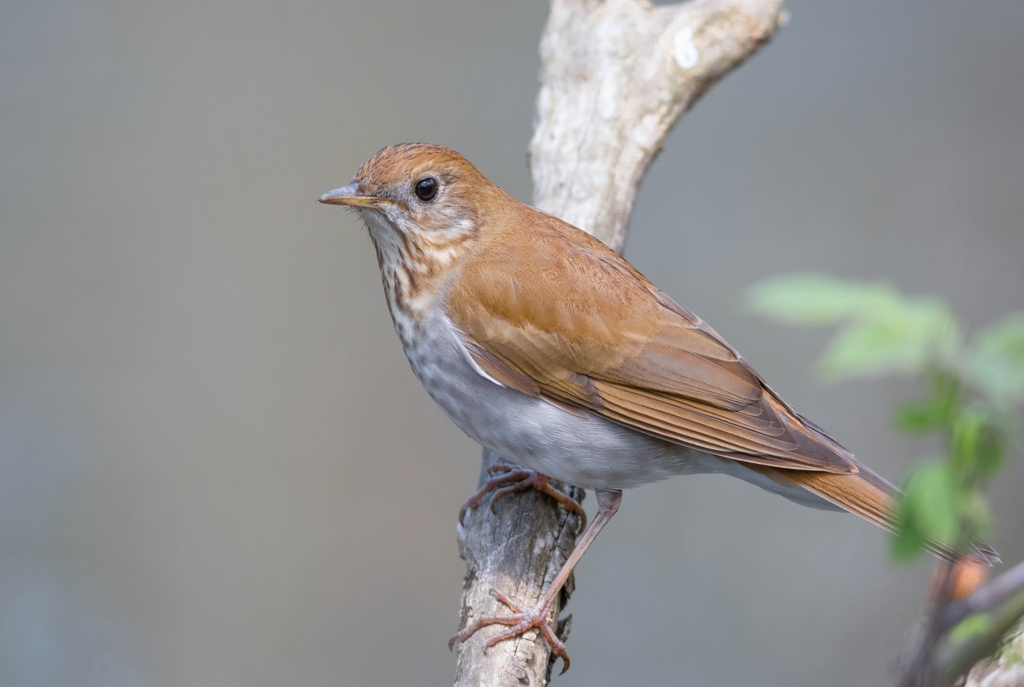
The veery (Catharus fuscescens) is a small North American thrush species, a member of a group of closely related and similar species in the genus Catharus, also including the gray-cheeked thrush (C. minimus), Bicknell's thrush (C. bicknelli), Swainson's thrush (C. ustulatus), and hermit thrush (C. guttatus). Alternate names for this species include Wilson's thrush (named so after Alexander Wilson) and tawny thrush. Up to six subspecies exist, which are grouped into the eastern veery (C. fuscescens fuscescens), the western veery or willow thrush (C. fuscescens salicicolus), and the Newfoundland veery (C. fuscescens fuliginosus).
The specific name fuscescens is Neo-Latin for "blackish", from Latin fuscus, "dark". The English name may imitate the call.
From the article Veery on Wikipedia (CC BY-SA), quoted section by section
Description
This species measures 16–19.5 cm (6.3–7.7 in) in length. Its mass is 26–39 g (0.92–1.38 oz), exceptionally up to 54 g (1.9 oz). The wingspan averages 28.5 cm (11.2 in). Each wing measures 8.9–10.4 cm (3.5–4.1 in), the bill measures 1.2–1.9 cm (0.47–0.75 in) and the tarsus is 2.7–3.25 cm (1.06–1.28 in). The veery shows the characteristic under-wing stripe of Catharus thrushes. Adults are mainly light brown on the upperparts. The underparts are white; the breast is light tawny with faint brownish spots. Veeries have pink legs and a poorly defined eye ring. Birds in the eastern portions of the species' breeding range are more cinnamon on the upper parts; western birds are more olive-brown. In the east, the veery is distinguished easily by its coloration; distinguishing western veeries from other Catharus thrushes is more difficult.
This bird has a breezy, downward-spiraling, flute-like song, often given from a low and concealed perch. The most common call is a harsh, descending vee-er, which gave the bird its name. Other calls include a chuckle, a sharp and low "wuck", and a slow wee-u. Veeries have been shown to decrease the rate and duration of singing when exposed to barred owl playback, possibly to decrease the chance of predation.
Range & habitat
The breeding habitat is humid deciduous forest across southern Canada and the northern United States. Breeding habitat includes dense growth and dense understory close to a water source, such as a stream. These birds migrate to eastern South America. It has been found that winter range may include the entire Amazon basin, Mérida state in Venezuela, the headwaters of the Orinoco River, and São Paulo state, Brazil. Stopover regions during migration of several veeries from Delaware include the coast of the Gulf of Mexico, the coasts of the Carolinas, Cuba, Jamaica, Colombia, and Venezuela. They are very rare vagrants to western Europe.
Wikipedia: “Breeding and wintering habitat”
What it does
They forage on the forest floor, flipping leaves to uncover insects; they may fly up to catch insects in flight. They mainly eat insects and berries. Insects are a main food source during the breeding season, while fruit and berries may compose most of the diet during the late summer and fall.
Wikipedia: “Feeding”
Listen
Looking for field recordings…
Where it lives
Recorded sightings
—
geo-referenced records in GBIF, from museums, herbaria and field observers.
Drag the globe to turn it. Dots are where records exist, not a range map; darker means more records.
In the stacks
Searching the stacks…
Every page naming Catharus fuscescens in the Biodiversity Heritage Library →
This page is assembled live from iNaturalist, GBIF, Wikipedia, the Source Library and the Internet Archive. It is not yet part of the hand-edited codex. iNaturalist taxon 12901.