On eBird ↗
Chestnut-necklaced Partridge
Live sightings near you, the range map, bar charts of when it is seen, and Macaulay Library photos and recordings.
Chestnut-necklaced Partridge
Tropicoperdix charltonii
The chestnut-necklaced partridge (Tropicoperdix charltonii) is a species of bird in the family Phasianidae. It is found in forests in the Malay Peninsula and Sumatra. It is threatened by habitat loss and trapping. The International Union for Conservation of Nature (IUCN) has assessed it as vulnerable.
From the article Chestnut-necklaced partridge on Wikipedia (CC BY-SA), quoted section by section
Description
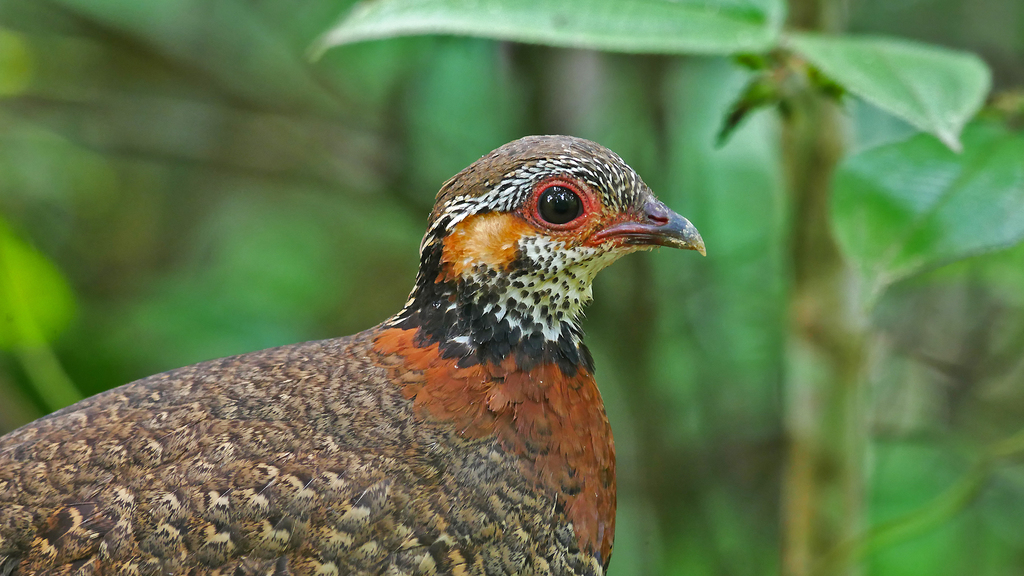
The chestnut-necklaced partridge is 26–32 cm (10–13 in) long. The male weighs about 290 g (10 oz) and the female weighs about 250 g (8.8 oz). The crown and nape are brown, with dark speckles. The whitish supercilium, throat and neck have brown streaks. The upper breast is chestnut, with a blackish collar above it. The lower breast is brown, and the belly and flanks are buff. There are dark scales on the lower breast and flanks. The upperparts are brown, finely marked blackish and buff. The beak is greenish yellow, and the legs are yellow. The female bird is smaller and a little duller than the male. The subspecies atjenensis has brighter plumage, and graydoni has greenish-yellow legs.
Range & habitat
This partridge is found in the Thai-Malay Peninsula, Aceh, and South Sumatra. Its habitat is lowland evergreen forest and secondary forest.
Wikipedia: “Distribution and habitat”
What it does
This partridge probably forages in small groups, eating seeds, berries and termites. Its breeding has not been recorded. Its call is loud, steady couplets and triplets of whistles, and pairs often duet.
Wikipedia: “Behaviour”
Listen
Looking for field recordings…
Where it lives
Recorded sightings
—
geo-referenced records in GBIF, from museums, herbaria and field observers.
Drag the globe to turn it. Dots are where records exist, not a range map; darker means more records.
In the stacks
Searching the stacks…
Every page naming Tropicoperdix charltonii in the Biodiversity Heritage Library →
This page is assembled live from iNaturalist, GBIF, Wikipedia, the Source Library and the Internet Archive. It is not yet part of the hand-edited codex. iNaturalist taxon 1289693.