On eBird ↗
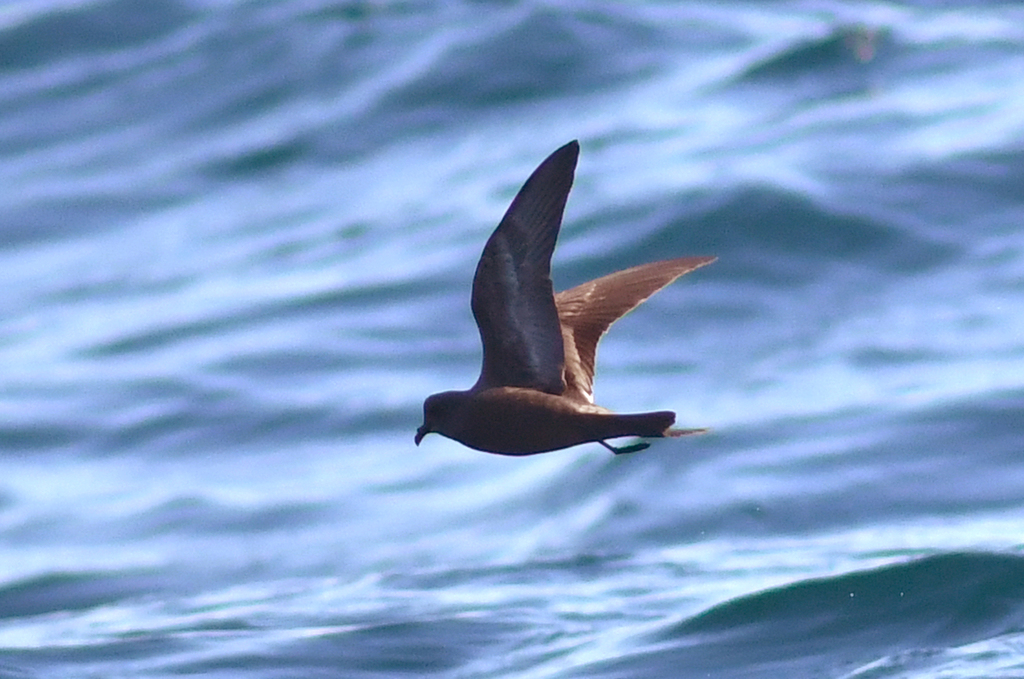
Ashy Storm-Petrel
Live sightings near you, the range map, bar charts of when it is seen, and Macaulay Library photos and recordings.
Ashy Storm-Petrel
Hydrobates homochroa
The ashy storm petrel (Hydrobates homochroa) is a small, scarce seabird of the storm petrel family Hydrobatidae. It breeds colonially on islands off the coasts of California and Mexico, and is one of six species of storm petrel that live and feed in the rich California Current system.
From the article Ashy storm petrel on Wikipedia (CC BY-SA), quoted section by section
Description
This is a small, uniformly sooty-brown storm petrel with a forked tail, closely resembling the black storm petrel, but it is smaller and has a more fluttering style of flight, with the upstroke only becoming horizontal to the body before beginning the downstroke (other storm petrels in its range have a higher upstroke). It is a gregarious bird at sea, feeding nocturnally on cephalopods, fish (particularly the deep-sea myctophids, which rise to the sea's surface at night) and euphausiid krill such as Thysanoessa spinifera, which also swarm at the surface. They also attend fishing vessels for the fish oils released when the nets are pulled.
Ashy storm petrels nest in rock burrows on offshore islands, returning to the nests at night. The species has a long breeding cycle, laying eggs in May and fledging in October, although timing varies greatly, more so than in most other storm petrels; some pairs may have a chick that is half grown when other pairs are still laying. Like in many other seabirds, pairs show both mate and site fidelity, mating in the same pair with the same mate for many years and nesting at the same burrow, despite the pairs spending their lives out of the breeding season separate from each other, and despite the fact that many individuals might seem to compete for burrows at the nesting colonies. …
Wikipedia: “Description and ecology”
Range & habitat
Ashy storm petrels breed on 17 islands in the northeast Pacific, principally off the coast of California, but including a few sites off the coast of northwestern Mexico. Half the world's population nests on the Farallon Islands near San Francisco. Other breeding islands include the eight Channel Islands of California and a small population on Mexico's Coronados. Bat Cave, on the north side of Santa Cruz Island in Southern California, has the largest nesting colony for the ashy storm petrel in the world, with over 100 nests. Outside of the breeding season, it is believed to be more widely distributed, foraging on the California Current, but it undertakes no large migration and does not range as far as other species of storm petrels. In the early fall, large flocks can be seen in Monterey Bay. The birds do not range inland any significant distance except when storm-blown; for example, a sighting in San Mateo County, California was considered "unusual" by an experienced naturalist. The world population is estimated to be around 10,000 birds, 8,000 of them breeders, with the Farallon population having declined by one-third between 1972 and 1992. The ashy storm petrel is designated as a species of conservation concern in California. …
Wikipedia: “Distribution, status, and threats”
Listen
Looking for field recordings…
Where it lives
Recorded sightings
—
geo-referenced records in GBIF, from museums, herbaria and field observers.
Drag the globe to turn it. Dots are where records exist, not a range map; darker means more records.
In the stacks
Searching the stacks…
Every page naming Hydrobates homochroa in the Biodiversity Heritage Library →
This page is assembled live from iNaturalist, GBIF, Wikipedia, the Source Library and the Internet Archive. It is not yet part of the hand-edited codex. iNaturalist taxon 1289618.