On eBird ↗
Chatham Islands Shag
Live sightings near you, the range map, bar charts of when it is seen, and Macaulay Library photos and recordings.
Chatham Shag
Leucocarbo onslowi
The Chatham Islands shag (Leucocarbo onslowi), also known as the Chatham shag, is a species of bird in the cormorant and shag family, Phalacrocoracidae. It is endemic to the Chatham Islands of New Zealand. For a long time the species was placed in the genus Phalacrocorax; today it is mostly placed with the other blue-eyed shags of New Zealand and Antarctica in the genus Leucocarbo. Its closest relative is the Otago shag of South Island.
This is a large, pied shag with a long crest. It is highly coastal, rarely foraging far from shore, although sometimes feeds in the large and brackish Te Whanga Lagoon. It forages for fish and cephalopods and roosts on rocky shores. The species is colonial, breeding in small colonies around the Chatham Islands. Little is known about its breeding behaviour. The species is threatened by introduced predators, disturbance at its breeding colonies and habitat loss.
From the article Chatham Islands shag on Wikipedia (CC BY-SA), quoted section by section
Description
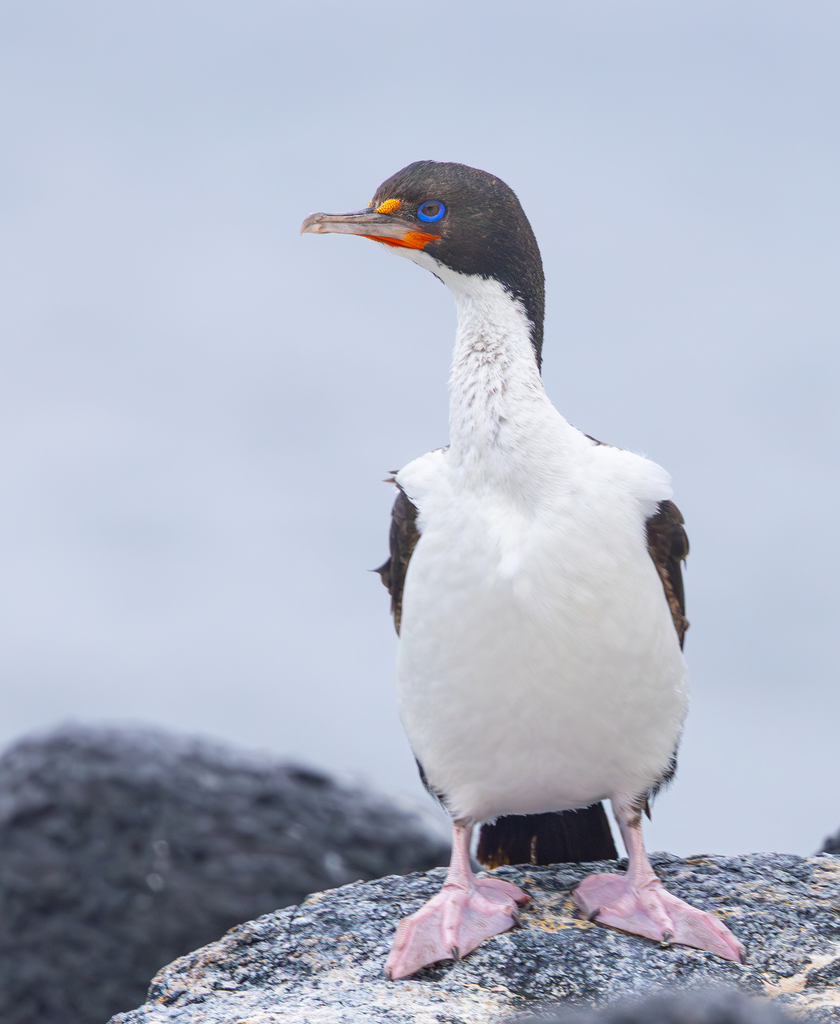
An adult Chatham Islands shag is 63 cm (25 in) in length and weighs around 1,790–2,400 g (63–85 oz). It is a large pied shag with a white throat, breast, belly and patches on the scapulars of the wings, and black or black-brown elsewhere. When breeding the head and hind-neck have a blue metallic sheen, the wings and mantle have a greenish sheen and the rest of the black areas have a purplish-blue sheen. The head has a prominent crest and there are white filoplumes on the neck. Adults have a red gular sac and orange-red caruncles on the face and the gape of the mouth. In spite of the common name of the genus the iris of the eye is brown, and the eye has a violet eye-ring. The bill is dark grey, with a bright red mouth, and the legs and feet are dull pink. Non-breeding birds look similar to breeding birds but are duller, have no crest or filoplumes, and duller bare parts. The caruncles are yellow, the eye-ring blue, the mouth orange and the bill is light-grey.
Range & habitat
The species is endemic to the Chatham Islands, an archipelago around 700 km (430 mi) to the east of New Zealand. In the Chathams it is an inshore species, rarely going more than a few kilometres away from shore, and it is more commonly found in sheltered water such as bays and inlets. It also forages in the large brackish Te Whanga Lagoon. It breeds in colonies on coastal areas and around Te Whanga Lagoon, either on flat areas, slopes or wide cliff ledges. There are currently thirteen colonies of this species, found on the main Chatham Island as well as Pitt Island, Star Keys, Rabbit Island and North East Reef. These colonies are located close to the high-tide mark and can have as many as 300 nests in them. It roosts on rocks close to shore or at sea, although it may have different roosting sites for day and night. The species is non-migratory and has never been recorded away from the Chatham Islands, although the species does feed and roost on islands in the Chathams away from their breeding colonies, for example Mangere.
Wikipedia: “Distribution and habitat”
What it does
Like all cormorants, the Chatham Islands shag is a pursuit-diver, propelling itself underwater with its feet and returning to the surface to consume small prey caught in its bill. The specific diet of the Chatham Islands shag is poorly known, but is dominated by fish, including opalfish, flatfish and bullies, as well as cephalopods such as octopuses, squid and cuttlefish. It generally feeds alone, but will form small feeding flocks at times.
Wikipedia: “Diet and feeding”
Listen
Looking for field recordings…
Where it lives
Recorded sightings
—
geo-referenced records in GBIF, from museums, herbaria and field observers.
Drag the globe to turn it. Dots are where records exist, not a range map; darker means more records.
In the stacks
Searching the stacks…
Every page naming Leucocarbo onslowi in the Biodiversity Heritage Library →
This page is assembled live from iNaturalist, GBIF, Wikipedia, the Source Library and the Internet Archive. It is not yet part of the hand-edited codex. iNaturalist taxon 1289595.