On eBird ↗
Jalca Tapaculo
Live sightings near you, the range map, bar charts of when it is seen, and Macaulay Library photos and recordings.
Jalca Tapaculo
Scytalopus frankeae
The jalca tapaculo (Scytalopus frankeae) is a species of bird in the family Rhinocryptidae. It is endemic to Peru.
From the article Jalca tapaculo on Wikipedia (CC BY-SA), quoted section by section
Description
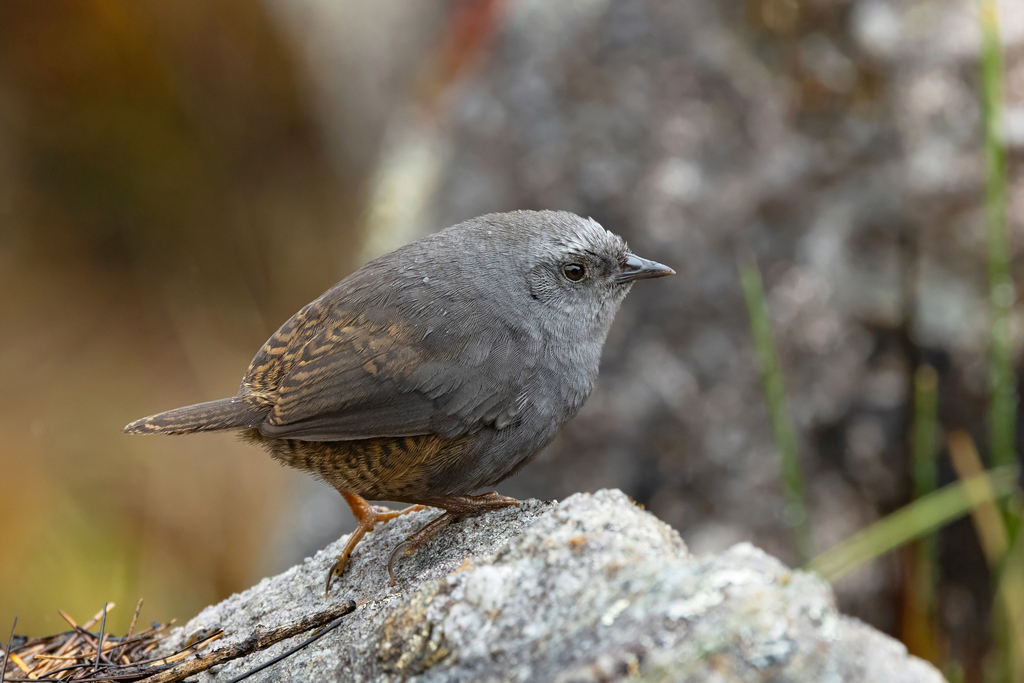
Like all members of genus Scytalopus, the jalca tapaculo is a small, plump, dull-colored bird. It is about 10 to 11 cm (3.9 to 4.3 in) long. Males weigh about 17 g (0.60 oz) and females about 16 g (0.56 oz). The male's crown and much of the face are dark gray, with a silvery white supercilium of variable size. Some also have a silvery crown. The nape and mantle are dark gray washed with dark reddish brown; the lower back and rump are cinnamon brown with blackish curving bars near the feather ends. The outer tail feathers of most males are dark reddish brown with narrow cinnamon brown bars near the feather ends. The inner tail feathers, and all of the tail feathers on some individuals, are banded with dusky gray and cinnamon. The wings are generally brown with cinnamon and blackish markings. The throat and belly are light gray, the breast a darker gray, and the lower flanks and vent area tawny brown with blackish markings. The female is similar to the male, but generally browner ranging from cinnamon brown to olive brown.
Range & habitat
The jalca tapaculo is endemic to east-central Peru. It is known from several sites in each of two general locations about 150 km (93 mi) apart. In the north it is found in the departments of Huánuco and Pasco and in the south the department of Junín. Its northern limit is the Huallaga River and in the south the Mantaro River. It mostly inhabits areas of dense bunchgrass and scattered shrubs ("jalca"), where it sticks to ravines and steep rocky slopes that are not grazed by sheep and cattle. It also occurs at the edge of treeline forest and in Polylepis and riparian evergreen forest. In elevation it ranges between 3,400 and 4,200 m (11,200 and 13,800 ft).
Wikipedia: “Distribution and habitat”
What it does
The jalca tapaculo forages on the ground by moving among moss, rocks, and clumps of grass and by hopping along branches near the ground. Details of its diet are lacking; only insects have been identified as prey.
Wikipedia: “Feeding”
Listen
Looking for field recordings…
Where it lives
Recorded sightings
—
geo-referenced records in GBIF, from museums, herbaria and field observers.
Drag the globe to turn it. Dots are where records exist, not a range map; darker means more records.
In the stacks
Searching the stacks…
Every page naming Scytalopus frankeae in the Biodiversity Heritage Library →
This page is assembled live from iNaturalist, GBIF, Wikipedia, the Source Library and the Internet Archive. It is not yet part of the hand-edited codex. iNaturalist taxon 1289541.