On eBird ↗
Pallas's Grasshopper Warbler
Live sightings near you, the range map, bar charts of when it is seen, and Macaulay Library photos and recordings.
Pallas's Grasshopper Warbler
Helopsaltes certhiola
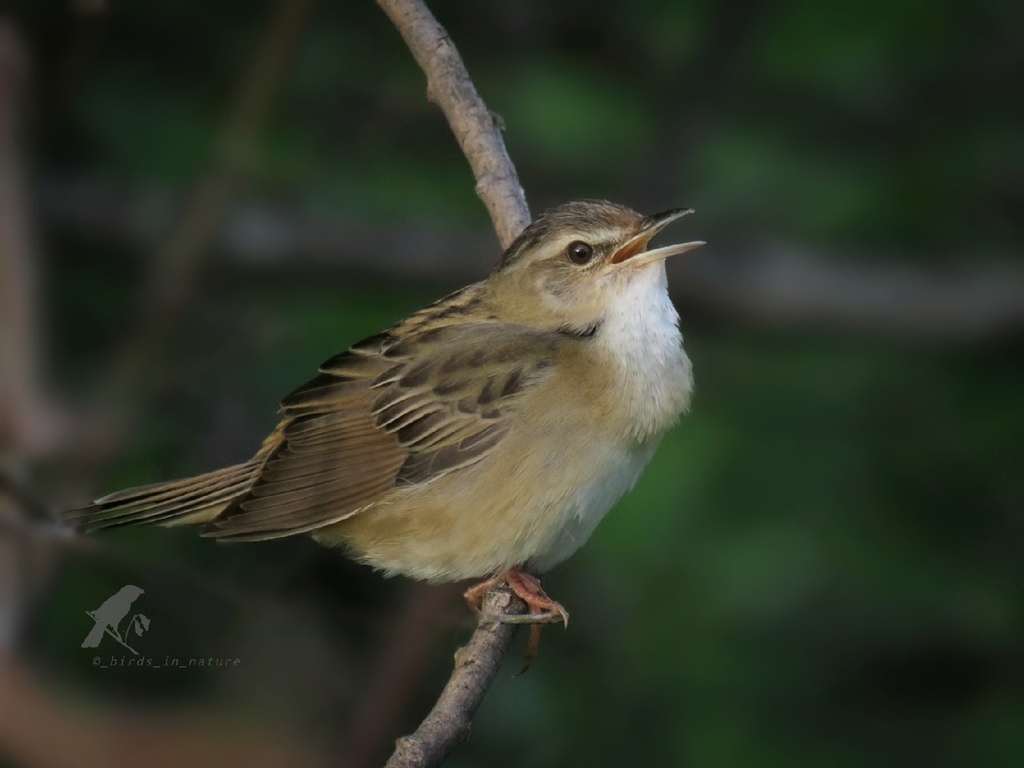
Pallas's grasshopper warbler (Helopsaltes certhiola), also known as the rusty-rumped warbler, is an Old World warbler in the grass warbler genus Helopsaltes. It breeds in the eastern Palearctic: from the Altai Mountains, Mongolia and Transbaikalia to northeastern China, the Korean Peninsula, and islands in the Sea of Okhotsk (Sakhalin and Kuril Islands). It is migratory, wintering from India eastward to Indonesia. It is a rare migrant in Sri Lanka.
From the article Pallas's grasshopper warbler on Wikipedia (CC BY-SA), quoted section by section
Description
This is a medium-sized warbler. The adult has a streaked brown back, whitish grey underparts, unstreaked except on the undertail. The sexes are identical, as with most warblers, but young birds are yellower below. Like most warblers, it is insectivorous. It is very similar to the common grasshopper warbler, but is slightly larger, has white tips to the tail and tertial feathers, and a warmer brown rump. The white tips are the reason for its colloquial, mnemonic name of "PG Tips". This is a skulking species which is very difficult to see except sometimes when singing. It creeps through grass and low foliage.
Range & habitat
This small passerine bird is found in tall grass with some thicker vegetation, usually close to water in bogs or wet meadows. From 4 to 7 eggs are laid in a nest on the ground in grass. This species is a very rare vagrant to western Europe. One of the best places to see this skulking species as a vagrant is Fair Isle, Shetland; for a species that only rarely appears in western Europe, it can be found there with some regularity.
Wikipedia: “Habitat”
In human culture
This bird was named after the German zoologist Peter Simon Pallas. The specific certhiola is a diminutive from the genus Certhia, the treecreepers. The sixth edition of Clements Checklist refers to this species as "Pallas's warbler", a name more commonly used for Phylloscopus proregulus.
Wikipedia: “Etymology”
Listen
Looking for field recordings…
Where it lives
Recorded sightings
—
geo-referenced records in GBIF, from museums, herbaria and field observers.
Drag the globe to turn it. Dots are where records exist, not a range map; darker means more records.
In the stacks
Searching the stacks…
Every page naming Helopsaltes certhiola in the Biodiversity Heritage Library →
This page is assembled live from iNaturalist, GBIF, Wikipedia, the Source Library and the Internet Archive. It is not yet part of the hand-edited codex. iNaturalist taxon 1289501.