On eBird ↗
Arabian Warbler
Live sightings near you, the range map, bar charts of when it is seen, and Macaulay Library photos and recordings.
Arabian Warbler
Curruca leucomelaena
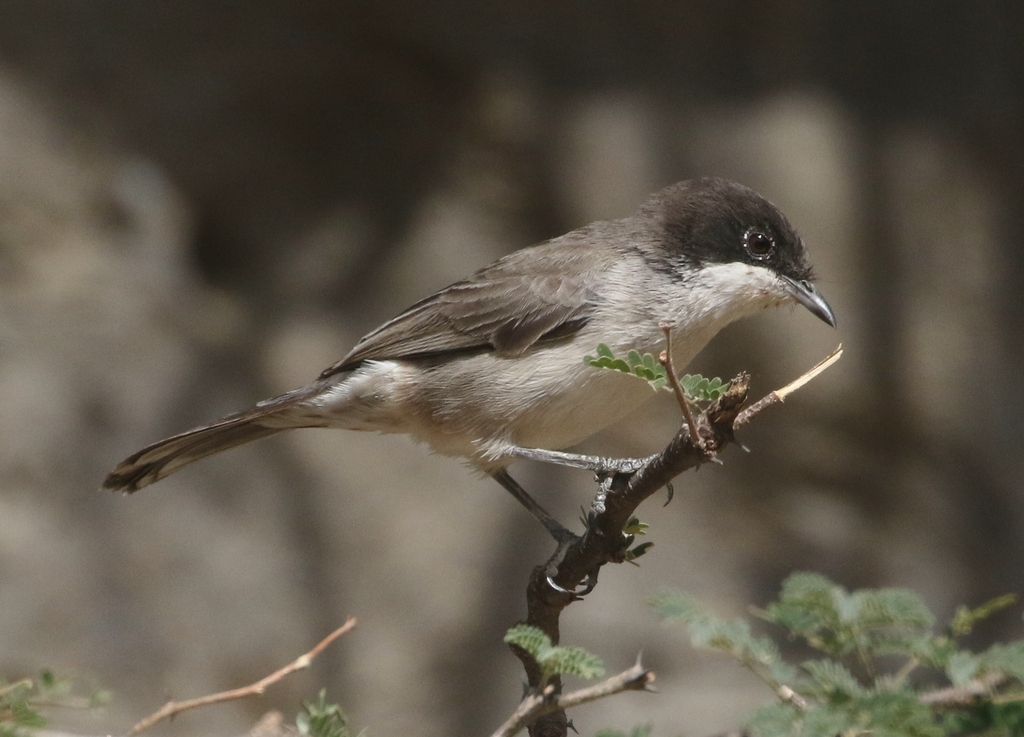
The Arabian warbler (Curruca leucomelaena), also known as Red Sea warbler or Blandford's warbler, is a species of Old World warbler in the family Sylviidae.
It is found in Djibouti, Egypt, Eritrea, Israel, Jordan, Oman, Palestine, Saudi Arabia, Somalia, Sudan, and Yemen. Its natural habitat is dry savanna country where it is often found in patches of Acacia.
From the article Arabian warbler on Wikipedia (CC BY-SA), quoted section by section
Description
The Arabian warbler is a large member of its genus, with a length of about 14.5 cm (5.7 in). It has an upright posture, relatively short, rounded wings and a long, graduated tail which it characteristically flicks downwards. The male has a white eye-ring, a blackish-brown hood and tail, greyish-brown upper parts, a whitish throat and pale grey underparts. The female is similar but the hood and tail are chocolate brown and the eye ring is less conspicuous. The song, normally uttered only by the male, is a short melodious, thrush-like bubbling warble, usually sung from an elevated perch, but sometimes sung from cover. The alarm call is a series of quiet "chack"s.
What it does
The Arabian warbler forages for insects and small arthropods, and also feeds on berries. Breeding takes place in the spring and there are often two or more broods. In Israel nesting takes place between February and mid-June. This bird is found in arid savannah country where it is particularly associated with Acacia groves.
Wikipedia: “Behaviour”
Listen
Looking for field recordings…
Where it lives
Recorded sightings
—
geo-referenced records in GBIF, from museums, herbaria and field observers.
Drag the globe to turn it. Dots are where records exist, not a range map; darker means more records.
In the stacks
Searching the stacks…
Every page naming Curruca leucomelaena in the Biodiversity Heritage Library →
This page is assembled live from iNaturalist, GBIF, Wikipedia, the Source Library and the Internet Archive. It is not yet part of the hand-edited codex. iNaturalist taxon 1289481.