On eBird ↗
Sanford's White-eye
Live sightings near you, the range map, bar charts of when it is seen, and Macaulay Library photos and recordings.
Sanford's White-eye
Zosterops lacertosus
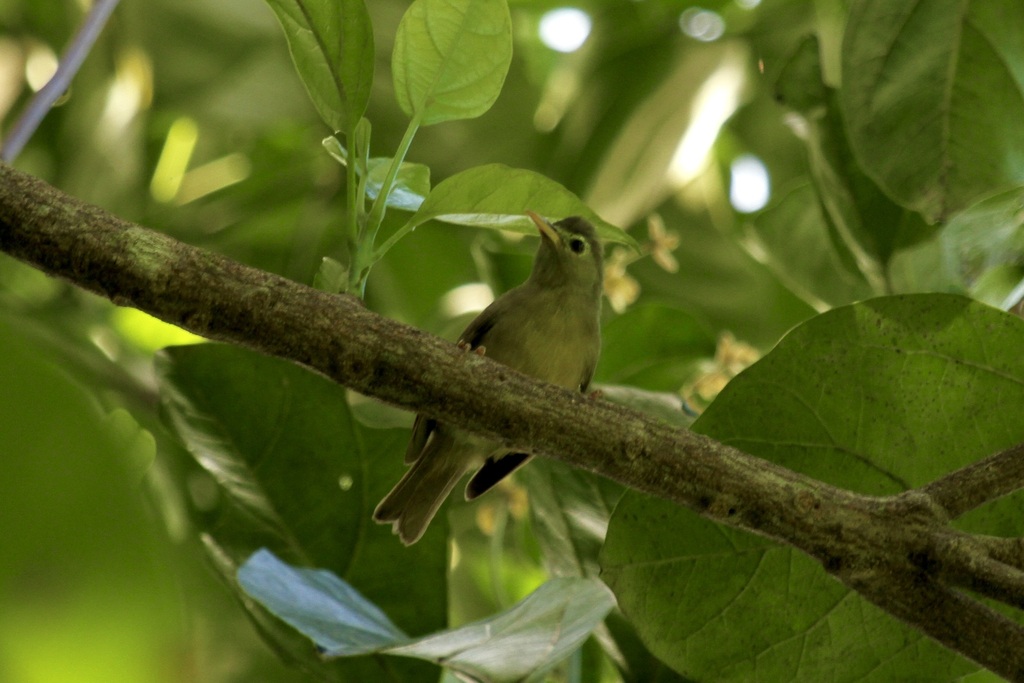
Sanford's white-eye (Zosterops lacertosus) is a species of bird in the family Zosteropidae. It is endemic to Nendo Island. It is named after Leonard Cutler Sanford, a trustee of the American Museum of Natural History.
Z. lacertosus is monotypic (there are no subspecies).
From the article Sanford's white-eye on Wikipedia (CC BY-SA), quoted section by section
Description
The Sanford's white-eye's average size is 15-16cm. It also has a narrow white eyering, making the eyes pop, and brown tails. Both males and females look the same. Its brown-feathered body has an olive wash on the throat. It has straw light yellow legs. It is primarily recognized for its distinctive white rings around its eyes, which is a common feature in the white-eye family. The white-eye family is also known for being very social. It typically has olive-green plumage with yellowish tones on its underparts.
Wikipedia: “Appearance”
Range & habitat
The Sanford's white-eye is found in habitats such as degraded forests, primary forests, forest edges, and secondary growth. It prefers areas with dense forest cover, which provide plenty of food and shelter. Because of this, it is classified as near threatened because its habitat quality is declining due to commercial logging. It sometimes feeds on tropical fruit and eats in the canopy and middle story. They primarily feed on insects, nectar, and small fruits, making it an important species for pollination and seed dispersal in its ecosystem.
Wikipedia: “Habitat and diet”
What it does
They are known for their rapid movements as they fly through the trees in search of food. They forge in pairs. When in flocks, they frequently make a basic "chirp" noise and sometimes mix with other bird species. They have distinctive high-pitched, melodious calls. These vocalizations are used for communication within flocks and between mates, especially during breeding season. Their songs help to establish territories and attract mates.
Wikipedia: “Behavior”
Listen
Looking for field recordings…
Where it lives
Recorded sightings
—
geo-referenced records in GBIF, from museums, herbaria and field observers.
Drag the globe to turn it. Dots are where records exist, not a range map; darker means more records.
In the stacks
Searching the stacks…
Every page naming Zosterops lacertosus in the Biodiversity Heritage Library →
This page is assembled live from iNaturalist, GBIF, Wikipedia, the Source Library and the Internet Archive. It is not yet part of the hand-edited codex. iNaturalist taxon 1289448.