- Animals
- ›Chordates
- ›Vertebrates
- ›Birds
- ›Perching Birds
- ›Tree-Babblers, Scimitar-Babblers, and Allies
- ›Dumetia
On eBird ↗
Dark-fronted Babbler
Live sightings near you, the range map, bar charts of when it is seen, and Macaulay Library photos and recordings.
Dark-fronted Babbler
Dumetia atriceps
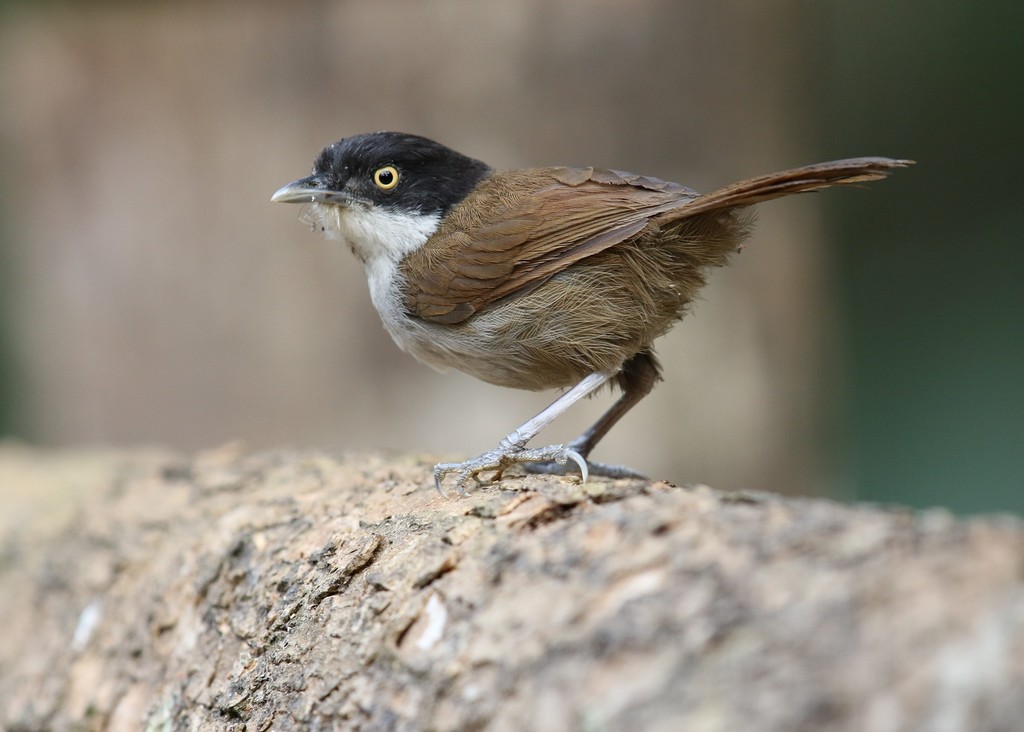
The dark-fronted babbler (Dumetia atriceps) is an Old World babbler found in the Western Ghats of India and the forests of Sri Lanka. They are small chestnut brown birds with a dark black cap, a whitish underside and pale yellow iris. They forage in flocks in the undergrowth of forests constantly making calls and uttering alarm calls when disturbed.
From the article Dark-fronted babbler on Wikipedia (CC BY-SA), quoted section by section
Description
The dark-fronted babbler measures 13 cm including its square-tipped tail. It is brown above and white below. The two subspecies in the Western Ghats have black hoods, but the two Sri Lankan races have this reduced to a dark bandit mask. The pale yellow iris stands in contrast. The subspecies in the southern Western Ghats bourdilloni has a duller sooty-black hood, browner underside and the upper parts are more olive. The nominate form found north of the Palghat Gap has the hood dark black. In Sri Lanka, the subspecies siccata is found in the lower elevation while nigrifrons is found in the wet zone. The former has more olive on the upperparts while the later is rufescent on the upperparts.
What it does
Babblers have a weak flight and are residents within their range. They forage in parties and clamber up vegetation and when disturbed, they tend to drop from the topmost perches of the bush into the undergrowth. Their typical habitat is undergrowth in forest or on the edge of forests in more open growth. Their food is mainly insects. They can be difficult to observe in the dense vegetation they prefer, but like other babblers, these are noisy birds, and their characteristic rattling churr alarm calls are often the best indication that these birds are present. They often join mixed-species foraging flocks. The breeding season is May to July. This babbler builds its nest low down in a bush, the nest being a ball of leaves, often of bamboo. The nest looks like some dry leaves stuck in a bush with the opening on the side. The normal clutch is two eggs. They are also said to construct dormitory nests within which birds may sometimes roost. These dormitory nests are not lined.
Wikipedia: “Behaviour and ecology”
Listen
Looking for field recordings…
Where it lives
Recorded sightings
—
geo-referenced records in GBIF, from museums, herbaria and field observers.
Drag the globe to turn it. Dots are where records exist, not a range map; darker means more records.
In the stacks
Searching the stacks…
Every page naming Dumetia atriceps in the Biodiversity Heritage Library →
This page is assembled live from iNaturalist, GBIF, Wikipedia, the Source Library and the Internet Archive. It is not yet part of the hand-edited codex. iNaturalist taxon 1289446.