- Animals
- ›Chordates
- ›Vertebrates
- ›Birds
- ›Perching Birds
- ›Tree-Babblers, Scimitar-Babblers, and Allies
- ›Erythrogenys
On eBird ↗
Rusty-cheeked Scimitar-Babbler
Live sightings near you, the range map, bar charts of when it is seen, and Macaulay Library photos and recordings.
Rusty-cheeked Scimitar-Babbler
Erythrogenys erythrogenys
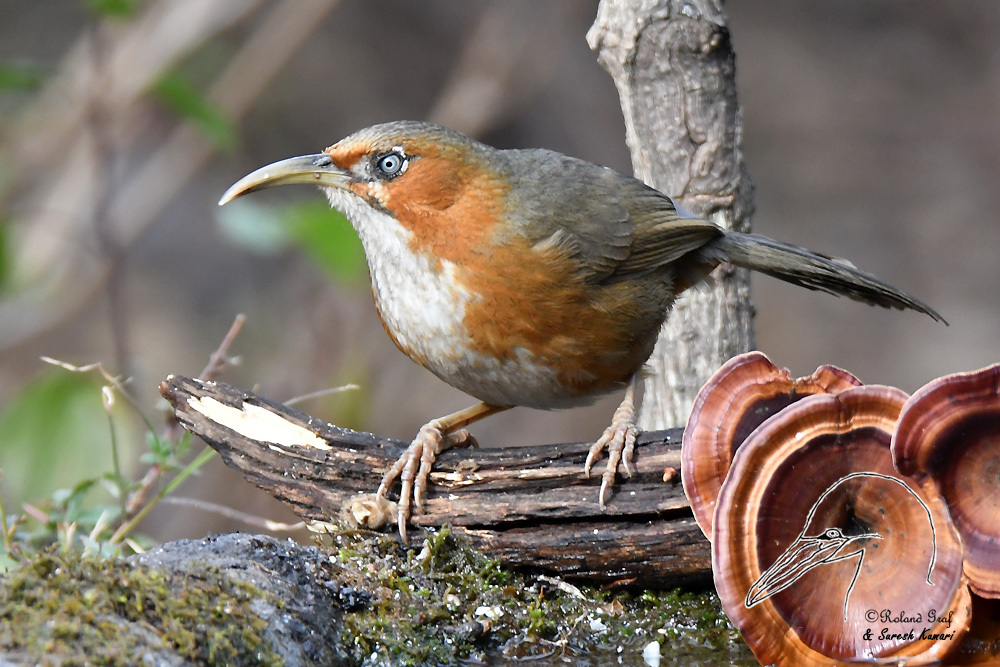
The rusty-cheeked scimitar babbler (Erythrogenys erythrogenys) is a passerine bird in the babbler family Timaliidae that is found in the Himalayas from northeast Pakistan to Bhutan. It was formerly considered as conspecific with the red-eyed scimitar babbler that is found in eastern Myanmar and northwestern Thailand.
From the article Rusty-cheeked scimitar babbler on Wikipedia (CC BY-SA), quoted section by section
Description
The species is olive-brown above, with rusty colouring on the sides of the face, head, thighs, and flanks. The belly is mostly white. Sexes are alike. The beak is long and decurved in a scimitar shape.
Range & habitat
The rusty-cheeked scimitar babbler is found from the Himalayas to Myanmar. It inhabits subtropical or tropical moist lowland forest and subtropical or tropical moist montane forest habitats at elevations up to 2,600 m (8,500 ft).
Wikipedia: “Distribution and habitat”
What it does
The bird feeds mostly on the forest floor and in low canopy, forming small groups. Food items include insects, grubs and seeds. Calls consist of a mellow, fluty whistle, a two-noted "CUE..PE...CUE..pe" call followed by single note replay by mate, guttural alarm calls and a liquid contact note. The species is generally quite noisy.
Wikipedia: “Ecology”
Listen
Looking for field recordings…
Where it lives
Recorded sightings
—
geo-referenced records in GBIF, from museums, herbaria and field observers.
Drag the globe to turn it. Dots are where records exist, not a range map; darker means more records.
In the stacks
Searching the stacks…
Every page naming Erythrogenys erythrogenys in the Biodiversity Heritage Library →
This page is assembled live from iNaturalist, GBIF, Wikipedia, the Source Library and the Internet Archive. It is not yet part of the hand-edited codex. iNaturalist taxon 1289442.