On eBird ↗
Golden-rumped Euphonia
Live sightings near you, the range map, bar charts of when it is seen, and Macaulay Library photos and recordings.
Golden-rumped Euphonia
Chlorophonia cyanocephala
The golden-rumped euphonia (Chlorophonia cyanocephala) is a species of bird in the family Fringillidae, formerly placed in the Thraupidae. It is found in Argentina, Bolivia, Brazil, Colombia, Ecuador, French Guiana, Guyana, Paraguay, Peru, Suriname, Trinidad and Tobago, and Venezuela.
From the article Golden-rumped euphonia on Wikipedia (CC BY-SA), quoted section by section
Description
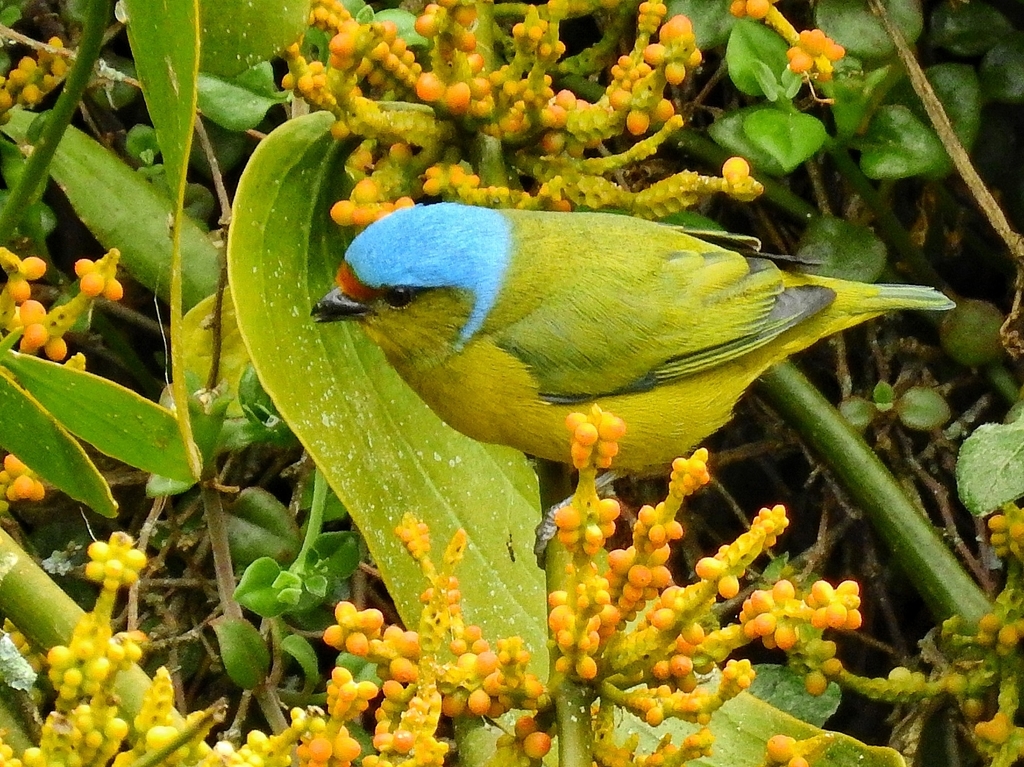
The golden-rumped euphonia is about 11 cm (4.3 in) long and weighs 15 to 16 g (0.53 to 0.56 oz). The species is sexually dimorphic. Adult males of the nominate subspecies C. c. cyanocephala have a bright turquoise-blue crown and nape whose color extends forward from the nape under the ear coverts. The rest of their face, head, and throat are black. Their mantle, back, and tail are black with a purplish to dark blue gloss. Their lower back and rump are golden-yellow to orange-yellow and their uppertail coverts are blue-black. Their upperwing coverts and their tertials are dusky black with a bluish tinge and the rest of their flight feathers are dark brown to dusky with yellowish olive outer webs and inner edges. Their underparts are deep yellow. Adult females have a tawny to yellowish buff forehead. Their crown and nape are turquoise-blue that curves forward like the male's. The rest of their head is olive-green. Their upperparts are olive-green that is paler and brighter on the rump. Their tail and flight feathers are fuscous with olive-green edges. Their chin, throat, and breast are yellow-olive and their belly and undertail coverts a more olive-yellow. Males of subspecies C. c. pelzelni have a paler rump and underparts than the nominate. C. c. insignis males have an orange-yellow forehead separated from the forecrown by a thin black line. …
Range & habitat
The golden-rumped euphonia has a disjunct distribution. The subspecies are found thus:
C. c. pelzelni: from southern Colombia south in western Ecuador to Chimborazo Province C. c. insignis: eastern slope of Ecuadorian Andes in Azuay and Loja provinces C. c. cyanocephala: southeastern Bolívar state in Venezuela and adjoining western Guyana and extreme northern Brazil; the Venezuelan Coastal Range, Serranía del Perijá on the Venezuela-Colombia border; Venezuelan Andes south through the Andes of Colombia and Ecuador into the Marañón River valley in Peru; far southeastern Peru south through Bolivia into northwestern Argentina; and separately from Bahia in eastern Brazil south through southeastern Paraguay and Uruguay into northeastern Argentina In addition, there are isolated records elsewhere in Brazil, Bolivia, and Argentina in areas not named above. The species previously was found on the island of Tobago but has been extirpated. The South American Classification Committee (SACC) also has records from French Guiana and Suriname. The golden-rumped euphonia inhabits a variety of somewhat open landscapes including secondary forest, the edges of mature forest, disturbed areas, and shade coffee plantations. …
Wikipedia: “Distribution and habitat”
What it does
The golden-rumped euphonia feeds almost entirely on fruits but is believed to also include insects in its diet. It seems to favor mistletoe (Loranthaceae) berries and is an important disperser of their seeds. It forages in pairs or small groups and only rarely joins mixed-species feeding flocks.
Wikipedia: “Feeding”
Listen
Looking for field recordings…
Where it lives
Recorded sightings
—
geo-referenced records in GBIF, from museums, herbaria and field observers.
Drag the globe to turn it. Dots are where records exist, not a range map; darker means more records.
In the stacks
Searching the stacks…
Every page naming Chlorophonia cyanocephala in the Biodiversity Heritage Library →
This page is assembled live from iNaturalist, GBIF, Wikipedia, the Source Library and the Internet Archive. It is not yet part of the hand-edited codex. iNaturalist taxon 1289368.