On eBird ↗
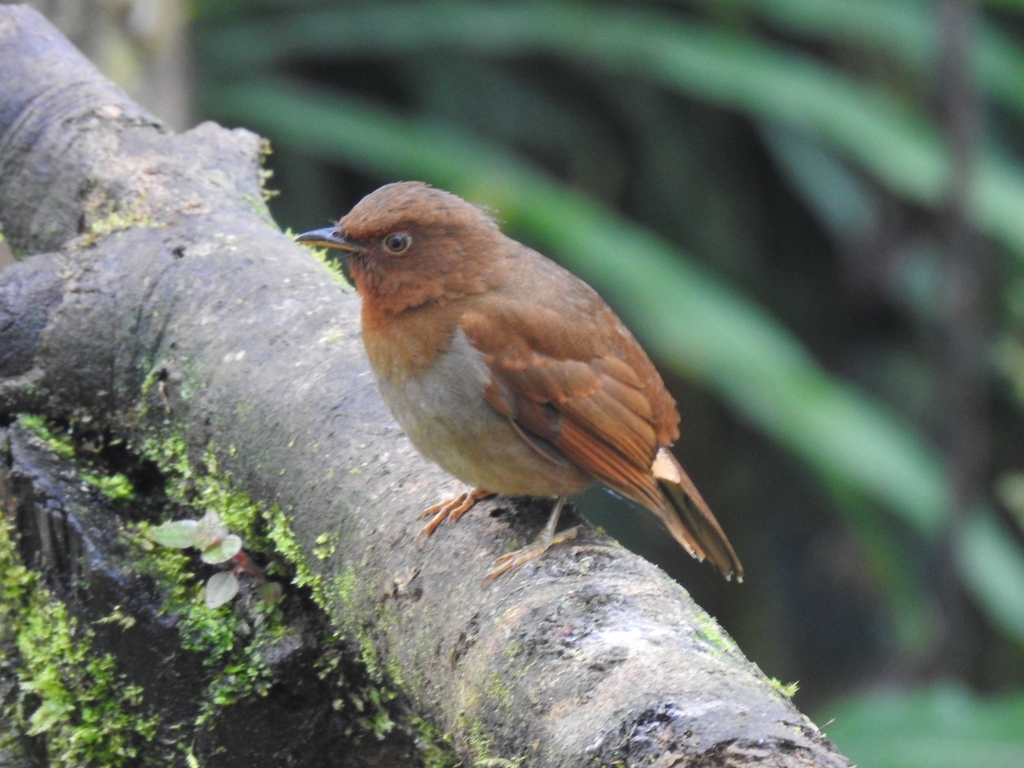
Rufous-brown Solitaire
Live sightings near you, the range map, bar charts of when it is seen, and Macaulay Library photos and recordings.
Rufous-brown Solitaire
Cichlopsis leucogenys
The rufous-brown solitaire (Cichlopsis leucogenys) is a species of bird in the family Turdidae. It is found in Brazil, Colombia, Ecuador, Guyana, Peru, Suriname, and Venezuela. Its natural habitats are subtropical or tropical moist lowland forest and subtropical or tropical moist montane forest.
From the article Rufous-brown solitaire on Wikipedia (CC BY-SA), quoted section by section
Description
The rufous-brown solitaire is 20 to 21 cm (7.9 to 8.3 in) long and weighs about 61 g (2.2 oz). The sexes have the same plumage. Adults of the nominate subspecies C. l. leucogenys have a rufous-brown, dark cinnamon, or brownish rufous head, upperparts, throat, and upper breast. They have a pale whitish to yellow ring of bare skin around the eye. The wings and tail feathers have dusky inner webs and outer webs the same color as the upperparts. Their breast below the rufous bib is dingy whitish with a gray wash and their belly dingy whitish with a tawny wash. Their undertail coverts are bright cinnamon. Juveniles are similar to adults but with indistinct buff spots on the upperparts and breast. The other subspecies differ from the nominate and each other thus:
C. l. gularis: buffy ochre throat, pale brown band across the breast, and milky rufous undertail coverts C. l. chubbi: darker chestnut throat than nominate with chestnut-tinged belly and rich chestnut undertail coverts C. l. peruviana: rufous-tinged ochre throat, blackish lores, pale tawny lower breast, and vague pale rufous supercilium and eye-ring Adults of all subspecies have a dark reddish brown iris, a stout slightly hooked bill with a blackish maxilla and a bright yellow to orangish yellow mandible, and yellowish to brownish yellow legs and feet.
Range & habitat
The rufous-brown solitaire has a highly disjunct distribution. The subspecies are found thus:
C. l. gularis: tepuis in southeastern Bolívar state in Venezuela, Guyana, western Suriname, and extreme northwestern Brazil C. l. chubbi: western slope of Colombia's Western Andes from Valle del Cauca Department south intermittently into far northwestern Ecuador's Esmeraldas and Pichincha provinces C. l. peruviana: intermittently on eastern Andean slope in Peru's Huánuco, Pasco, and Junín departments C. l. leucogenys: southeastern Brazil's states of Bahia, Minas Gerais, and Espírito Santo with scattered records north and south of that range The rufous-brown solitaire inhabits humid to wet montane forest and mature secondary forest, especially areas heavy with moss. In elevation it ranges between 900 and 1,450 m (3,000 and 4,800 ft) in Venezuela, below 1,000 m (3,300 ft) in Colombia, between 400 and 1,200 m (1,300 and 3,900 ft) in Ecuador, between 900 and 1,100 m (3,000 and 3,600 ft) in Peru, and from sea level to 800 m (2,600 ft) in eastern Brazil.
Wikipedia: “Distribution and habitat”
What it does
The rufous-brown solitaire feeds primarily on fruit and is believed to include invertebrates in its diet as well. Fruits of fig (Ficus) and Melastomataceae are known dietary components. It usually forages singly or in pairs but occasionally joins mixed-species feeding flocks in fruiting trees. It plucks fruit while perched and with brief sallies from a perch.
Wikipedia: “Feeding”
Listen
Looking for field recordings…
Where it lives
Recorded sightings
—
geo-referenced records in GBIF, from museums, herbaria and field observers.
Drag the globe to turn it. Dots are where records exist, not a range map; darker means more records.
In the stacks
Searching the stacks…
Every page naming Cichlopsis leucogenys in the Biodiversity Heritage Library →
This page is assembled live from iNaturalist, GBIF, Wikipedia, the Source Library and the Internet Archive. It is not yet part of the hand-edited codex. iNaturalist taxon 12866.