- Animals
- ›Chordates
- ›Vertebrates
- ›Birds
- ›Perching Birds
- ›Old World Flycatchers, Robins, and Chats
- ›Oenanthe
On eBird ↗
Capped Wheatear
Live sightings near you, the range map, bar charts of when it is seen, and Macaulay Library photos and recordings.
Capped Wheatear
Oenanthe pileata
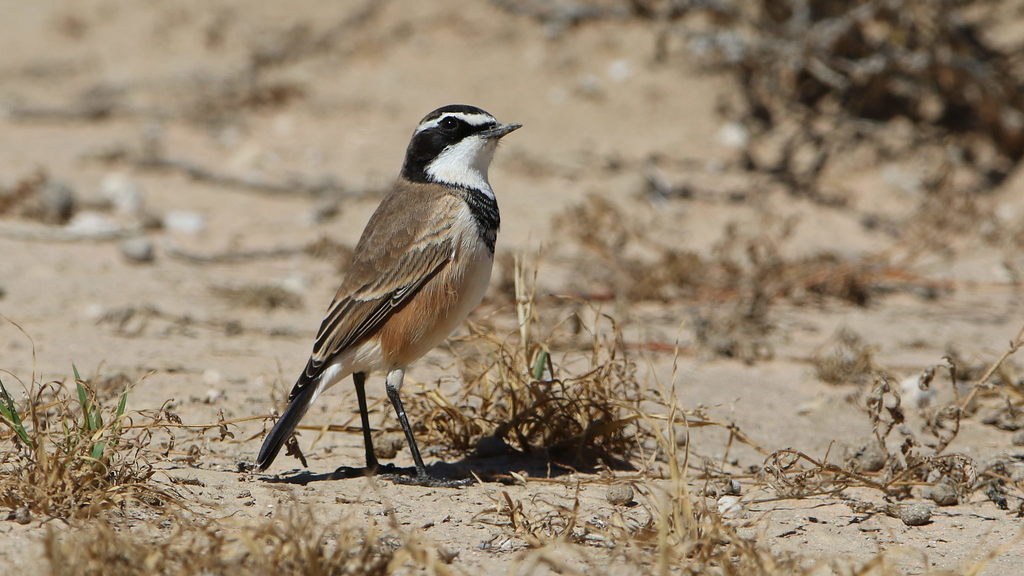
The capped wheatear (Oenanthe pileata) is a small insectivorous passerine bird that is widely distributed over southern Africa. It was formerly classed as a member of the thrush family Turdidae, but is now placed in the Old World flycatcher family, Muscicapidae.
From the article Capped wheatear on Wikipedia (CC BY-SA), quoted section by section
Description
The capped wheatear is 17–18 cm long and weighs 32 g. Its legs and pointed bill are black. This common species is striking and unmistakable in appearance. The adult has a black cap, cheeks and breast band, and white eye stripe and throat. The rest of the underparts are white with buff on the flanks and lower belly. Like other wheatears, it has a distinctive tail pattern with a black feathers on the base and centre of the tail forming an inverted T against the otherwise white rump. The juvenile has a brown cap and cheeks, and the breast band is weak and diffuse. However, the breast band, larger size, and white at the base of the outer tail feathers distinguish it from the migrant northern wheatear, which is rare over most of the capped wheatear's range.
Range & habitat
This wheatear is found in open dry sandy and stony habitats and short grassland with a few bushes and termite mounds in Africa, from Kenya and Angola south to the Cape. It is largely non-migratory, but undertakes seasonal movements.
Wikipedia: “Distribution and habitat”
What it does
The capped wheatear's song is a loud melodic warble interspersed with slurred chattering, and it has a chik-chik alarm call. It is monogamous and builds a nest of straw, grass, and leaves in a hole in the ground or a termite mound. It may use man-made drainage pipes if available. Typically three or four, sometimes more, eggs are laid. This solitary species feeds on insects, especially ants. Like other wheatears, it perches on mounds and hops over the short grass, or flies low over the ground.
Wikipedia: “Behaviour”
Listen
Looking for field recordings…
Where it lives
Recorded sightings
—
geo-referenced records in GBIF, from museums, herbaria and field observers.
Drag the globe to turn it. Dots are where records exist, not a range map; darker means more records.
In the stacks
Searching the stacks…
Every page naming Oenanthe pileata in the Biodiversity Heritage Library →
This page is assembled live from iNaturalist, GBIF, Wikipedia, the Source Library and the Internet Archive. It is not yet part of the hand-edited codex. iNaturalist taxon 12839.