- Animals
- ›Chordates
- ›Vertebrates
- ›Ray-finned Fishes
- ›Spiny-rayed fishes
- ›Anglerfishes
- ›Frogfishes
- ›Fibonacci frogfishes
- ›Antennarius
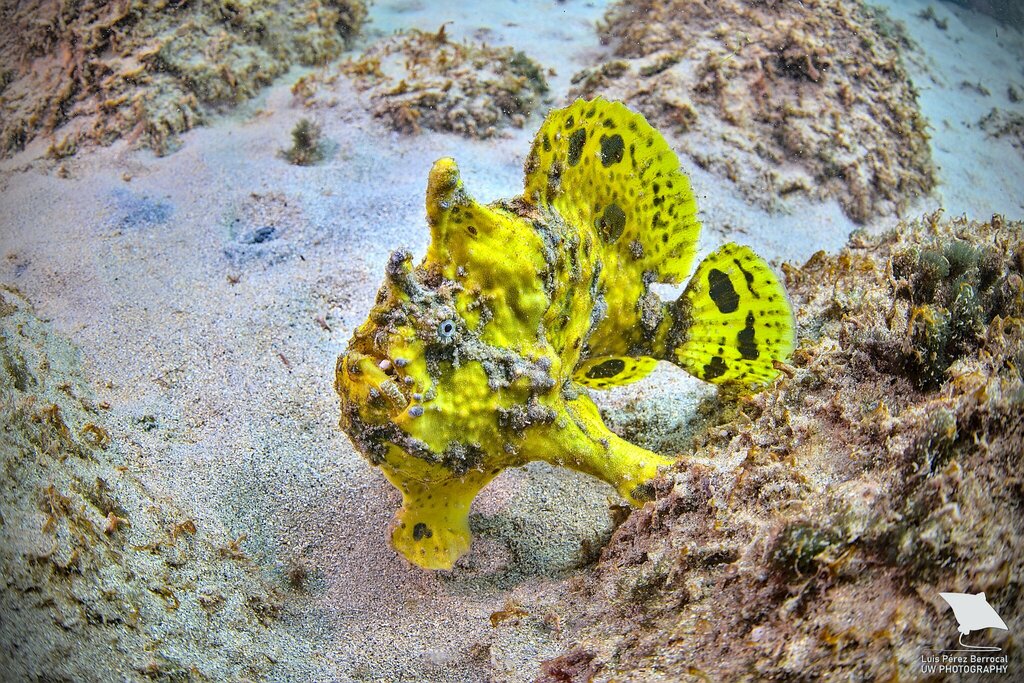
leopard frogfish
Antennarius pardalis
Antennarius pardalis, the leopard frogfish or peixe pescador, is a species of marine ray-finned fish belonging to the family Antennariidae, the frogfishes. This species is found in the eastern Atlantic Ocean.
From the article Antennarius pardalis on Wikipedia (CC BY-SA), quoted section by section
Description
Antennarius pardalis has the globose, short body covered in rough skin with closely set spinules typical of the genus Antennarius. The lobe of the pectoral fin has a broad connection to the body with pelvic fins are short, less than a quarter of the standard length. The illicium is long, roughly double the length of the second dorsal spine. The second dorsal spine is attached to the head by a membrane. The body and fins are typically marked with dark spots and ocelli, frequently with three spots on the caudal fin arranged in a triangular pattern. The dorsal fin contains between 11 and 14 soft rays while the anal fin contains between 6 and 10 soft rays. The large mouth has many small, bristle-like teeth. This species has a maximum published standard length of 10.2 cm (4.0 in).
Range & habitat
Antennarius pardalis is found in the eastern Atlantic Ocean along the western coast of Africa from southern Western Sahara to Angola, including Cape Verde and São Tomé and Príncipe. It is found in coastal waters at depths between 18 and 50 m (59 and 164 ft) on rocky reefs and rocky reefs.
Wikipedia: “Distribution and habitat”
In human culture
Antennarius pardalis has the genus name Antennarius which suffixes -ius to antenna, an allusion to first dorsal spine being adapted into a tentacle on the snout used as a lure to attract prey. The specific name pardalis means "leopard-like", a reference to the black spots and ocelli on the red body.
Wikipedia: “Etymology”
Where it lives
Recorded sightings
—
geo-referenced records in GBIF, from museums, herbaria and field observers.
Drag the globe to turn it. Dots are where records exist, not a range map; darker means more records.
In the stacks
Searching the stacks…
Every page naming Antennarius pardalis in the Biodiversity Heritage Library →
This page is assembled live from iNaturalist, GBIF, Wikipedia, the Source Library and the Internet Archive. It is not yet part of the hand-edited codex. iNaturalist taxon 128154.