On eBird ↗
Chiguanco Thrush
Live sightings near you, the range map, bar charts of when it is seen, and Macaulay Library photos and recordings.
Chiguanco Thrush
Turdus chiguanco
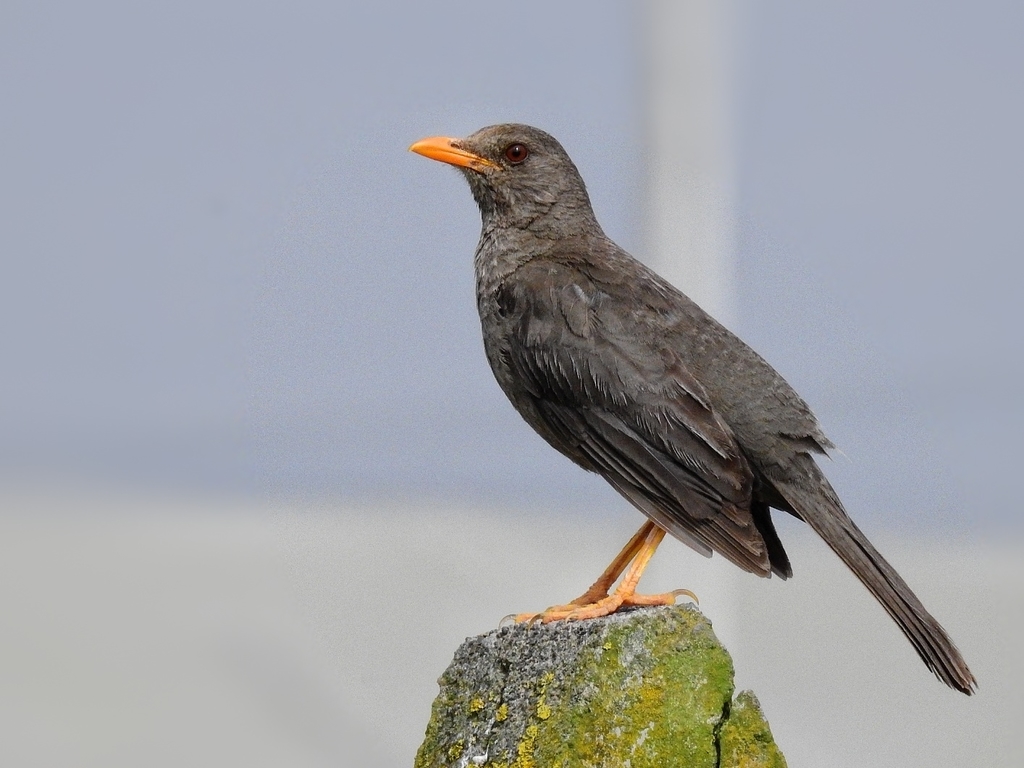
The Chiguanco thrush (Turdus chiguanco) is a species of bird in the family Turdidae. It is found in Ecuador and the Altiplano. Its natural habitats are subtropical or tropical high-altitude shrubland and heavily degraded former forest.
From the article Chiguanco thrush on Wikipedia (CC BY-SA), quoted section by section
Description
The Chiguanco thrush is 25 to 30 cm (9.8 to 12 in) long and weighs 75 to 120 g (2.6 to 4.2 oz). Adults of both sexes of the nominate subspecies T. c. chiguanco have a plain olive gray-brown head and upperparts, wings, and tail. Their underparts are slightly paler. They have a red to chestnut iris, a yellow bill, and yellow legs and feet. Juveniles are dull grayish olive with browner wings and tail than adults. They have pale spots on the wing coverts, pale buff streaks on the back, and buff to brown spots and streaks on the underparts. Subspecies T. c. conradi is larger and paler than the nominate but "not separable in the field". Adult males of T. c. anthracinus are almost entirely sooty black with a slightly paler throat and underparts. They have a yellow eye-ring and orange-yellow bill, legs, and feet. Adult females are overall dark brown or grayish brown with little difference between the upper- and underparts. Their eye-ring, bill, legs, and feet are paler than those of the male. Juveniles are warm brown that is darker above than below with chestnut spots on the wing coverts and pale spots and streaks on the underparts.
Range & habitat
The Chiguanco thrush has a disjunct distribution. The nominate subspecies is found from Pichincha Province in north-central Ecuador south to central Peru. Subspecies T. c. conradi is found from coastal Peru east into western Bolivia and south into extreme northern Chile. T. c. anthracinus is found from central Bolivia and northeastern Chile south to west-central Argentina with perhaps an extension from the last into central Chile. The Chiguanco thrush inhabits a variety of dry, somewhat open, landscapes. These include agricultural areas with scattered trees, gardens, scrubby deciduous woodland, thickets, montane scrublands, and Polylepis woodlands. Within them it often is along watercourses or in irrigated areas. In elevation in Ecuador it mostly ranges between 1,500 and 3,200 m (4,900 and 10,500 ft). In Peru it mostly is found above 1,600 m (5,200 ft) on the western Andean slope but occurs locally down to sea level. On the eastern slope it mostly is found between 2,400 and 4,300 m (7,900 and 14,100 ft) but has records down to 1,300 m (4,300 ft). In Bolivia it mostly occurs between 700 and 3,500 m (2,300 and 11,500 ft) but is known down to 550 m (1,800 ft).
Wikipedia: “Distribution and habitat”
What it does
The Chiguanco thrush feeds on insects, spiders, earthworms, and fruit. It usually is found alone or in pairs. It forages on the ground.
Wikipedia: “Feeding”
Listen
Looking for field recordings…
Where it lives
Recorded sightings
—
geo-referenced records in GBIF, from museums, herbaria and field observers.
Drag the globe to turn it. Dots are where records exist, not a range map; darker means more records.
In the stacks
Searching the stacks…
Every page naming Turdus chiguanco in the Biodiversity Heritage Library →
This page is assembled live from iNaturalist, GBIF, Wikipedia, the Source Library and the Internet Archive. It is not yet part of the hand-edited codex. iNaturalist taxon 12780.