On eBird ↗
Pale Thrush
Live sightings near you, the range map, bar charts of when it is seen, and Macaulay Library photos and recordings.
Pale Thrush
Turdus pallidus
The pale thrush (Turdus pallidus) is a passerine bird of the eastern Palearctic belonging to the genus Turdus in the thrush family Turdidae. It is closely related to the eye-browed thrush and grey-backed thrush.
From the article Pale thrush on Wikipedia (CC BY-SA), quoted section by section
Description
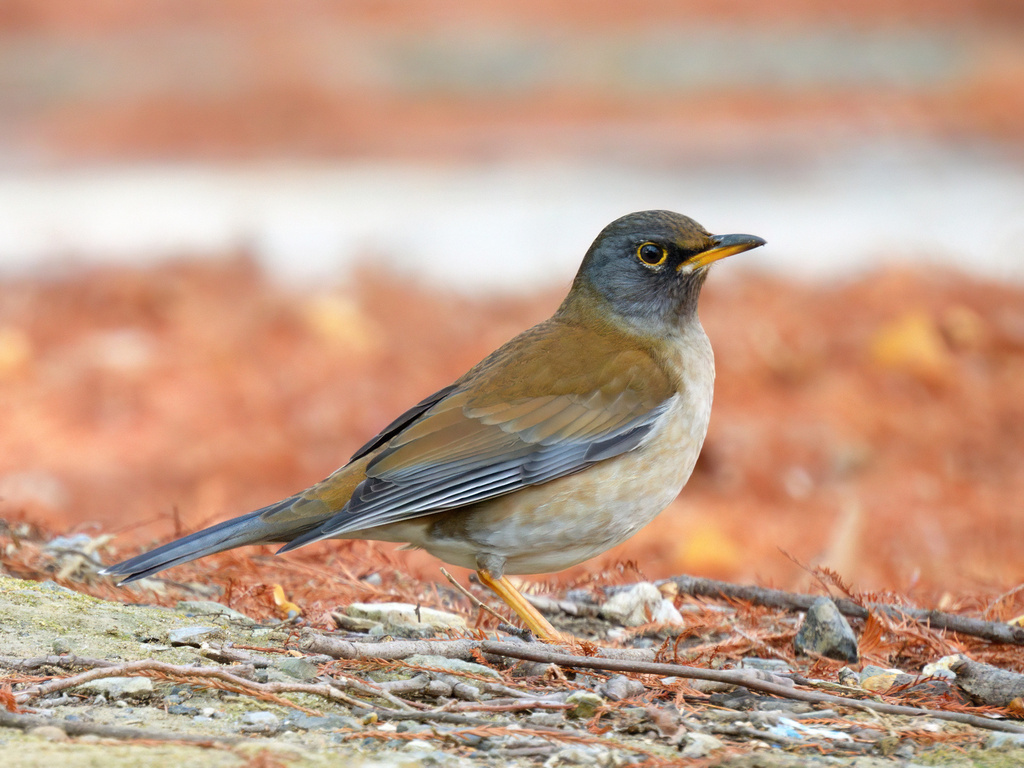
It is 23 cm long. The feet are pale pinkish-brown and the bill is grey above and yellow below. The male is brown above with a blue-grey head and throat. The underparts are pale brown, darker on the flanks and whitish on the belly and undertail-coverts. The flight feathers of the wing are dark grey and the underwing-coverts are grey or white. The tail is dark grey with white tips to the outer feathers. The female is similar to the male but duller with a browner head and pale throat. It has harsh chuck-chuck and see-ip calls and a bubbling alarm call.
Range & habitat
It breeds in south-east Siberia, north-east China and Korea and may breed in Japan, especially on Tsushima Island. It is largely migratory, wintering in southern and central Japan, South Korea and southern China, occasionally reaching as far as Yunnan, Taiwan and the Philippines. It inhabits forests, scrub, gardens and parks. It is a shy bird which keeps to cover. It can occur in large flocks on migration, particularly where there are berries.
Wikipedia: “Distribution and habitat”
Listen
Looking for field recordings…
Where it lives
Recorded sightings
—
geo-referenced records in GBIF, from museums, herbaria and field observers.
Drag the globe to turn it. Dots are where records exist, not a range map; darker means more records.
In the stacks
Searching the stacks…
Every page naming Turdus pallidus in the Biodiversity Heritage Library →
This page is assembled live from iNaturalist, GBIF, Wikipedia, the Source Library and the Internet Archive. It is not yet part of the hand-edited codex. iNaturalist taxon 12779.