On eBird ↗
White-eyed Thrush
Live sightings near you, the range map, bar charts of when it is seen, and Macaulay Library photos and recordings.
White-eyed Thrush
Turdus jamaicensis
The white-eyed thrush (Turdus jamaicensis) is a species of bird in the family Turdidae. It is found in the Cayman Islands and Jamaica. Its natural habitats are subtropical or tropical moist lowland forests, subtropical or tropical moist montane forests, and heavily degraded former forest.
From the article White-eyed thrush on Wikipedia (CC BY-SA), quoted section by section
Description
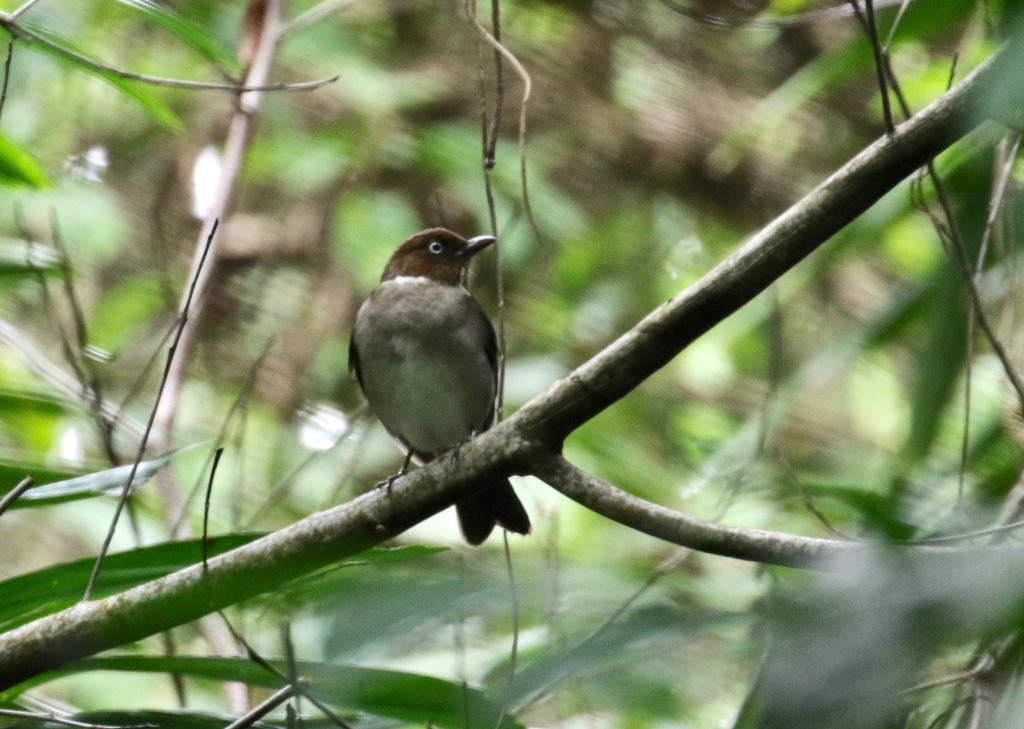
The white-eyed thrush is 23 to 24 cm (9.1 to 9.4 in) long and weighs about 59 g (2.1 oz). The sexes have the same plumage. Adults have a mostly reddish brown head with a white eye-ring and a white chin and throat streaked with chestnut-brown. Their upperparts, wings, and tail are slate gray. Their underparts are mostly pale gray-brown with a white crescent between the throat and breast and a white vent area. They have a dark iris, a blackish bill, and blackish legs and feet. Juveniles are similar to adults but with heavy darker streaks on the breast.
Range & habitat
The white-eyed thrush is found across most of Jamaica, shunning only the lowest areas. It inhabits wet forest in the foothills and mountains, other woodlands, and shade coffee plantations. In elevation it ranges from about 100 m (300 ft) up to the highest points on the island.
Wikipedia: “Distribution and habitat”
What it does
The white-eyed thrush feeds on a variety of fruits, insects, and other invertebrates such as worms. It forages from the forest floor, where it searches leaf litter, to the canopy.
Wikipedia: “Feeding”
Listen
Looking for field recordings…
Where it lives
Recorded sightings
—
geo-referenced records in GBIF, from museums, herbaria and field observers.
Drag the globe to turn it. Dots are where records exist, not a range map; darker means more records.
In the stacks
Searching the stacks…
Every page naming Turdus jamaicensis in the Biodiversity Heritage Library →
This page is assembled live from iNaturalist, GBIF, Wikipedia, the Source Library and the Internet Archive. It is not yet part of the hand-edited codex. iNaturalist taxon 12778.