On eBird ↗
White-chinned Thrush
Live sightings near you, the range map, bar charts of when it is seen, and Macaulay Library photos and recordings.
White-chinned Thrush
Turdus aurantius
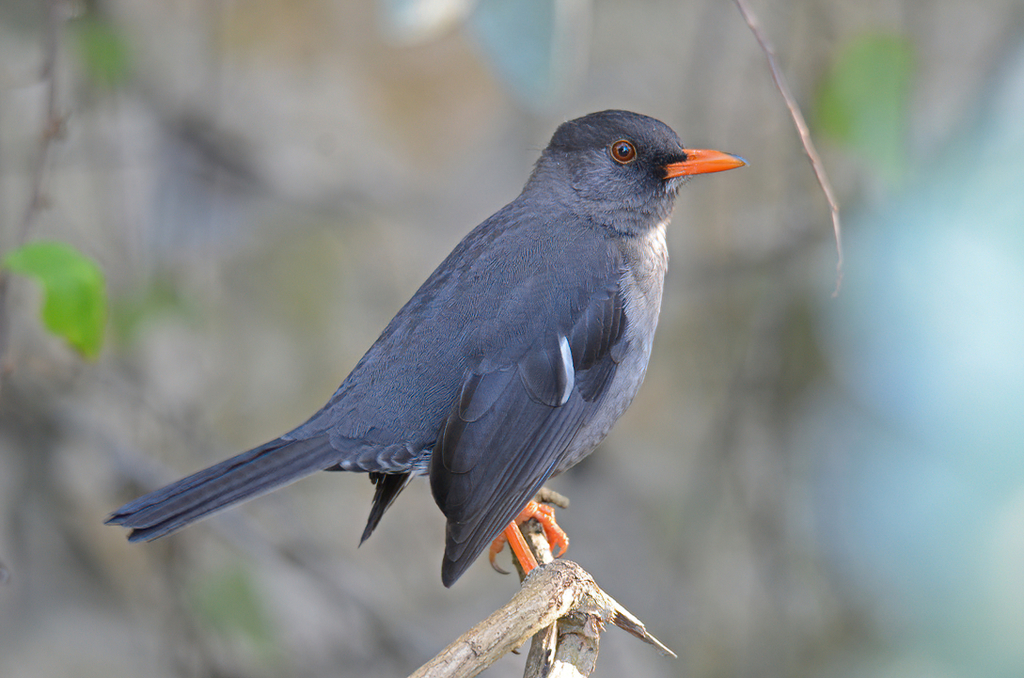
The white-chinned thrush, known in Jamaica as the hopping dick (Turdus aurantius) is a species of bird in the family Turdidae. It is endemic to Jamaica where it is common and widespread. Its natural habitats are subtropical or tropical moist lowland forests, subtropical or tropical moist montane forests, and heavily degraded former forest.
From the article White-chinned thrush on Wikipedia (CC BY-SA), quoted section by section
Description
The white-chinned thrush in 24–26.5 cm (9.4–10.4 in) in overall length. The sexes are similar in appearance. The face, crown and nape are black. The rest of the upperparts dark grey. Two small broad white edges to the innermost greater coverts form a small white wing patch. The chin is whitish but the rest of the underparts are mid-grey with the palest feathers on the belly. The bill, legs and feet are orange. The eye is brown. The only other thrush present in Jamaica is the white-eyed thrush. This lacks the white wing patch and the orange bill. Local names for the bird in Jamaica include hopping dick and chick-me-chick.
What it does
Breeding occurs between May and August. The nest is placed in a shrub and is an untidy cup of leaves, fibres and twigs that is lined with finer material. The clutch is 2–4 eggs which are dull whitish or pale green background with reddish brown spots. They are incubated by the female for 16 days. Two broods are usually raised.
Wikipedia: “Behaviour”
Listen
Looking for field recordings…
Where it lives
Recorded sightings
—
geo-referenced records in GBIF, from museums, herbaria and field observers.
Drag the globe to turn it. Dots are where records exist, not a range map; darker means more records.
In the stacks
Searching the stacks…
Every page naming Turdus aurantius in the Biodiversity Heritage Library →
This page is assembled live from iNaturalist, GBIF, Wikipedia, the Source Library and the Internet Archive. It is not yet part of the hand-edited codex. iNaturalist taxon 12777.