On eBird ↗
Gray-backed Thrush
Live sightings near you, the range map, bar charts of when it is seen, and Macaulay Library photos and recordings.
Grey-backed Thrush
Turdus hortulorum
The grey-backed thrush (Turdus hortulorum) is a species of bird in the family Turdidae. It breeds in eastern Manchuria and winters in southern China and northern Vietnam. Its natural habitat is temperate forests. A captive bred pair laid five eggs, which hatched 14 days after the first egg was laid. The young left the nest 12 days later.
From the article Grey-backed thrush on Wikipedia (CC BY-SA), quoted section by section
Description
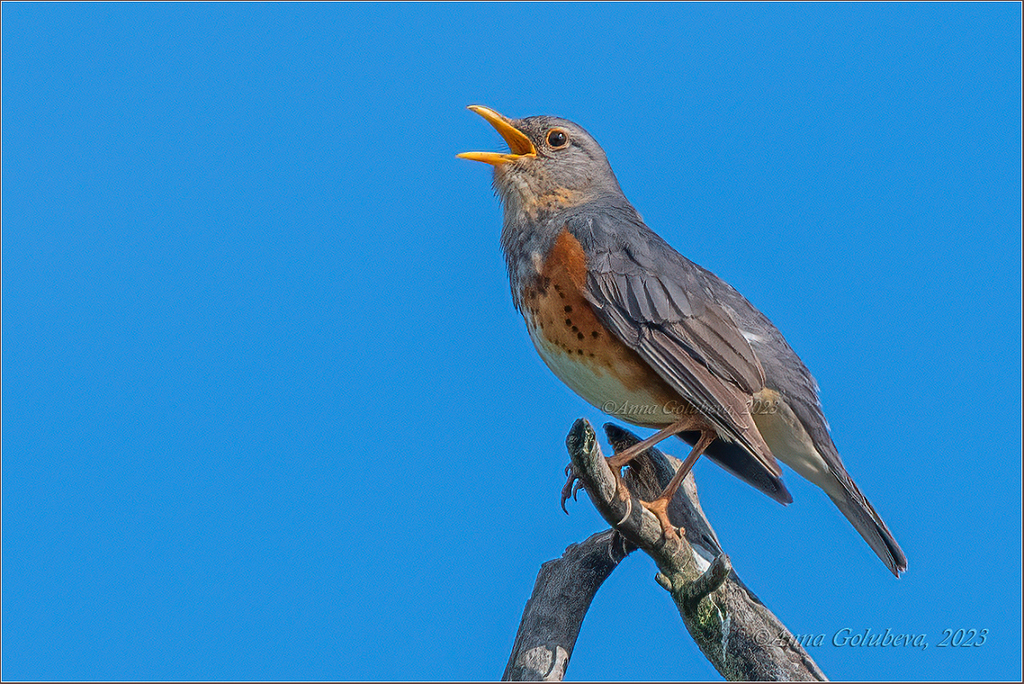
The grey-backed thrush is a medium-sized passerine measuring approximately 20 to 23 cm (7.9 to 9.1 in) in length. It is sexually dimorphic. Males have slate-grey upperparts and breast, a whitish chin and belly, and rufous-orange flanks. Females have greyer or browner upperparts, with dark spotting on the breast and similar rufous coloration on the flanks. The mean recorded body mass is 66.7 g (2.35 oz), with recorded individuals ranging from 61 to 69 g.
Range & habitat
The grey-backed thrush is monotypic. It breeds in southeastern Siberia, northeastern China and North Korea. In China, its breeding range is concentrated in the northeast, while wintering birds occur mainly south of the Yangtze River. It also winters in northern Vietnam. During the breeding season, the species inhabits deciduous and mixed forests, often in hilly terrain. A study of 79 nests in Jilin Province, northeastern China, found that nest placement and surrounding vegetation influenced breeding success. In winter it also occurs in more open woodland, bamboo and scrub habitats.
Wikipedia: “Distribution and habitat”
What it does
The grey-backed thrush forages on the ground, including in leaf litter along forest paths. Its diet includes both invertebrates and fruit. A study of breeding grey-backed thrushes in northeastern China monitored 79 nests during the 2008 breeding season. Of these, 29 were successful, while predation accounted for most nest failures. Another experimental study found that grey-backed thrushes rejected all 12 experimentally introduced foreign eggs, indicating a strong egg-recognition response. Captive breeding observations have recorded a clutch of five eggs, with hatching occurring 14 days after the first egg was laid and fledging 12 days later.
Wikipedia: “Behaviour and ecology”
Listen
Looking for field recordings…
Where it lives
Recorded sightings
—
geo-referenced records in GBIF, from museums, herbaria and field observers.
Drag the globe to turn it. Dots are where records exist, not a range map; darker means more records.
In the stacks
Searching the stacks…
Every page naming Turdus hortulorum in the Biodiversity Heritage Library →
This page is assembled live from iNaturalist, GBIF, Wikipedia, the Source Library and the Internet Archive. It is not yet part of the hand-edited codex. iNaturalist taxon 12770.