- Plants
- ›Vascular Plants
- ›flowering plants
- ›Dicots
- ›Sunflowers, Bellflowers, Fanflowers, and Allies
- ›Sunflowers, Daisies, Asters, and Allies
- ›Asteroideae
- ›Sunflowers and Allies
- ›Zinniinae
- ›Echinacea
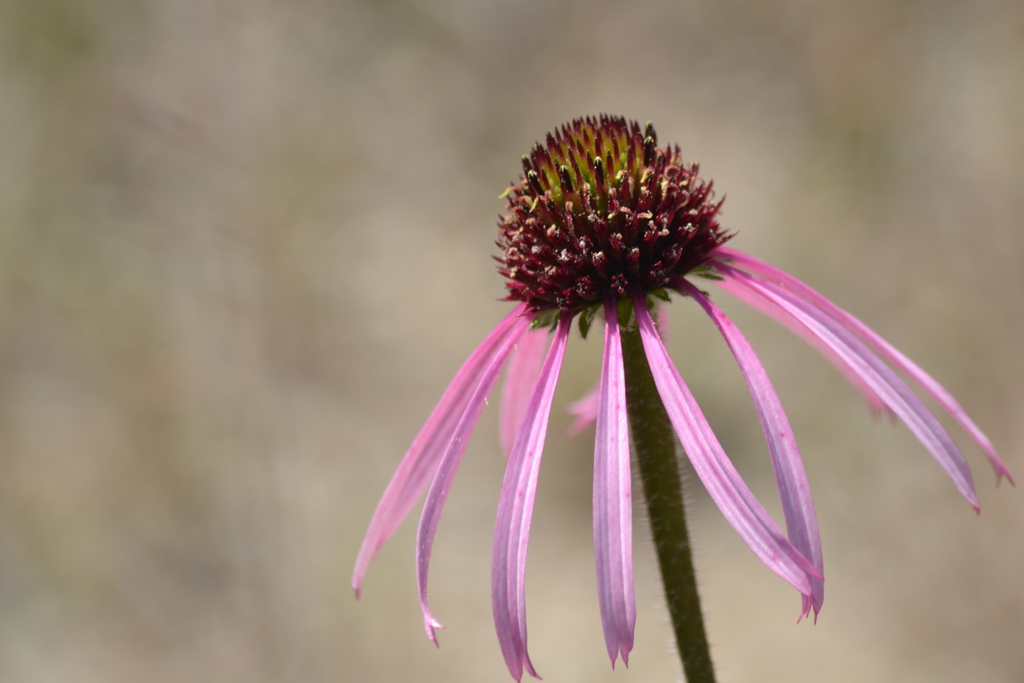
pale purple coneflower
Echinacea pallida
Echinacea pallida, commonly called pale purple coneflower, is a species of herbaceous perennial plant in the family Asteraceae. It is sometimes grown in gardens and used for medicinal purposes. Its native range is the central region of the United States, in the Mississippi Valley, the southeastern Great Plains, and the region south of Lake Michigan. Most of the known populations are in the region from southern Wisconsin and Iowa south to Louisiana and eastern Texas, with...
From the article Echinacea pallida on Wikipedia (CC BY-SA), quoted section by section
Description
Echinacea pallida is similar to E. angustifolia, but plants often grow taller, ranging from 1.5 to 2.5 ft (45 to 75 cm) tall, with some growing 3 ft (90 cm) or more tall. Plants normally grow with one unbranched stem in the wild, but often produce multi-stemmed clumps in gardens. They have deep taproots that are spindle shaped, wider in the center and narrowing at the ends. Stems are green or mottled with purple and green. The leaves are elongated lanceolate or linear-lanceolate with three veins and are concentrated at the base of the stem. Flower head rays are narrow, linear, elongated, and drooping, ranging from 1 to 3 inches (2.5 to 7.6 cm) long. The flower heads are from 3⁄4 to 3 inches (1.9 to 7.6 cm) wide with pale rose-purple or nearly white ray florets. The flowers have white pollen. Echinacea pallida blooms from May into July. The fruits are cypselae and are tan or bi-colored with angled edges.
Range & habitat
It is found in the Mississippi Valley, the southeastern Great Plains, and the region south of Lake Michigan. Most of the known populations are in the region from southern Wisconsin and Iowa south to Louisiana and eastern Texas, with additional reports (many of them likely from introductions) in the Southeastern United States, New England, New York, Michigan, and Ontario.
Wikipedia: “Distribution”
Where it lives
Recorded sightings
—
geo-referenced records in GBIF, from museums, herbaria and field observers.
Drag the globe to turn it. Dots are where records exist, not a range map; darker means more records.
In the stacks
Searching the stacks…
Every page naming Echinacea pallida in the Biodiversity Heritage Library →
This page is assembled live from iNaturalist, GBIF, Wikipedia, the Source Library and the Internet Archive. It is not yet part of the hand-edited codex. iNaturalist taxon 127689.