On eBird ↗
Ecuadorian Thrush
Live sightings near you, the range map, bar charts of when it is seen, and Macaulay Library photos and recordings.
Ecuadorian Thrush
Turdus maculirostris
The Ecuadorian thrush (Turdus maculirostris) is a resident bird found in western South America in western Ecuador and far northwestern Peru. It was formerly considered to be a subspecies of the spectacled thrush (yellow-eyed thrush), Turdus nudigenis, but has a narrower eyering, and is widely separated in range.
From the article Ecuadorian thrush on Wikipedia (CC BY-SA), quoted section by section
Description
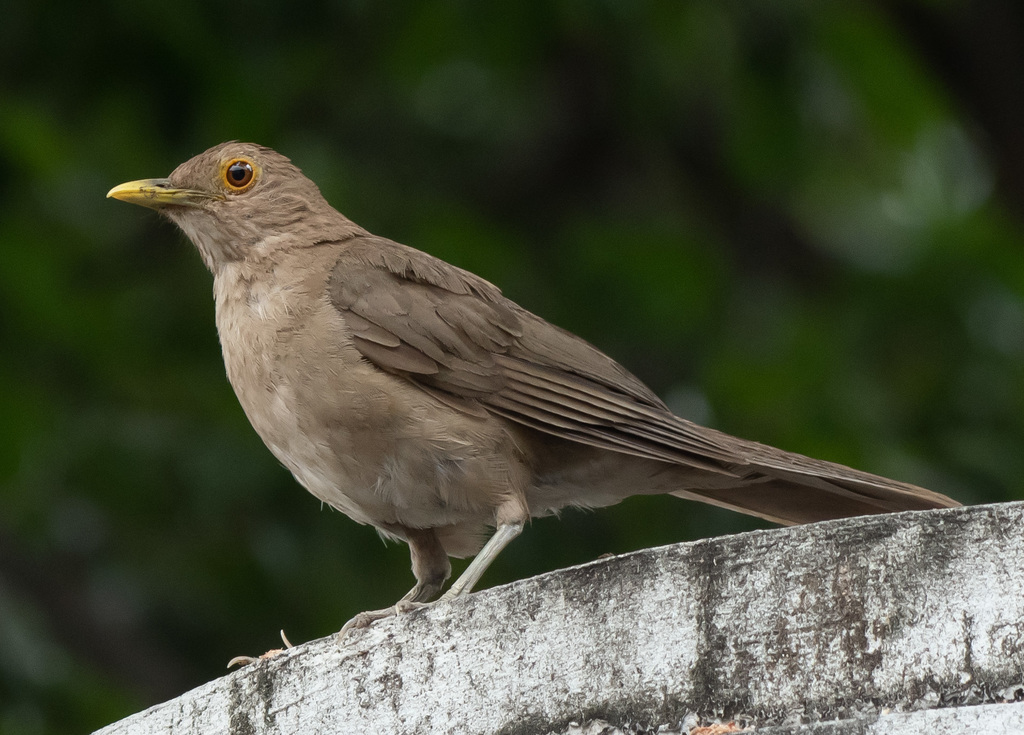
The Ecuadorian thrush is 21.5 to 23 cm (8.5 to 9.1 in) long and weighs 62 to 76 g (2.2 to 2.7 oz). The sexes have the same plumage. Adults have an olive-brown head with a faint yellow eye-ring. Their upperparts, wings, and tail are olive-brown. Their throat is white with dark streaks. Their breast and flanks are a paler olive-brown than their upperparts and their belly and vent are whitish. They have a dark iris, a dusky yellow bill, and olive-brownish legs and feet. Juveniles have thin buff streaks on their upperparts, wing bars of orangey spots, and dark brown mottling on their breast and flanks.
Range & habitat
The Ecuadorian thrush is found in western Ecuador from just south of the Colombian border south through the length of the country and into far northwestern Peru's Tumbes Department. In Ecuador it is found coastally and inland south to Santa Elena Province and beyond there into Peru only inland from the coast. In Ecuador it mostly ranges in elevation from sea level to 1,900 m (6,200 ft) and in Peru ranges between 400 and 750 m (1,300 and 2,500 ft). It inhabits a variety of somewhat open landscapes in the lowlands and subtropical zone. These include light forest and woodlands, clearings and edges of denser forest, and gardens near forest.
Wikipedia: “Distribution and habitat”
What it does
Little is known about the Ecuadorian thrush's diet or foraging behavior. It is known to forage mostly in trees.
Wikipedia: “Feeding”
Listen
Looking for field recordings…
Where it lives
Recorded sightings
—
geo-referenced records in GBIF, from museums, herbaria and field observers.
Drag the globe to turn it. Dots are where records exist, not a range map; darker means more records.
In the stacks
Searching the stacks…
Every page naming Turdus maculirostris in the Biodiversity Heritage Library →
This page is assembled live from iNaturalist, GBIF, Wikipedia, the Source Library and the Internet Archive. It is not yet part of the hand-edited codex. iNaturalist taxon 12762.