- Animals
- ›Arthropods
- ›Hexapods
- ›Insects
- ›Winged and Once-winged Insects
- ›Butterflies and Moths
- ›Geometrid and Swallowtail Moths
- ›Geometer Moths
- ›Carpet Moths
- ›Epirrhoini
- ›Epirrhoe
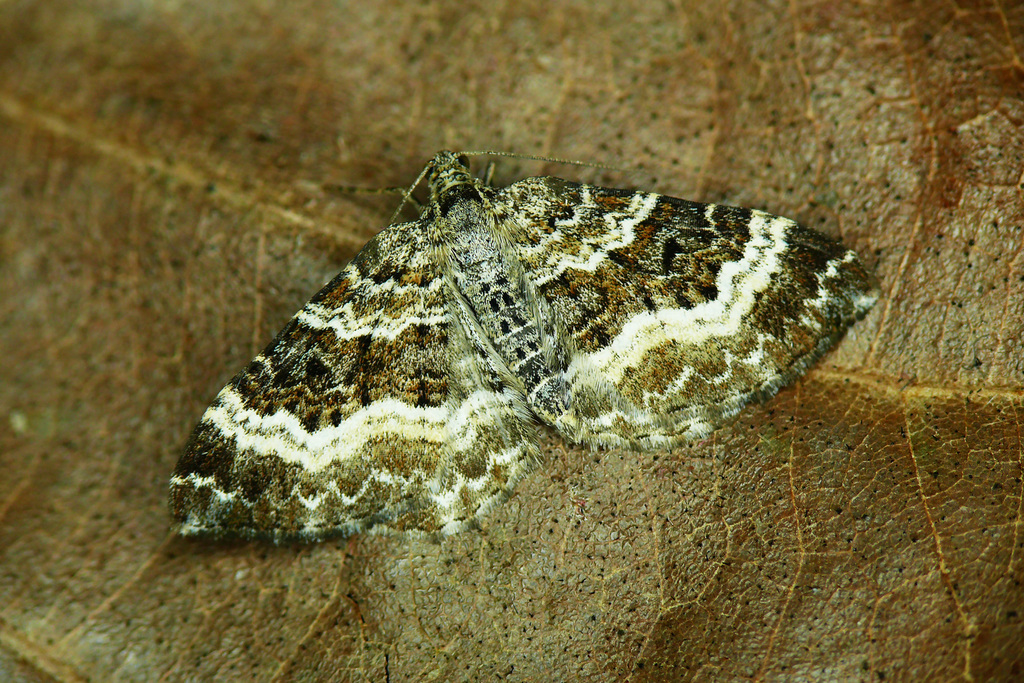
Common Carpet Moth
Epirrhoe alternata
The common carpet or white-banded toothed carpet (Epirrhoe alternata) is a moth of the family Geometridae. The species was first described by Otto Friedrich Müller in 1764. It is found throughout the Palearctic and the Near East. In North America it ranges across the northern tier of the United States plus every province and territory of Canada.
From the article Common carpet on Wikipedia (CC BY-SA), quoted section by section
Description
The wingspan is 27–30 mm. The forewings vary from grey to black, marked with white fascia, giving a striped appearance. The forewings are patterned grey at the base of the wings, after a narrow light fascia comes a wide, brown patterned band, which is followed by an almost pure, light band. Beyond it, on the outer edge of the wings, the wings are again dark brown and grey patterned. The outer dark fascia is intersected throughout its length by a grey line.The hindwings are paler grey with white fascia. Northern races tend to be paler overall. The central fascia varies in width; it is often contracted below the middle, sometimes completely severed at this point, and in ab. degenerata, Haworth, both portions are much reduced in width. There are brownish-grey examples from the Isle of Lewis; these are var. obscurata, South. There are intermediate modifications leading up to a form in which the whole of the central third of the fore wings is whitish, with the usual cross lines dingy grey, and some tiny clouds of the same colour around the black discal spot. The larva is generally brown or green but is very variable in its markings. It feeds on bedstraw. The species overwinters as a pupa.
What it does
One or two broods are produced each year, and the adults may be seen any time from May to September[1]. The species flies at night and is attracted to light.
^ The flight season refers to the British Isles. This may vary in other parts of the range.
Wikipedia: “Ecology”
Listen
Looking for field recordings…
Where it lives
Recorded sightings
—
geo-referenced records in GBIF, from museums, herbaria and field observers.
Drag the globe to turn it. Dots are where records exist, not a range map; darker means more records.
In the stacks
Searching the stacks…
Every page naming Epirrhoe alternata in the Biodiversity Heritage Library →
This page is assembled live from iNaturalist, GBIF, Wikipedia, the Source Library and the Internet Archive. It is not yet part of the hand-edited codex. iNaturalist taxon 127618.