On eBird ↗
Ring Ouzel
Live sightings near you, the range map, bar charts of when it is seen, and Macaulay Library photos and recordings.
Ring Ouzel
Turdus torquatus
The ring ouzel (Turdus torquatus) is a mainly European member of the thrush family Turdidae. It is a medium-sized thrush, 23–24 centimetres (9.1–9.4 in) in length and weighing 90–138 grams (3.2–4.9 oz). The male is predominantly black with a conspicuous white crescent across its breast. Females are browner and duller than males, and young birds may lack the pale chest markings altogether. In all but the northernmost part of its range, this is a high-altitude species, with three subspecies breeding in mountains from Ireland east to Iran. It breeds in open mountain areas with some trees or shrubs, the latter often including juniper and other treeline conifers, rowan, bilberry, heather, and hairy alpenrose. It is a migratory bird, leaving the breeding areas to winter in southern Europe, North Africa and Turkey, typically in mountains with junipers. The typical clutch is 3–6 brown-flecked pale blue or greenish-blue eggs. They are incubated almost entirely by the female, with hatching normally occurring after 13 days. The altricial, downy chicks fledge in another 14 days and are dependent on their parents for about 12 days after fledging.
The ring ouzel is omnivorous, eating invertebrates, particularly insects and earthworms, some small vertebrates, and a wide range of fruit. Most animal prey is caught on the ground. During spring migration and the breeding season, invertebrates dominate the adult's diet and are also fed to the chicks. Later in the year, fruit becomes more important, particularly the common juniper.
From the article Ring ouzel on Wikipedia (CC BY-SA), quoted section by section
Description
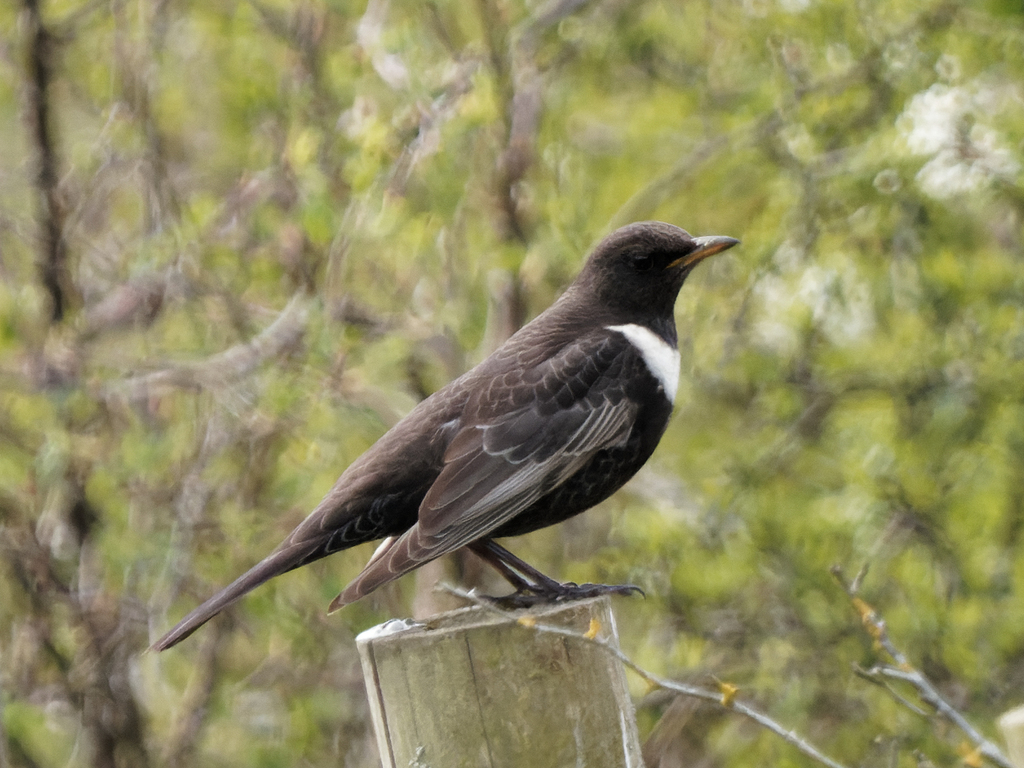
The ring ouzel is 23–24 centimetres (9.1–9.4 in) in length and weighs 90–138 grams (3.2–4.9 oz). The plumage of the male of the nominate race is entirely black except for a conspicuous white crescent on the breast, narrow greyish scaling on the upperparts and belly and pale edges to the wing feathers. The bill is yellow and the legs are greyish brown. The female resembles the male but is browner and with a duller breast band. Juveniles are like the female, but with a faint or non-existent breast crescent. The pale breast marking makes adults of this species unmistakeable; first-winter males also sometimes show a pale crescent. Other young ouzels can be confused with the common blackbird, but always show a paler wing panel than that species. Males of T. t. alpestris have broader white scalloping (repeated small curves) on their underparts than T. t. torquatus, giving a distinctly scaly appearance below. The wing panel is also paler than in the nominate subspecies. Females are much as the nominate race, but with broad white fringes on the chin and throat. Males of T. t. amicorum have the largest and whitest breast band of the three subspecies, and the broader white edges and tips of the wing feathers form a distinctive whitish panel in the wing. Females have narrow white fringes on their underparts. …
Range & habitat
The ring ouzel breeds discontinuously across western and northern Europe from northwest Ireland through Scandinavia to northwest Russia, and in mountains across central southern Europe from the Pyrenees through the Alps, the Balkans, Greece and Turkey east to Turkmenistan. In 2014, breeding was recorded on the Timan Ridge, Arkhangelsk Oblast, about 300 kilometres (190 mi) further east than previously known breeding sites in north Russia. The species is migratory, birds leaving the breeding areas in September and October. Birds of the nominate subspecies winter in southern Spain and northwest Africa. Central European populations of T. t. alpestris move to higher elevations initially before moving south or southwest through the Swiss Alps; some two weeks later migrants of the nominate subspecies pass through the same area to winter in the south of the breeding range or around the Mediterranean. Eastern T. t. alpestris ouzels migrate through the Balkans and Turkey. T. t. amicorum moves south to Egypt and neighbouring areas. The return migration is mainly in March and April, the males arriving some days before the females. Northern breeders arrive later, and in the mountains, some birds may ascend in stages as the snow melts. …
Wikipedia: “Distribution and habitat”
What it does
The ring ouzel is territorial and normally seen alone or in pairs, although loose flocks may form on migration. When not breeding, several birds may be loosely associated in good feeding areas, such as a fruiting tree, often with other thrushes such as song thrushes or redwings. The ouzel's flight is direct, and birds often perch on rocks or heather clumps.
Breeding. Ring ouzels nest from mid-April to mid-July in the Alps and the British Isles, and from May to August in Scandinavia. Territories may be strung out along streams, 160–200 metres (520–660 ft) apart and the ranges may overlap, but this species does not form breeding colonies. The nest, built by the female, is a cup of leaves, dry grass and other plant material consolidated with mud. In the west of the range nests are almost always built on the ground, but T. t. alpestris may also nest in a small tree or scrub at an average height of 3.5 metres (11 ft). The clutch is 3–6 pale blue or greenish-blue eggs flecked with reddish-brown. The eggs are 30 mm × 22 mm (1.18 in × 0.87 in) in size and weigh 7.4 grams (0.26 oz) of which 6% is shell. Incubation is almost always by the female, hatching typically occurring after 13 days. The altricial, downy chicks fledge in another 14 days. …
Wikipedia: “Behaviour”
In human culture
"Ouzel" is an old name for the common blackbird, the word being cognate with the German Amsel. "Ouzel" may also be applied to a group of superficially similar but more distantly related birds, the dippers, the European representative of which was sometimes known as the "water ouzel". "Ring Ouzel" was first used by John Ray in his 1674 Collection of English Words not Generally Used and became established with his 1678 book The Ornithology of Francis Willughby of Middleton in the County of Warwick. As with the English term, the scientific name also refers to the male's prominent white neck crescent, being derived from the Latin words turdus, "thrush", and torquatus, "collared". Old and local names for the ring ouzel include "fell blackbird", "hill blackbird", "moor blackbird", "rock ouzel" and "mountain blackbird".
Wikipedia: “Etymology”
Listen
Looking for field recordings…
Where it lives
Recorded sightings
—
geo-referenced records in GBIF, from museums, herbaria and field observers.
Drag the globe to turn it. Dots are where records exist, not a range map; darker means more records.
In the old herbals & bestiaries

In the stacks
Searching the stacks…
Every page naming Turdus torquatus in the Biodiversity Heritage Library →
This page is assembled live from iNaturalist, GBIF, Wikipedia, the Source Library and the Internet Archive. It is not yet part of the hand-edited codex. iNaturalist taxon 12740.