On eBird ↗
Pale-breasted Thrush
Live sightings near you, the range map, bar charts of when it is seen, and Macaulay Library photos and recordings.
Pale-breasted Thrush
Turdus leucomelas
The pale-breasted thrush (Turdus leucomelas) is a species of bird in the family Turdidae. It is found in every mainland South American country except Chile and Ecuador.
From the article Pale-breasted thrush on Wikipedia (CC BY-SA), quoted section by section
Description
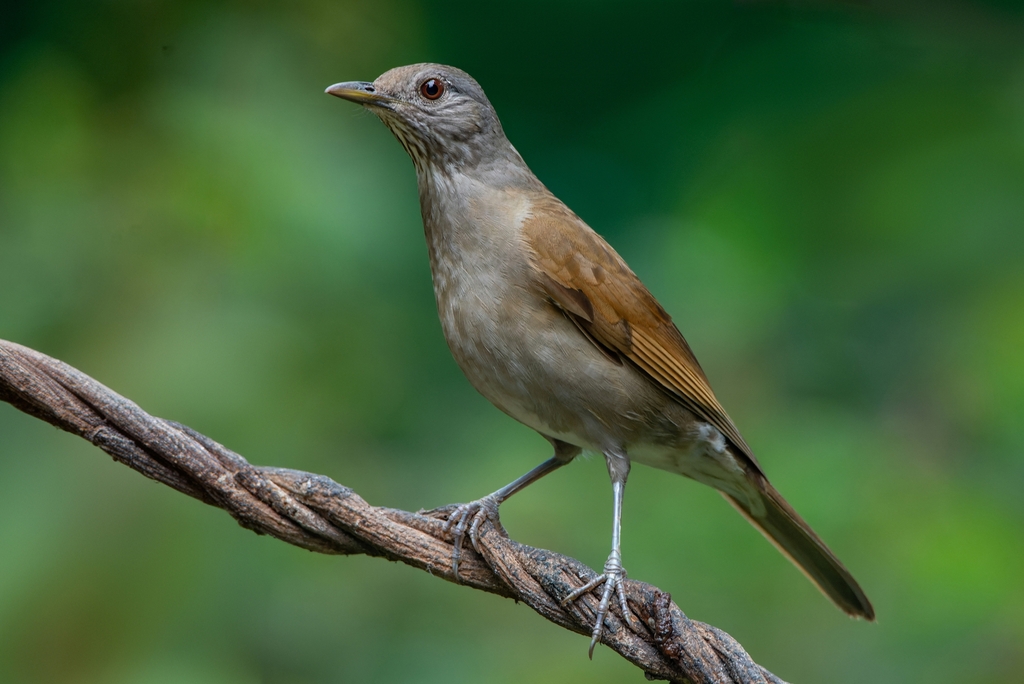
The pale-breasted thrush is 23 to 27 cm (9.1 to 11 in) long and weighs 47 to 78 g (1.7 to 2.8 oz). The sexes have essentially the same plumage, though females sometimes have darker heads than males. Adults of the nominate subspecies T. l. leucomelas have a medium gray crown and whitish-streaked grayish ear coverts. Their upperparts, wings, and tail are generally pale olive brown. Their wing coverts and the edges of their secondaries are slightly rustier and their primaries and tail are somewhat darker. Their throat is whitish with thin brown streaks, their breast and flanks pale grayish buff, and their belly to vent whitish. Juveniles resemble adults with the addition of buff streaks and spots on their upperparts and brownish mottling on their underparts. All subspecies have a dark iris, a greenish yellow bill, and light brown legs and feet. The other subspecies differ from the nominate and each other thus:
T. l. albiventer: smaller than nominate with a more ashy-gray head, back, and rump and less rust in the wing T. l. cautor: brown back and wings intermediate between nominate and albiventer T. l. upichiarum: similar to albiventer but smaller and darker, more uniform head-to-rump color, and darker gray underparts
Range & habitat
The subspecies of the pale-breasted thrush are found thus:
T. l. albiventer: northern (except Guajira Peninsula) and northeastern Colombia; from eastern Colombia across most of the northern half of Venezuela; southeastern Venezuela; and east across the Guianas and northern Brazil including along the lower Amazon River T. l. cautor: extreme northern Colombia's Guajira Peninsula T. l. upichiarum: southeastern Colombia T. l. leucomelas: extreme southeastern Peru east through central and eastern Bolivia into Brazil; Brazil south of a line roughly from southern Rondônia northeast to northern Maranhão; eastern Paraguay, northeastern Argentina, and northeastern Uruguay; separately in extreme northern Peru The pale-breasted thrush inhabits a wide variety of landscapes, most of which are somewhat open. They include the edges and openings of extensive forest, the interior of more open forest and woodland, secondary forest, savanna, gallery forest, palm groves, plantations such as those of shade coffee, other cultivated areas, parks, gardens, and yards. To be attractive the last four require enough shrubs to provide shade. In elevation in Colombia it ranges up to 1,800 m (5,900 ft), in Venezuela north of the Orinoco River to 2,000 m (6,600 ft) and to 1,900 m (6,200 ft) south of it, and in Brazil mostly to 1,500 m (4,900 ft) and locally higher. …
Wikipedia: “Distribution and habitat”
What it does
The pale-breasted thrush feeds mostly on fruits but includes much smaller amounts of insects, worms, and small lizards in its diet. It feeds on both wild and cultivated fruits. It takes fruit in trees and also feeds on fallen fruit on the ground.
Wikipedia: “Feeding”
Listen
Looking for field recordings…
Where it lives
Recorded sightings
—
geo-referenced records in GBIF, from museums, herbaria and field observers.
Drag the globe to turn it. Dots are where records exist, not a range map; darker means more records.
In the stacks
Searching the stacks…
Every page naming Turdus leucomelas in the Biodiversity Heritage Library →
This page is assembled live from iNaturalist, GBIF, Wikipedia, the Source Library and the Internet Archive. It is not yet part of the hand-edited codex. iNaturalist taxon 12737.