On eBird ↗
Sooty Thrush
Live sightings near you, the range map, bar charts of when it is seen, and Macaulay Library photos and recordings.
Sooty Thrush
Turdus nigrescens
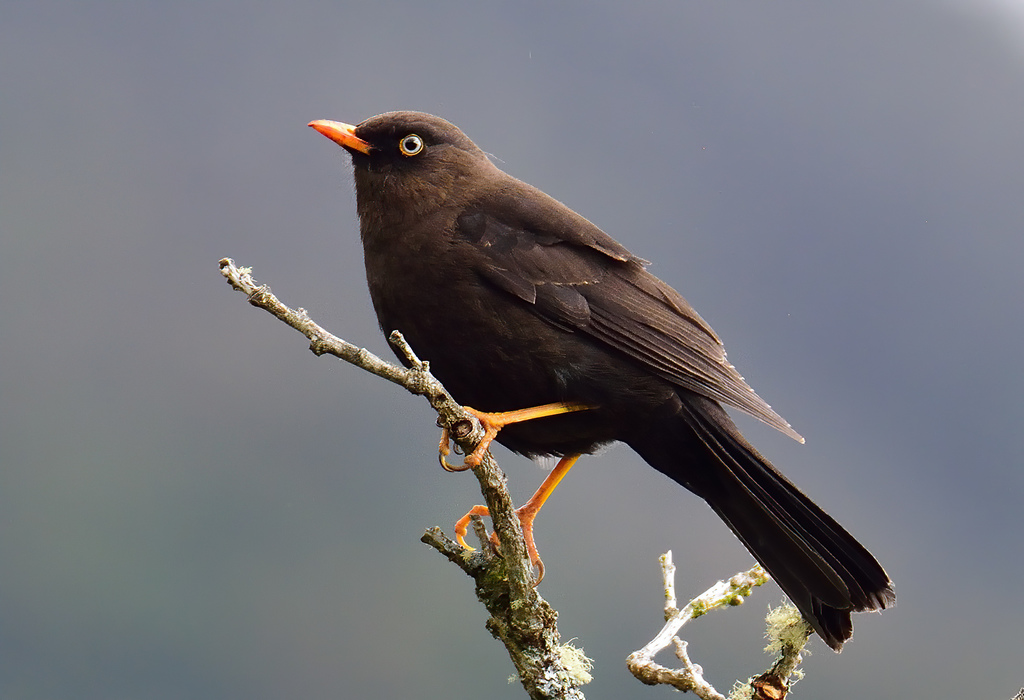
The sooty thrush (Turdus nigrescens) is a species of bird in the family Turdidae, the thrushes and allies. It is found in Costa Rica and Panama. It was formerly known as the sooty robin.
From the article Sooty thrush on Wikipedia (CC BY-SA), quoted section by section
Description
The sooty thrush is 24 to 25.5 cm (9.4 to 10 in) long and weighs about 96 g (3.4 oz). The species is sexually dimorphic. Adult males have a mostly brownish black head and body with sooty black lores and an orange eye-ring. Their wings and tail are also sooty black. Adult females resemble males but are browner overall and sometimes have some darker streaks on the throat. Both sexes have a white iris, a yellow-orange bill, and orange legs and feet. Juveniles have dark brown upperparts with buff streaks and buff underparts with dark brown spots. They have a white chin, a pale iris, and a brownish yellow bill, legs, and feet. The superficially similar mountain thrush (T. plebejus) shares its range but is uniformly brown with dark bare parts. It also resembles the slaty-backed nightingale-thrush (Catharus fuscater) but there is no range overlap.
Range & habitat
The sooty thrush has a disjunct distribution. It is found in Costa Rica's Cordillera Central and Cordillera de Talamanca; the latter range extends into far western Panama's Chiriquí Province. In the Cordillera Central it occurs on volcanos separated by low passes, and a major valley separates them from the Cordillera de Talamanca. The sooty thrush inhabits the edges of montane evergreen forest, semi-humid to humid montane scrublands, and second-growth scrublands in the subtropical and temperate zones. The scrubby areas include páramo, bogs, and pastures. In elevation it ranges from 2,150 to 3,500 m (7,100 to 11,500 ft) but is most common above 2,400 m (7,900 ft).
Wikipedia: “Distribution and habitat”
What it does
The sooty thrush feeds on a variety of insects, spiders, and fruits and berries. It forages mostly on the ground in open areas and along the forest edge. It pokes into grass clumps and flips leaves with its bill. It usually forages in small loose flocks.
Wikipedia: “Feeding”
Listen
Looking for field recordings…
Where it lives
Recorded sightings
—
geo-referenced records in GBIF, from museums, herbaria and field observers.
Drag the globe to turn it. Dots are where records exist, not a range map; darker means more records.
In the stacks
Searching the stacks…
Every page naming Turdus nigrescens in the Biodiversity Heritage Library →
This page is assembled live from iNaturalist, GBIF, Wikipedia, the Source Library and the Internet Archive. It is not yet part of the hand-edited codex. iNaturalist taxon 12736.