- Animals
- ›Arthropods
- ›Hexapods
- ›Insects
- ›Winged and Once-winged Insects
- ›Grasshoppers, Crickets, and Katydids
- ›Grasshoppers, Locusts, and Allies
- ›Grasshoppers
- ›Short-horned Grasshoppers and Locusts
- ›Short-horned Grasshoppers
- ›Slant-faced Grasshoppers
- ›Gomphocerini
- ›Chorthippus
- ›Glyptobothrus
- ›Chorthippus brunneus
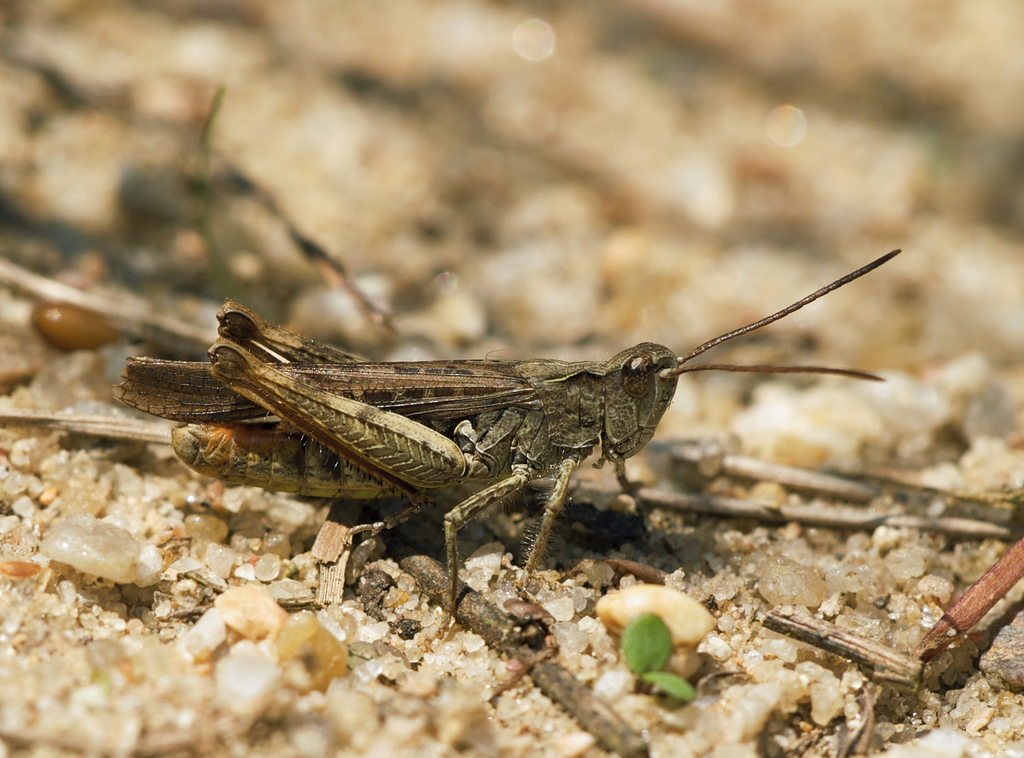
Common Field Grasshopper
Chorthippus brunneus
Chorthippus brunneus, a member of the subfamily Gomphocerinae, are more commonly referred to as the common field grasshopper. They were first described by Thunberg in 1815 and also are known as Gryllus brunneus although this name is not adopted in the literature. The IUCN lists C. brunneus as Least Concern.
From the article Chorthippus brunneus on Wikipedia (CC BY-SA), quoted section by section
Description
C. brunneus are predominantly brown. However, they show a large variation in colour and can also be black, green, purple, or white. Wing patterns vary between individuals and can be mottled, striped, striped-mottled, or plain. Both green and purple grasshoppers tend to have plain forewing patterns while black grasshoppers primarily have mottled forewing patterns. Brown grasshoppers do not consistently have the same forewing pattern instead they have variable forewing patterns. At least two loci are responsible for pronotum color in C. brunneus. Green alleles are dominant to all other colors while brown alleles are recessive to all other colors. Wing pattern is determined by a separate locus than colour. The plain forewing pattern is dominant and the striped and mottled forewing patterns are codominant.
Wikipedia: “Appearance”
Range & habitat
C. brunneus are found in Europe, north Africa, and temperate Asia. They prefer dry habitats. They are present in higher numbers in heathland areas compared to agricultural areas. This can be explained by the difference in sward height in the two areas. C. brunneus prefer habitats with sward heights of 100 to 200 mm and fine leaved grass species. In fact a positive correlation between C. brunneus and both Agrostis species and Festuca species exists. Fine leaved grass species and taller sward heights occur more commonly in heathlands where less human alteration of the land occurs compared to agricultural sites. Sward height also influences abundance. A greater number of C. brunneus are found in taller swards although some scientific literature suggests C. brunneus thrives in wastelands. Vertebrate grazing also influences C. brunneus density by directly influencing sward height. Ungrazed areas have higher densities of C. brunneus than grazed areas. Vertebrate grazing is thought to alter plant hormones two of which are known to effect fecundity, abscisic acid, and gibberellins. Additionally grazing results in the production of proteinase inhibitors in plants and the alteration of nitrogen levels. In areas that experience less vertebrate grazing C. brunneus have increased rates of development, higher adult weights, and increased fecundity.
Wikipedia: “Habitat and range”
Listen
Looking for field recordings…
Where it lives
Recorded sightings
—
geo-referenced records in GBIF, from museums, herbaria and field observers.
Drag the globe to turn it. Dots are where records exist, not a range map; darker means more records.
In the stacks
Searching the stacks…
Every page naming Chorthippus brunneus in the Biodiversity Heritage Library →
This page is assembled live from iNaturalist, GBIF, Wikipedia, the Source Library and the Internet Archive. It is not yet part of the hand-edited codex. iNaturalist taxon 127308.