On eBird ↗
Clay-colored Thrush
Live sightings near you, the range map, bar charts of when it is seen, and Macaulay Library photos and recordings.
Clay-colored Thrush
Turdus grayi
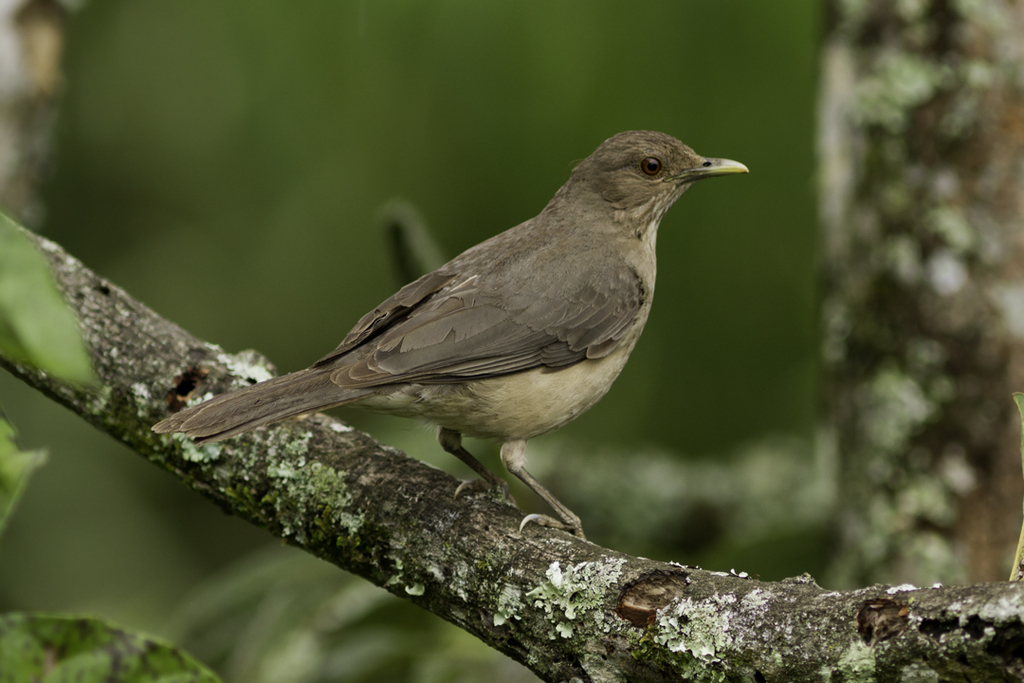
The clay-colored thrush (Turdus grayi) is a common Middle American bird of the thrush family (Turdidae). It is the national bird of Costa Rica, where it is well known as the yigüirro (Spanish: [ʝi'ɣwiro]). Other common names include clay-colored robin.
From the article Clay-colored thrush on Wikipedia (CC BY-SA), quoted section by section
Description
In general appearance and habits it resembles other Turdus thrushes such as the American robin. It is about the same length or slightly smaller: 23–27 cm (9.1–10.6 in), and weighs 74–76 g (2.6–2.7 oz) on average. The plumage is brownish, somewhat lighter below than above, lightest on the flanks. Birds from humid regions are darker than those from dry regions. The throat is faintly streaked. Immature birds have faint mottling on the back and underparts. The bill is greenish-yellow with a dark base, the legs are pinkish or flesh-colored, and the irises are reddish—all useful identification points.
Call. The song, rather low-pitched and with a slow steady tempo, consists of many slurred musical phrases which are often repeated irregularly. The tock flight call is like the American robin's but harsher. T. grayi's dry season mating call is quite region-specific, with noticeable differences in calls just a few hundred miles apart. Alexander Skutch (1904-2004), a naturalist and writer, described the birds call in his book, "A Guide to the Birds of Costa Rica," as "a long-continued caroling of varied phrases, mostly rich and melodious, containing slurred whistles, warbles, short trills, and now and then dry, piercing notes. The song is said by local people to 'call the rains,' and has earned the yigüirro its status as Costa Rica's national bird.".
Diet. …
Range & habitat
It ranges from South Texas (where it is rapidly expanding its range) to northern Colombia. West and north of the Isthmus of Tehuantepec, it is limited to the Atlantic slope, except for a population around Oaxaca City, Mexico that probably originates from escaped cage birds. In much of its range it is familiar in yards and gardens, similar to some other thrushes such as the American robin, the Eurasian blackbird, and the song thrush.
Wikipedia: “Distribution and habitat”
In human culture
In 1977, Costa Ricans chose the yigüirro as a national symbol (over many much more colorful birds that inhabit the country) due to its strong and melodious song that always comes during the start of the rainy season. In addition, unlike many of the forest songsters of Costa Rica, the present bird has been familiar to the general population since the country's early history, thanks to the species' tendency to live near houses and settlements.
Wikipedia: “Culture”
Listen
Looking for field recordings…
Where it lives
Recorded sightings
—
geo-referenced records in GBIF, from museums, herbaria and field observers.
Drag the globe to turn it. Dots are where records exist, not a range map; darker means more records.
In the stacks
Searching the stacks…
Every page naming Turdus grayi in the Biodiversity Heritage Library →
This page is assembled live from iNaturalist, GBIF, Wikipedia, the Source Library and the Internet Archive. It is not yet part of the hand-edited codex. iNaturalist taxon 12720.