On eBird ↗
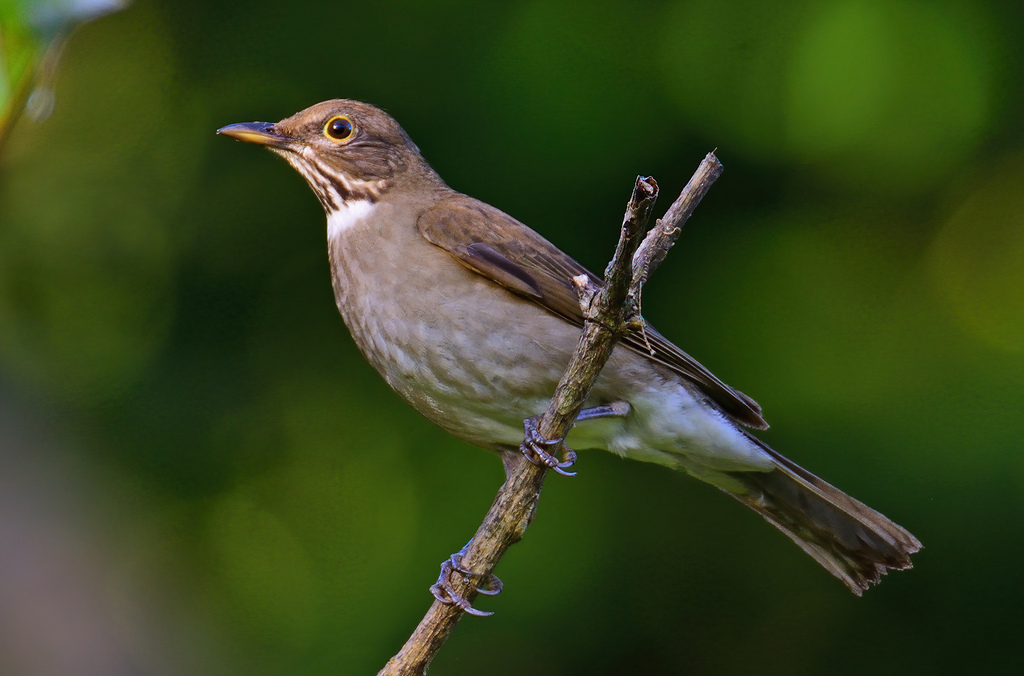
White-throated Thrush
Live sightings near you, the range map, bar charts of when it is seen, and Macaulay Library photos and recordings.
White-throated Thrush
Turdus assimilis
The white-throated thrush (Turdus assimilis) is a species of bird in the family Turdidae. It is found in Central America. Its natural habitats are subtropical or tropical dry forests, subtropical or tropical moist lowland forests, and subtropical or tropical moist montane forests. It is common in its range and an extremely rare vagrant into Texas; 2 sightings have been recorded (in 1990 and 1998).
From the article White-throated thrush on Wikipedia (CC BY-SA), quoted section by section
Description
The white-throated thrush is 22 to 26.5 cm (8.7 to 10.4 in) long and weighs about 61 to 90 g (2.2 to 3.2 oz). The sexes have the same plumage. Adults of the nominate subspecies T. a. assimilis have a somewhat rusty brown head, upperparts, wings, tail. They have a yellow eye-ring. Their throat is white with dark brown streaks and a white crescent below it. Their breast is pale olive-brown that becomes whitish from the middle of the belly to the vent. Their undertail coverts are white. They have a reddish brown iris, a dark maxilla, a mixed yellow and dark mandible, and dirty yellow legs and feet. The other subspecies of the white-throated thrush differ from the nominate and each other thus:
T. a. calliphthongus: paler overall than nominate T. a. lygrus: paler but warmer brown than nominate T. a. suttoni: paler than nominate; darker crown and back than lygrus T. a. leucauchen: blacker upperparts than nominate; darker and browner underparts but less so than rubicundus; bright yellow eye-ring, bill, legs, and feet T. a. hondurensis: essentially like rubicundus T. a. benti: essentially like rubicundus T. a. rubicundus: most reddish brown upperparts of all; darker and browner underparts than nomimate; bright yellow eye-ring, bill, legs, and feet T. a. atrotinctus: deep slaty to blackish upperparts and deep gray underparts; bright yellow eye-ring, bill, legs, and feet T. a. …
Range & habitat
The white-throated thrush has a disjunct distribution. The subspecies are found thus:
T. a. calliphthongus: northwestern Mexico from southeastern Sonora to northeastern Sinaloa and Chihuahua T. a. lygrus: central and southern Mexico T. a. suttoni: eastern Mexico T. a. assimilis: eastern Mexico from southern Tamaulipas to eastern México, northern Oaxaca, and western Veracruz T. a. leucauchen: Gulf/Caribbean slope from Veracruz south through Belize, Guatemala, and Honduras into north-central Nicaragua T. a. hondurensis: central Honduras T. a. benti: southwestern El Salvador T. a. rubicundus: Pacific slope of Guatemala and El Salvador T. a. atrotinctus: Caribbean side of Honduras and northern Nicaragua T. a. cnephosus: southwestern Costa Rica into western Panama's Chiriquí and Veraguas provinces T. a. campanicola: central Panama T. a. croizati: Azuero Peninsula in south-central Panama T. a. coibensis: Coiba Island and nearby islets off western Panama White-throated thrushes have also been documented in the United States, 18 times in Texas since the country's first in 1990 and twice in Arizona. The white-throated thrush's habitat varies geographically and between the breeding and non-breeding seasons. Overall it generally occurs in wooded habitats. …
Wikipedia: “Distribution and habitat”
What it does
The white-throated thrush feeds on fruit, insects, and other invertebrates such as worms. It typically forages near or on the ground but will ascend into fruiting trees. In the breeding season it typically forages in pairs. During the non-breeding season is often is in small flocks that may include several species. It occasionally attends army ant swarms.
Wikipedia: “Feeding”
Listen
Looking for field recordings…
Where it lives
Recorded sightings
—
geo-referenced records in GBIF, from museums, herbaria and field observers.
Drag the globe to turn it. Dots are where records exist, not a range map; darker means more records.
In the stacks
Searching the stacks…
Every page naming Turdus assimilis in the Biodiversity Heritage Library →
This page is assembled live from iNaturalist, GBIF, Wikipedia, the Source Library and the Internet Archive. It is not yet part of the hand-edited codex. iNaturalist taxon 12711.