On eBird ↗
Creamy-bellied Thrush
Live sightings near you, the range map, bar charts of when it is seen, and Macaulay Library photos and recordings.
Creamy-bellied Thrush
Turdus amaurochalinus
The creamy-bellied thrush (Turdus amaurochalinus) is a species of bird in the family Turdidae. It occurs in a wide range of wooded habitats in a large part of central and eastern South America. It is generally common, even in human altered habitats such as gardens and parks. While the plumage varies from overall greyish to brownish, and the bill from dusky to yellow, adult creamy-breasted thrushes always have distinctive blackish lores. This separates it from other...
From the article Creamy-bellied thrush on Wikipedia (CC BY-SA), quoted section by section
Description
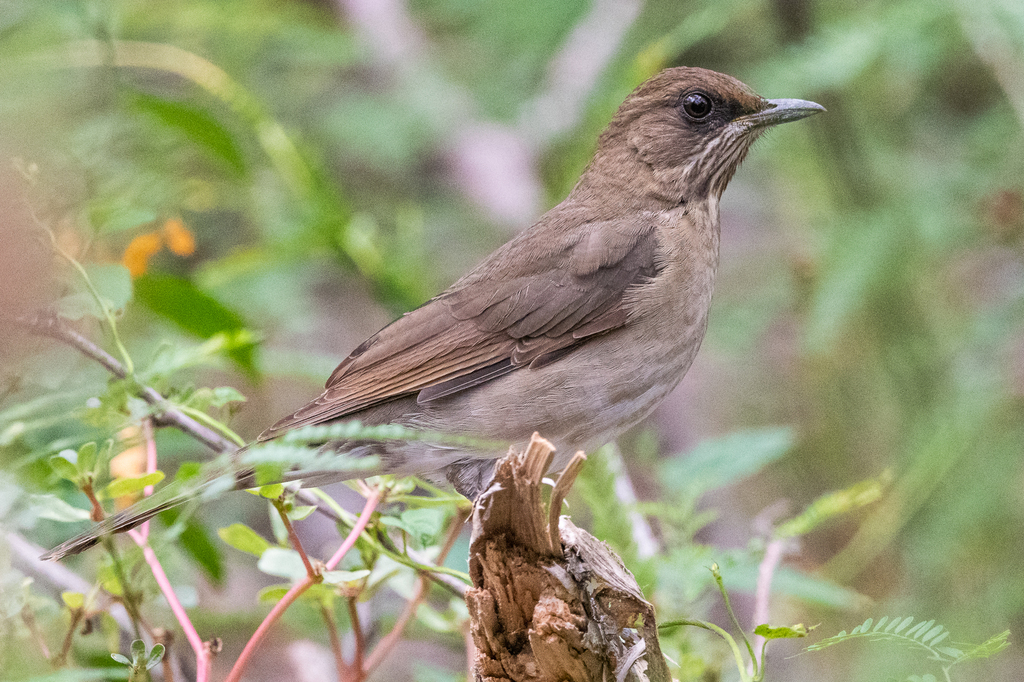
The creamy-bellied thrush is 22 to 25 cm (8.7 to 9.8 in) long and weighs 52 to 73 g (1.8 to 2.6 oz). The sexes have the same plumage. Adults have a mostly olive-brown head with black lores and a brown-streaked white throat. Their upperparts, wings, and tail are the same olive-brown as the head. Their breast and flanks are usually grayish buff that becomes creamy white on the belly and undertail coverts. (Some individuals have pure gray instead of grayish buff underparts.) They have a dark iris, a yellowish bill when breeding and a darker one otherwise, and drab brown legs and feet. Juveniles have dark brown upperparts with buff spots and streaks, mostly brown-mottled buff underparts, and a white chin and belly.
Range & habitat
The creamy-bellied thrush is found from extreme eastern Ucayali and eastern Madre de Dios departments in southeastern Peru east across Brazil roughly following a line from southern Acre to central Tocantins and from there north to the Atlantic in Pará. From there its range continues south through the rest of Brazil, eastern Bolivia, Paraguay, and Uruguay into Argentina. In Argentina it occurs along the eastern slope of the Andes south to Río Negro Province and on the Atlantic to Buenos Aires Province. It has also been recorded as a vagrant in Chile and on the Falkland Islands. The creamy-bellied thrush inhabits a wide variety of semi-open to open landscapes. These include cerrado, light forest and woodland, the edges of denser forest, middle-aged secondary forest, scrublands and thorny thickets, and human-modified areas such as farmland, parks, and gardens. It is primarily a bird of the lowlands and reaches its highest elevation of 2,600 m (8,500 ft) in Bolivia.
Wikipedia: “Distribution and habitat”
What it does
The creamy-bellied thrush feeds on invertebrates and fruit. It forages mostly in trees but will do so on the ground near cover.
Wikipedia: “Feeding”
Listen
Looking for field recordings…
Where it lives
Recorded sightings
—
geo-referenced records in GBIF, from museums, herbaria and field observers.
Drag the globe to turn it. Dots are where records exist, not a range map; darker means more records.
In the stacks
Searching the stacks…
Every page naming Turdus amaurochalinus in the Biodiversity Heritage Library →
This page is assembled live from iNaturalist, GBIF, Wikipedia, the Source Library and the Internet Archive. It is not yet part of the hand-edited codex. iNaturalist taxon 12710.