- Plants
- ›Vascular Plants
- ›flowering plants
- ›Dicots
- ›Mints, Plantains, Olives, and Allies
- ›Mint Family
- ›Viticoideae
- ›Vitex
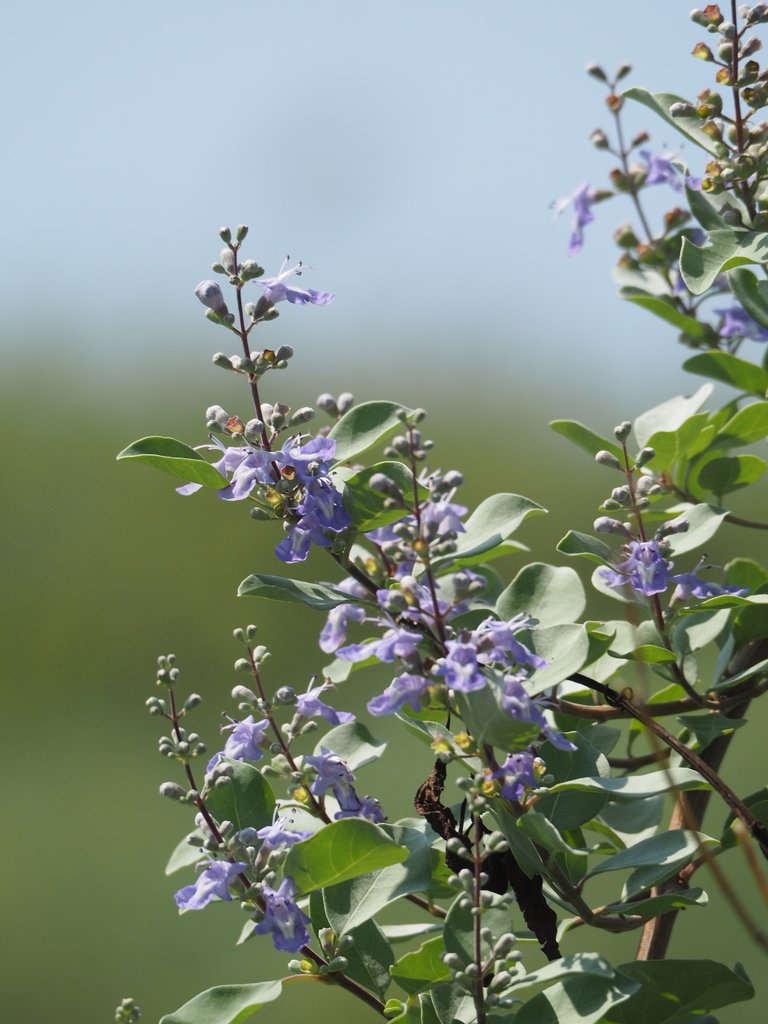
Beach Vitex
Vitex rotundifolia
Vitex rotundifolia, the roundleaf chastetree or beach vitex, is a species of flowering plant in the sage family Lamiaceae. It is native to seashores throughout the Pacific. Its range includes continents and islands stretching from India east to Hawaii and from Korea south to Australia. This shrub typically grows approximately 1 m in height. It has a sprawling growth habit and produces runners that root regularly at nodes. This rooting pattern allows the plant to spread rapidly. At maturity, V. rotundifolia produces blue-purple flowers that are borne in clusters and ultimately yield small brown-black fruits. Its leaves are rounded at the tips with green upper surfaces and silver lower surfaces. While the plant is a seashore obligate, it grows over a wide latitude range. It has been used for medicinal purposes throughout its native range. More recently, it was imported to the eastern United States where it has become a seashore invasive. Control efforts are presently underway to protect the fragile beach dune ecosystem.
From the article Vitex rotundifolia on Wikipedia (CC BY-SA), quoted section by section
Description
Vitex rotundifolia is a sprawling shrub that can grow as tall as 1.5 m though it typically ranges from 0.5 to 1 m in height. As a product of its rapid nodal rooting, the plant can form dense mats reaching in excess of 10 m from the parent plant.
Stems. New stems are green, square and fleshy initially before maturing brown and woody. Older, large-diameter stems are covered with heavily fissured bark. Running horizontal stems produce frequent upright branches. Leaves are strongly aromatic, intensifying when crushed.
Leaves. The majority of leaves are simple, but they can occasionally be palmate trifoliate or 2-leaved. Leaves measure 2 to 6.5 cm in length and 1–4.5 cm in width. Leaf margins are entire. The leaf shape varies from ovate to obovate with acute bases and obtuse apices. Occasionally, leaf apexes are acute or emarginate. Upper leaf surfaces are dark green whereas lower leaf surfaces range in color from silver to white to light green; all leaf surfaces are tomentose. Petiole bases are typically somewhat purple and measure 0 to 1 cm in length. Blades are cupped downward slightly. Leaf veins are lighter green than surrounding tissue.
Flowers. The flowers are borne in indeterminate panicles that may be terminal or axillary. Inflorescences measure 3 to 7 cm in length. The calyx is cup-shaped and 4 to 4.5 cm long. …
Range & habitat
V. rotundifolia grows along sandy and rocky coasts from 0 to 15 m above sea level. Plants grow down to the ocean waves themselves. V. rotundifolia is highly tolerant of the harsh beach dune environment characterized by intense heat, high wind, coarse-textured soil, and elevated salinity. This plant's natural range includes much of the Pacific Rim and many of the Pacific islands. The plant was observed by Munir from Northern and Western Australia, New Guinea, Indonesia, New Caledonia, Polynesia, Hawaii, Malaya, Philippines, and Hong Kong. Moldenke reported V. rotundifolia in Brazil, Mauritius, Reunion, Bangladesh, Sri Lanka, Andaman Islands, China, Taiwan, Japan, Ryukyu Islands, Korea, Indochina, Thailand, Borneo, and Sarawak. The plant has also been observed in southern India. Cultivation of V. rotundifolia has been reported in England, Florida, Germany, the Hawaiian Islands, Hong Kong, Java, Johnston Island, Maryland, and New York. At present in the United States, beach vitex has become naturalized only in southeastern states along the east and gulf coasts.
Wikipedia: “Distribution and habitat”
What it does
Beach vitex is a perennial that grows throughout the summer months in temperate and tropical areas of the Pacific. In temperate areas, the plant is deciduous and loses its leaves during the cool nights of fall. In the southeastern United States, leaves emerge in April while flowering occurs from June–August with fruiting following shortly thereafter. Fruits may remain attached to the plant into the early spring. V. rotundifolia is capable of overwintering on the dunes in South and North Carolina and in gulf coastal areas. It can survive in USDA hardiness zones 6b to 10.
Growth. The plant grows rapidly, and reproduces through vegetative means. As the plant matures, it begins to flower. After maturation, the plant produces large numbers of fruits (up to 5581 fruits per square meter).
Pollination. Insect visitation is the likely method of pollen transfer due to the spatial separation of the anthers and stigma, which would make self-pollination unlikely. Abe reported V. rotundifolia flowers on Nishino-shima Island were visited by flies, honey bees, beetles, butterflies, and ants though most of the visitors were ants. Diverse groups of pollinators visit the flowers in search of the 0.5 μL per flower nectar reward. Due to this wide range of visitors, it is unlikely the plant would require a specialist insect to mediate successful pollination.
Dormancy. …
Wikipedia: “Biology and ecology”
At the table
Vitex rotundifolia has many medicinal uses. These uses generally parallel those of Vitex agnus-castus.
Wikipedia: “Medicinal uses”
Where it lives
Recorded sightings
—
geo-referenced records in GBIF, from museums, herbaria and field observers.
Drag the globe to turn it. Dots are where records exist, not a range map; darker means more records.
In the stacks
Searching the stacks…
Every page naming Vitex rotundifolia in the Biodiversity Heritage Library →
This page is assembled live from iNaturalist, GBIF, Wikipedia, the Source Library and the Internet Archive. It is not yet part of the hand-edited codex. iNaturalist taxon 126845.