On eBird ↗
Ferruginous Partridge
Live sightings near you, the range map, bar charts of when it is seen, and Macaulay Library photos and recordings.
Ferruginous Partridge
Caloperdix oculeus
The ferruginous partridge (Caloperdix oculeus) is a species of bird in the family Phasianidae. It belongs to the monotypical genus Caloperdix. It is found in Indonesia, Malaysia, Myanmar, and Thailand.
From the article Ferruginous partridge on Wikipedia (CC BY-SA), quoted section by section
Description
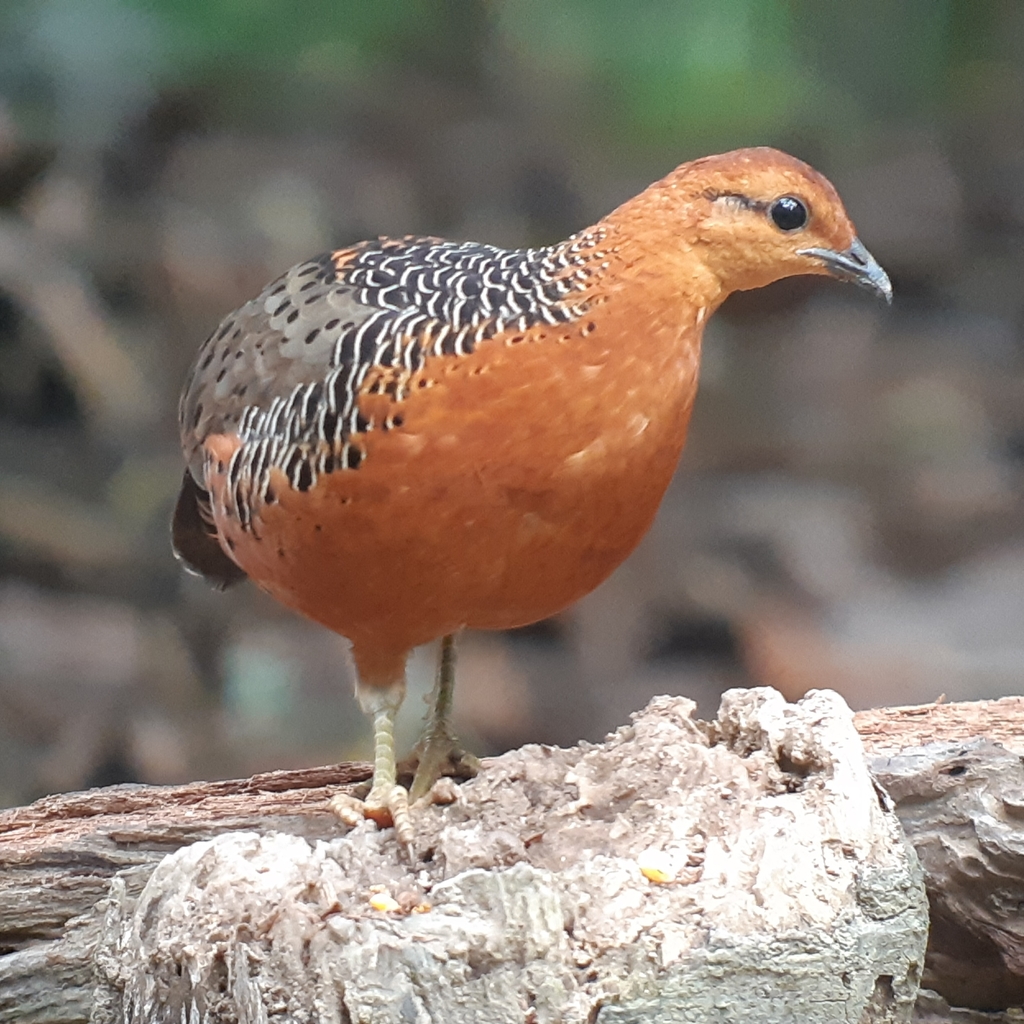
The ferruginous partridge measures from 27 to 32 cm (11–13 in) in length and weighs between 191–230 g (6.7–8.1 oz). The plumage is distinctive, having a rufous head, breast and belly and black scaled with white upper back and sides of breast and flanks. The wings are brown with black spots, and the rest of the back is black scaled with rufous. The sexes are similar except the male has two spurs and the female just one.
Range & habitat
The ferruginous partridge is found in a variety of habitats, including tropical dry forest and tropical moist lowland forest, secondary scrub and secondary bamboo growth. It is found from sea-level to 1,200 m (3,900 ft). The ferruginous partridge ranges from southern Myanmar through the Kra Isthmus into the Malay Peninsula, as well as Borneo and Sumatra.
Wikipedia: “Distribution and habitat”
What it does
The ferruginous partridge forages in small pairs or alone for seeds, fruits, grasses and insects. Very little is known about its breeding behaviour; the clutch size is 8-10 pure white eggs laid in a domed nest.
Wikipedia: “Behaviour”
Listen
Looking for field recordings…
Where it lives
Recorded sightings
—
geo-referenced records in GBIF, from museums, herbaria and field observers.
Drag the globe to turn it. Dots are where records exist, not a range map; darker means more records.
In the stacks
Searching the stacks…
Every page naming Caloperdix oculeus in the Biodiversity Heritage Library →
This page is assembled live from iNaturalist, GBIF, Wikipedia, the Source Library and the Internet Archive. It is not yet part of the hand-edited codex. iNaturalist taxon 1267.