- Animals
- ›Chordates
- ›Vertebrates
- ›Ray-finned Fishes
- ›Spiny-rayed fishes
- ›Cichlids and Allies
- ›Cichlids
- ›South and Central American Cichlids
- ›Cichla
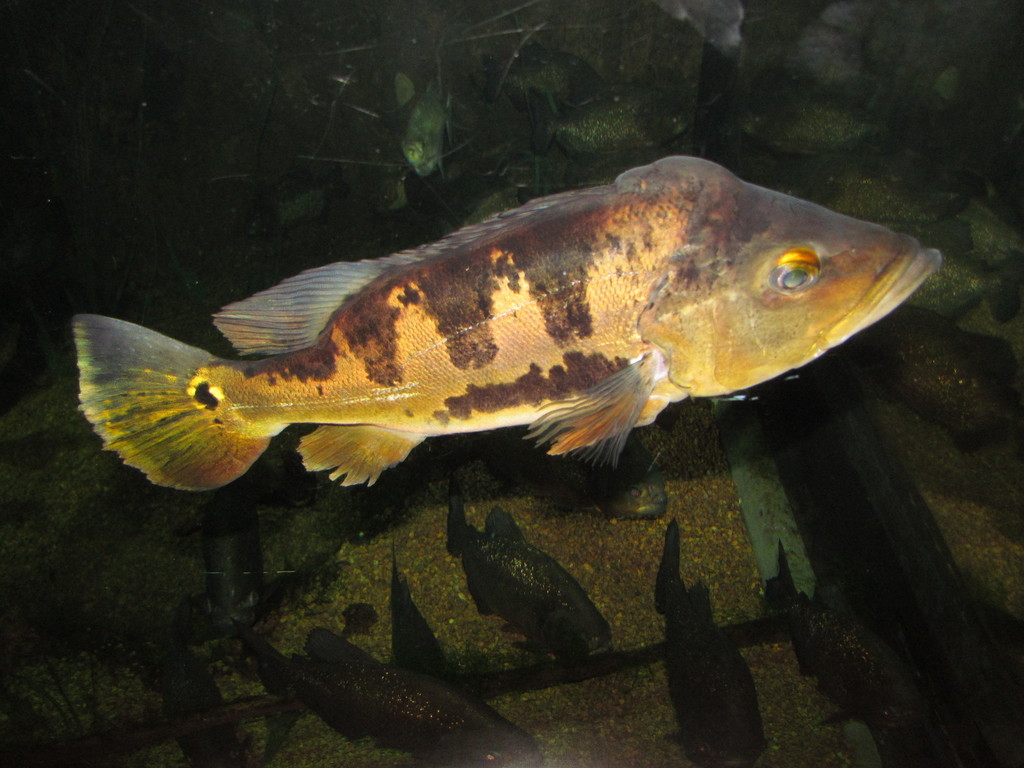
Butterfly Peacock Bass
Cichla ocellaris
Cichla ocellaris, sometimes known as the butterfly peacock bass ("peacock bass" is also used for some of its relatives), is a very large species of cichlid from South America, and a prized game fish. It reaches 74 cm (29 in) in length. It is native to the Marowijne and Essequibo drainages in the Guianas, and the Branco River in Brazil. It has also been introduced to regions outside its natural range (e.g., Florida, Hawaii, and Puerto Rico), but some uncertainty exists over the exact identity, and at least some of the introductions may involve another Cichla species or hybrids. It is frequently confused with C. monoculus. Studies conclude that the introduction of Cichla ocellaris does not negatively impact fish communities in Florida, making it an effective fisheries management tool.
From the article Cichla ocellaris on Wikipedia (CC BY-SA), quoted section by section
Description
Similarly shaped in body size compared to the largemouth bass, the butterfly peacock bass can reach lengths of up to 29 in (740 mm), but averages 12–14 in (300–360 mm) in length. Body and fin colors range from yellows, greens, and light red to orange. While color is extremely variable, the most prominent physical characteristics are the three vertical black lines along the sides of the body. With having the tendency to fade, these lines may not be found on some older fish. The common name of the fish originates from the black spot with a yellow halo surrounding. This spot is located on the caudal fin and resembles the feathers of a peacock.
Wikipedia: “Appearance and identification”
Range & habitat
Native to the tropical Americas, the true Cichla ocellaris is restricted to the Guianas. The species thrives in warm, slow-moving bodies of water including lakes, ponds, canals, and rock pits. Like other species of bass, they tend to inhabit shaded areas under trees, bridges, and culverts. Butterfly peacock bass cannot survive in salinities exceeding 18 ppt, nor can they live in temperatures less than 60 degrees Fahrenheit.
Wikipedia: “Origins and habitat”
What it does
The introduction of the butterfly peacock bass to Florida has successfully aided in managing and controlling tilapia and oscar populations that once were a threat via overpopulation. The fish primarily feeds on fish allowing for them to be roleplayers in the balancing of a habitat. These fish typically feed during daylight hours where visibility is better for hunting. Like other bass, they use their incredible speed and large mouth to capture prey.
Wikipedia: “Ecological and feeding habits”
At the table
The edibility of the fish is considered to be very good, as it provides a clean and flaky white filet. Many people refer to it as having a "non-fishy" taste.
== References ==
Wikipedia: “Edibility”
Where it lives
Recorded sightings
—
geo-referenced records in GBIF, from museums, herbaria and field observers.
Drag the globe to turn it. Dots are where records exist, not a range map; darker means more records.
In the stacks
Searching the stacks…
Every page naming Cichla ocellaris in the Biodiversity Heritage Library →
This page is assembled live from iNaturalist, GBIF, Wikipedia, the Source Library and the Internet Archive. It is not yet part of the hand-edited codex. iNaturalist taxon 126567.