- Animals
- ›Chordates
- ›Vertebrates
- ›Mammals
- ›Therians
- ›Placental Mammals
- ›Ungulates, Carnivorans, and Allies
- ›Carnivorans
- ›Mustelids
- ›Weasels
- ›Neogale
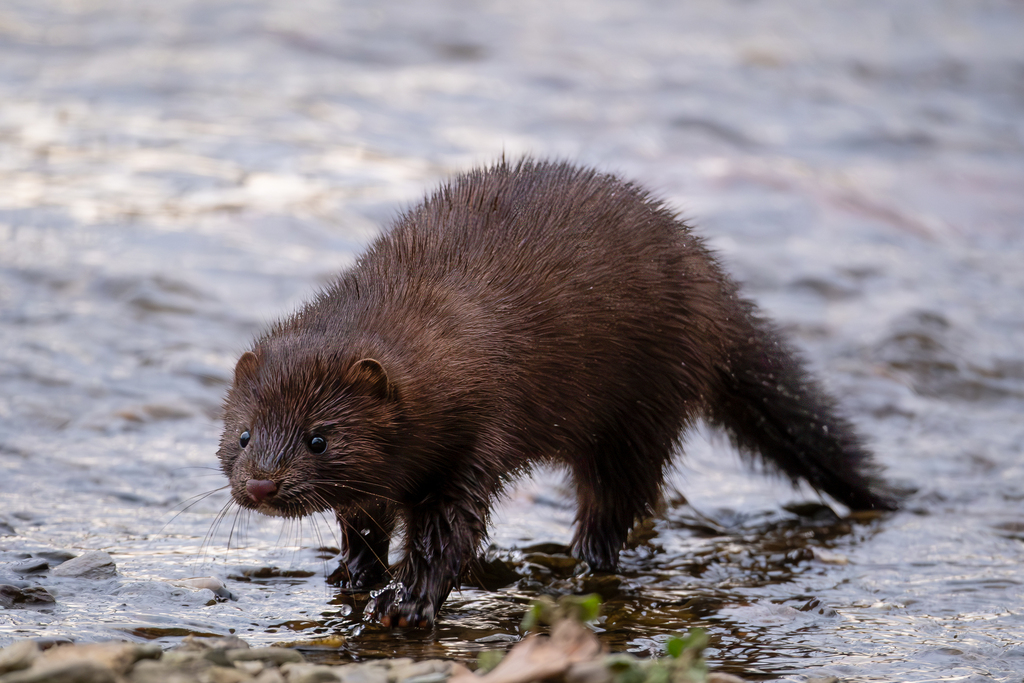
American Mink
Neogale vison
The American mink (Neogale vison) is a semiaquatic species of mustelid native to North America, though human introduction has expanded its range to many parts of Europe, Asia, and South America. Because of range expansion, the American mink is classed as a least-concern species by the IUCN. The American mink was formerly thought to be the only extant member of the genus Neovison following the extinction of the sea mink (N. macrodon), but recent studies, followed by taxonomic authorities, have reclassified it and the sea mink within the genus Neogale, which also contains a few New World weasel species. The American mink is a carnivore that feeds on rodents, fish, crustaceans, frogs, and birds. In its introduced range in Europe it has been classified as an invasive species linked to declines in European mink, Pyrenean desman, and water vole populations. It is the animal most frequently farmed for its fur, exceeding the silver fox, sable, marten, and skunk in economic importance.
From the article American mink on Wikipedia (CC BY-SA), quoted section by section
What it does
American mink territories are held by individual animals with minimal intrasex overlap, but with extensive overlap between animals of the opposite sex. Most territories are in undisturbed, rocky coastal habitats with broad littoral zones and dense cover. Some are on estuaries, rivers and canals near urban areas. Home ranges are typically 1–6 kilometres (0.62–3.73 miles) long, with male territories larger than females'. As long as it is close to water, the American mink is not fussy about its choice of den. Mink dens typically consist of long burrows in river banks, holes under logs, tree stumps, or roots and hollow trees, though dens located in rock crevices, drains, and nooks under stone piles and bridges are occasionally selected. The burrows they dig themselves are typically about four inches in diameter and may continue along for 10–12 feet (300–370 cm) at a depth of 2–3 feet (61–91 cm). The American mink may nest in burrows dug previously by muskrats, badgers and skunks, and may also dig dens in old ant hills. The nesting chamber is at the end of a four-inch tunnel, and is about a foot in diameter. It is warm, dry, and lined with straw and feathers. The American mink's dens are characterized by a large number of entrances and twisting passages. …
Wikipedia: “Social and territorial behaviours”
Listen
Looking for field recordings…
Where it lives
Recorded sightings
—
geo-referenced records in GBIF, from museums, herbaria and field observers.
Drag the globe to turn it. Dots are where records exist, not a range map; darker means more records.
In the stacks
Searching the stacks…
Every page naming Neogale vison in the Biodiversity Heritage Library →
This page is assembled live from iNaturalist, GBIF, Wikipedia, the Source Library and the Internet Archive. It is not yet part of the hand-edited codex. iNaturalist taxon 1264432.