- Animals
- ›Chordates
- ›Vertebrates
- ›Mammals
- ›Therians
- ›Placental Mammals
- ›Ungulates, Carnivorans, and Allies
- ›Carnivorans
- ›Mustelids
- ›Weasels
- ›Neogale
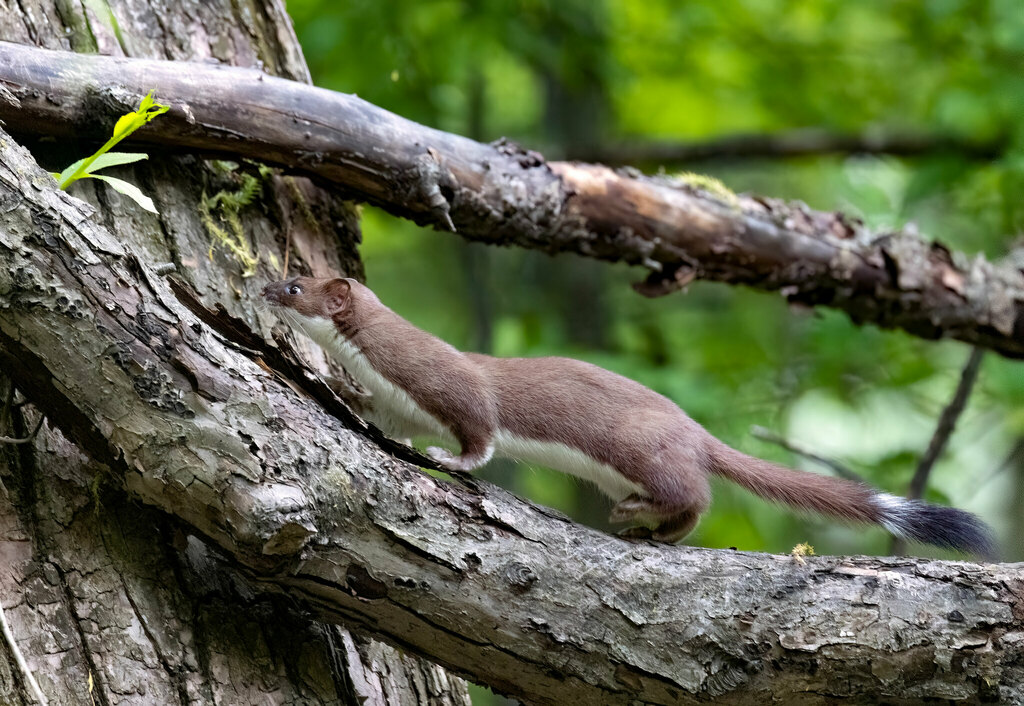
Long-tailed Weasel
Neogale frenata
The long-tailed weasel (Neogale frenata), also known as the bridled weasel, masked ermine, or big stoat, is a species of weasel found in North, Central, and South America. It is distinct from the short-tailed weasel (Mustela erminea), also known as a "stoat", a close relation in the genus Mustela that originated in Eurasia and crossed into North America some half million years ago; the two species are visually similar, having long, slender bodies and tails with short legs and a black tail tip.
Long-tailed weasels exhibit scale-dependent patterns of habitat selection, favoring forest patches, fencerows, and drainage ditches while avoiding agricultural fields. They typically make their habitats in forests and underground in burrows of other small mammals.
From the article Long-tailed weasel on Wikipedia (CC BY-SA), quoted section by section
Description
The long-tailed weasel is one of the larger weasels (comprising both Neogale and Mustela) in North America. There is substantial disagreement both on the upper end of their size and difference in size by sex by source: one indicates a body length of 300–350 mm (12–14 in) and a tail comprising 40–70% of the head and body length. It adds that in most populations, females are 10–15% smaller than males, thus making them about the same size as large male stoats, according to a second source. A third states they range from 11 to 22 inches (280–560 mm) in length, with the tail measuring an additional 3 to 6 inches (80–150 mm). It maintains the long-tailed weasel weighs between 3 and 9 ounces (85-267 g) with males being about twice as large as the females. The eyes are black in daylight, but glow bright emerald green when caught in a spotlight at night. The dorsal fur is brown in summer, while the underparts are whitish and tinged with yellowish or buffy brown from the chin to the inguinal region. The tail has a distinct black tip. Long-tailed weasels in Florida and the southwestern US may have facial markings of a white or yellowish colour. In northern areas in winter, the long-tailed weasel's fur becomes white, sometimes with yellow tints, but the tail retains its black tip. …
Range & habitat
Long-tailed weasels are found in a variety of habitats, but have been found to make use of both coniferous and deciduous forests in a mix of mid-successional and early-successional stages. They prefer open forests, wooded areas, or shrub lands as they offer optimal cover for habitation and hunting. Long-tailed weasel habitats range in altitude from sea level to alpine meadow. Typically, long-tailed weasels are not present in dry brush, shrub, and scrub habitats such as deserts. It is assumed that long-tailed weasels are susceptible to habitat fragmentation, as they avoid habitation of areas used for farming.
Wikipedia: “Habitat type”
What it does
The long-tailed weasel mates in July–August, with implantation of the fertilised egg on the uterine wall being delayed until about March. The gestation period lasts 10 months, with actual embryonic development taking place only during the last four weeks of this period, an adaptation to timing births for spring, when small mammals are abundant. Litter size generally consists of 5–8 kits, which are born in April–May. The kits are born partially naked, blind and weighing 3 grams (0.11 oz), about the same weight of a hummingbird. The long-tailed weasel's growth rate is rapid, as by the age of three weeks, the kits are well furred, can crawl outside the nest and eat meat. At this time, the kits weigh 21–27 grams (0.74–0.95 oz). At five weeks of age, the kits' eyes open, and the young become physically active and vocal. Weaning begins at this stage, with the kits emerging from the nest and accompanying the mother in hunting trips a week later. The kits are fully grown by autumn, at which time the family disbands. The females are able to breed at 3–4 months of age, while males become sexually mature at 15–18 months.
Wikipedia: “Reproduction and development”
In human culture
In North America, Native Americans (in the region of Chatham County, North Carolina) deemed the long-tailed weasel to be a bad sign; crossing its path meant a "speedy death".
Wikipedia: “Cultural meanings”
Listen
Looking for field recordings…
Where it lives
Recorded sightings
—
geo-referenced records in GBIF, from museums, herbaria and field observers.
Drag the globe to turn it. Dots are where records exist, not a range map; darker means more records.
In the stacks
Searching the stacks…
Every page naming Neogale frenata in the Biodiversity Heritage Library →
This page is assembled live from iNaturalist, GBIF, Wikipedia, the Source Library and the Internet Archive. It is not yet part of the hand-edited codex. iNaturalist taxon 1264431.